
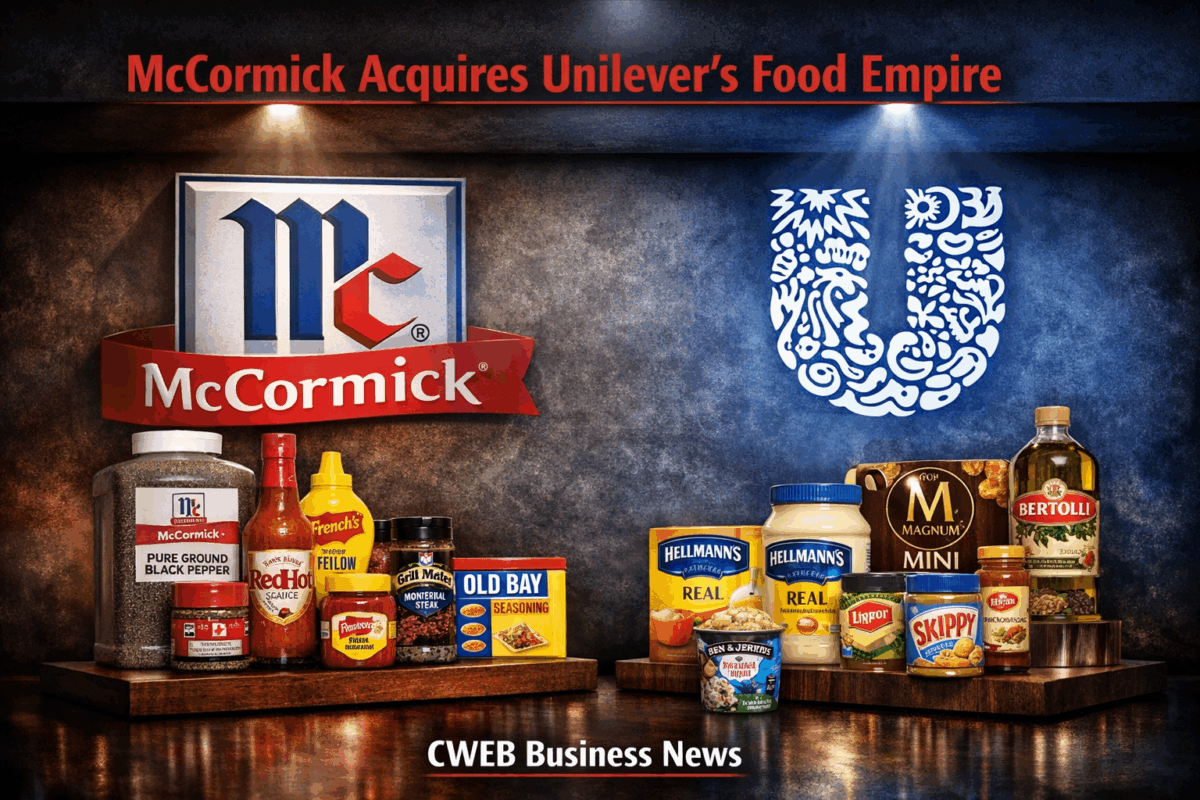
In a seismic shift within the consumer goods landscape, McCormick & Company has secured a definitive agreement to acquire Unilever’s food business in a complex transaction that assigns the unit a staggering enterprise value of nearly $45 billion. The deal, unveiled by the two industry titans, marks a decisive move to consolidate the flavor sector, blending McCormick’s renowned spice portfolio with a suite of globally recognized condiments and meal solutions. The agreement employs a hybrid cash-and-equity structure, signaling a strategic partnership that will fundamentally reshape the ownership and competitive dynamics of the packaged food industry.
This transformative acquisition positions McCormick as a global flavor powerhouse by merging its existing spice portfolio with Unilever’s iconic condiment brands. The $44.8 billion enterprise value deal creates a new ownership structure where Unilever shareholders become the majority stakeholders in the combined entity. By divesting its food operations, Unilever sharpens its strategic focus on high-growth personal care while unlocking significant value for its investors.
Under the finalized terms, the transaction values the Unilever Foods division at approximately $44.8 billion, calculated at roughly 13.8 times its fiscal year 2025 EBITDA. McCormick will facilitate the acquisition through a substantial cash payment of $15.7 billion, alongside a significant equity exchange.
Upon closure, Unilever and its existing shareholders are positioned to hold a commanding 65.0% of the fully diluted outstanding equity of the combined company—valued at $29.1 billion based on McCormick’s recent share price. McCormick shareholders will retain the remaining 35.0%. In a structure designed for tax efficiency, the deal is expected to shield Unilever and its shareholders from U.S. federal income tax liabilities, substantially mitigating the overall fiscal burden typically associated with a merger of this magnitude.

For McCormick, the acquisition represents a transformative leap beyond its core spice identity. By absorbing most of Unilever’s food portfolio, the company is set to add billions in annual revenue, deepening its foothold in the lucrative spreads and condiments category.
The deal brings household staples such as Hellmann’s mayonnaise and the culturally iconic Marmite under the same corporate umbrella as McCormick’s existing roster of hot sauces, including Frank’s RedHot and Cholula, as well as French’s mustard. Notably, approximately 70% of the acquired unit’s sales are driven by the Hellmann’s and Knorr brands, the latter being a cornerstone in seasonings, bouillon, and soups, providing McCormick with a fortified platform in both consumer retail and food service channels.
Conversely, the divestiture enables Unilever to execute a strategic pivot toward its faster-growing personal care division. This move follows the company’s recent spinoff of its ice cream unit in December, now operating independently as Magnum Ice Cream Co., underscoring a broader corporate restructuring to streamline operations and sharpen focus on higher-margin categories. The transaction notably excludes Unilever’s food operations in India, preserving a distinct segment of the company’s international footprint.
Leadership from both organizations emphasized the strategic alignment underpinning the merger. Brendan Foley, Chairman, President, and CEO of McCormick, framed the deal as a natural evolution of the company’s long-term vision. “This transformative combination accelerates McCormick’s strategy and reinforces our continued focus on flavor. The Unilever Foods business is one we have long admired, with a portfolio that complements our existing business, capabilities and long-term vision,” Foley stated. He added that the unified entity will be uniquely positioned to drive growth in attractive categories, distinguishing itself by concentrating on flavoring calories in a market crowded with competitors vying for the calories themselves.
The transaction, which is projected to reach completion by mid-2027 pending customary shareholder and regulatory approvals, is anticipated to yield sustainable organic sales growth between 3% and 5% post-merger. The combined entity is poised to emerge as a diversified flavor leader, leveraging a robust and complementary portfolio to capture evolving consumer preferences across the global food landscape.
