At CWEB, we are always looking to expand our network of strategic investors and partners. If you're interested in exploring investment opportunities or discussing potential partnerships and serious inquiries. Contact:jacque@cweb.com
The Chrysler Fiat Chrysler (FCAU) name isn’t as popular with consumers in the United States as it once was many years ago. Chrysler offers the 300 model which is a boxy luxury type sedan that will likely erode into the dust and the Pacific minivan which consumers can also purchase as a plug-in hybrid.
One of the most popular brands in the United States is Jeep and the pickup truck Ram that was a spinoff from Dodge in 2009. Alfa Romeo and Maserati luxury and performance vehicles have been a bit late in joining the global SUV and crossovers vehicle market compared to its competitors.
Dodge is known for cars and SUVs with powerful engines. These vehicles covet many loyal customers for the Dodge Challenger. The Durango SUV and Charger sedan saw sales decline 15% and 9%, respectively, from a year ago from June 2018.
Model
May 2018 sales
Change vs. May 2017
Year-to-date sales
Change vs. 2017
Jeep Cherokee
23,789
63%
91,286
31%
Jeep Compass
17,327
223%
72,398
315%
Jeep Wrangler
25,102
26%
110,382
38%
FIAT CHRYSLER AUTOMOBILES. YEAR TO DATE SALES ARE THROUGH MAY; COMPARISON IS TO THE SAME PERIOD IN 2017.
Year
Jan
Feb
Mar
Apr
May
Jun
Jul
Aug
Sep
Oct
Nov
Dec
Total
2018
132,803
165,903
216,063
184,149
214,294
Fiat Chrysler shares hit a high of 20.15 euros past Friday, June 8th, 2018 closing down to 18.33 euros. Fiat Chrysler Shares are still up 95% for the past year. Fiat Chrysler is looking to triple its profits by the year 2022 by investing in electric vehicles and focusing on the Maserati, Alfa Romeo and Jeep Fiat Chrysler shares high of 20.15 euros past Friday closing down to 18.33 Fiat Chrysler Shares are still up 95% for the past year. Fiat Chrysler is looking to triple its profits by the year 2022 by investing in electric vehicles and focusing on Ram trucks Maserati Alfa Romeo and Jeep.
CEO Sergio Marchionne is stepping down next year, and there is no word on who will replace him. Investors are worried that the departure of Sergio Marchionne could cause trouble for the company, just like when Alan Mulally former President and Chief Executive Officer of the Ford Motor Company stepped down, the company did not fare as well. Marchionne speaking at Fiat Chrysler’s Capital Markets Day in Italy actually wore a tie to the meeting, something that the media has not seen on him since 2007. Marchionne is known for his outspoken and brazen remarks. While Marchionne speaking at Fiat Chrysler’s Capital conference laid out some impressive plans, the future is uncertain when a new CEO takes over. Marchionne is credited in saving Fiat SpA from bankruptcy in the mid-2000s and rescued Chrysler five years later.
Let’s not forget Marchionne legacy of leading Fiat Chrysler’s 14-year turnaround.
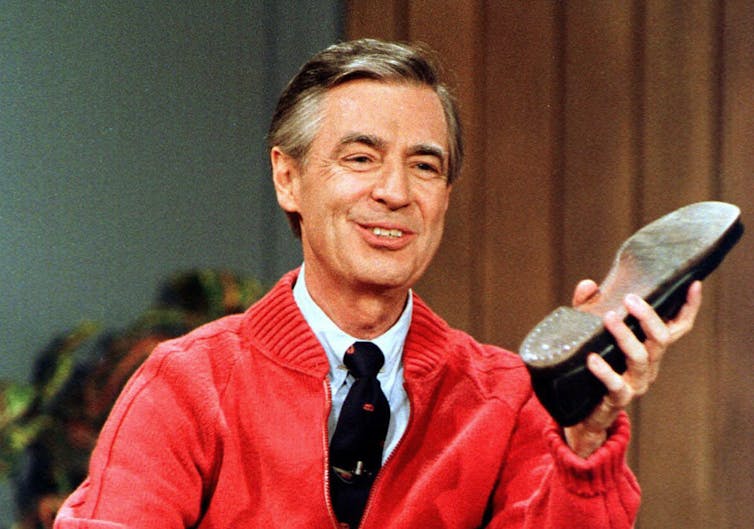
The release of the Mister Rogers documentary, “Won’t You Be My Neighbor?” calls to mind the essential message of Rogers’ long-running children’s program, “Mister Rogers’ Neighborhood.” Fred McFeely Rogers, who died in 2003, was also an ordained Presbyterian minister. Over the course of three decades on public broadcasting, he brought to millions of children what his faith’s General Assembly referred to as “unconditional love.”
In preaching love, Rogers wasn’t just attending to the moral character of his youthful audience. He believed that he was also promoting their health. As he said in 1979, “My whole approach in broadcasting has always been, ‘You are an important person just the way you are. You can make healthy decisions.’ Maybe I’m going on too long, but I just feel that anything that allows a person to be more active in the control of his or her life, in a healthy way, is important.”
Since Rogers’ death, evidence has mounted that he was on to something — namely, that love and kindness truly are healthful, and that people who express them regularly really do lead healthier lives. Simply put, people who are generous and volunteer their time for the benefit of others seem to be happier than those who don’t, and happy people tend to have fewer health complaints and live longer than those who are unhappy.
Love gave rise to a calling
Born in Pennsylvania in 1928, as a young minister Rogers regretted the messages television was conveying to children in the 1960s. He said, “I went into television because I hated it so, and I thought there’s some way of using this fabulous instrument to nurture those who would watch and listen.” “Mr. Rogers’ Neighborhood” debuted nationally in 1968 and won its creator and host many accolades, including a Presidential Medal of Freedom, two Peabody Awards, and over 40 honorary degrees.
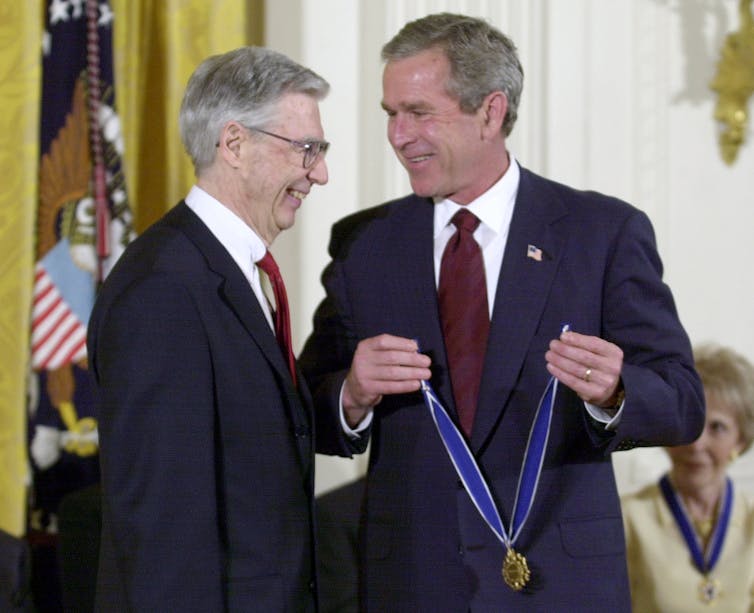
Fred Rogers with Pres. George W. Bush, who is about to place the Presidential Medal of Freedom on Rogers in a July 9, 2002 ceremony. Kenneth Lambert/AP Photo
Rogers believed that the need to love and be loved was universal, and he sought to cultivate these capacities through every program, saying in a 2004 documentary hosted by actor Michael Keaton, one of his former stagehands, “You know, I think everybody longs to be loved, and longs to know that he or she is lovable. And consequently, the greatest thing we can do is to help somebody know they’re loved and capable of loving.”
Love and health
As it turns out, there are many ways in which love and kindness are good for health. For one thing, they tend to reduce factors that undermine it. Doing something nice for someone causes the release of endorphins, which help to relieve pain. People who make kindness a habit have lower levels of stress hormones such as cortisol. Intentionally helping others can even lower levels of anxiety in individuals who normally avoid social situations.
Carrying out acts of kindness, or even merely witnessing them, also increases levels of oxytocin, a hormone with health benefits as diverse as lowering blood pressure, promoting good sleep and reducing cravings for drugs such as cocaine and alcohol. That oxytocin should have so many health benefits is not so surprising when we recall its central role in stimulating uterine contractions during birth, the letdown of milk during lactation, the pleasure associated with orgasm and pair bonding.
Acts of generosity and compassion also appear to be good for mood. A 2010 study showed that while people with money tend to be somewhat happier than those without it, people who spend money on others report even greater levels of happiness, an effect that can be detected even in toddlers. When people give money to others, areas of the brain associated with pleasure are activated, and this response is greater when the transfer is voluntary rather than mandatory.
Such happiness can have big benefits in longevity. For example, a review of 160 published studies concluded that there is compelling evidence that life satisfaction and optimism are associated with better health and enhanced longevity. Another study of older people showed that, even after correcting for other factors such as age, disease and health habits, those who rated their happiness highest were 35 percent less likely to die in five years than those who were least content.
Of course, Rogers would remind us that there are reasons to be committed to love and kindness that extend far beyond their health benefits. Rogers was, after all, not a physician but a minister, and ultimately he was ministering to an aspect of human wholeness that cannot be analyzed by blood tests or visualized with CT scans. In a commencement address at Dartmouth College in 2002, he focused less on the body than what he might have called the spirit:
“When I say it’s you I like, I’m talking about that part of you that knows that life is far more than anything you can ever see or hear or touch. That deep part of you that allows you to stand for those things without which humankind cannot survive. Love that conquers hate, peace that rises triumphant over war, and justice that proves more powerful than greed.”
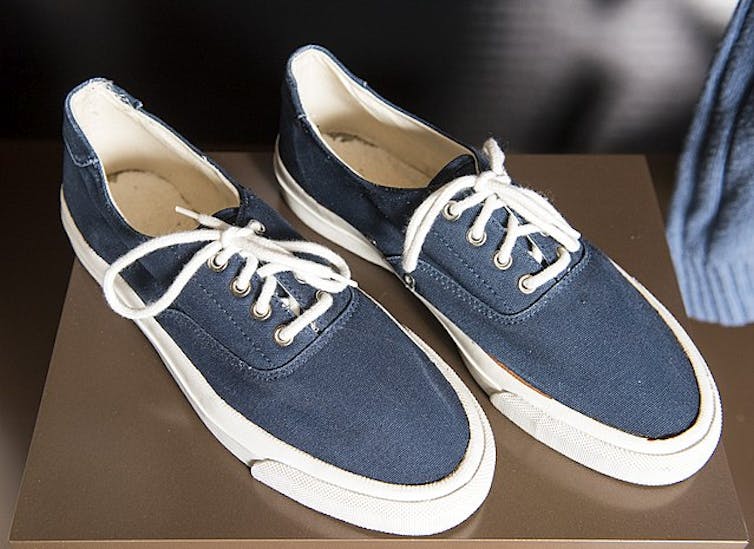
A pair of Mister Rogers’ sneakers at the LBJ Library exhibition to celebrate the 50th anniversary of Pres. Johnson signing the public broadcasting act in 1967. Jay Godwin/LBJ Foundation
When Rogers encouraged children to be kinder and more loving, he believed that he was not only promoting public health but also nurturing the most important part of a human being — the part that exhibits a divine spark. As Rogers indicated in another commencement speech the year before at Middlebury College, “I believe that appreciation is a holy thing, that when we look for what’s best in the person we happen to be with at the moment, we’re doing what God does; so in appreciating our neighbor, we’re participating in something truly sacred.”
In expressing such deeply religious sentiments, Rogers was not trying to undermine a concern with bodily health. In fact, he regularly encouraged his viewers to adopt healthy life habits, and Rogers himself was a committed vegetarian and lifelong swimmer who maintained a low body weight his entire life. Yet he also believed that health alone does not a full life make, and he regarded the soundness of the body as but part of the wellness of whole persons and communities, which may explain why he was able to face his own mortality with such equanimity.
Just a few months before he died, Rogers recorded a message for the many adult fans who had grown up watching “Mister Rogers’ Neighborhood.” In it, he practiced what he preached, saying:
“I would like to tell you what I often told you when you were much younger. I like you just the way you are. And what’s more, I’m so grateful to you for helping the children in your life to know that you’ll do everything you can to keep them safe. And to help them express their feelings in ways that will bring healing in many different neighborhoods. It’s such a good feeling to know that we’re lifelong friends.”
Competition is heating up between Costco (NASDAQ:COST) Walmart (NYSE:WMT) and Target (TGT) — That’s Good News For Consumers
By Leslie Cohen
CWEB (@cweb) | Twitter
Cutting prices for these companies can also eat into profit margins. Shares of Costco Wholesale (NASDAQ:COST) are up more than 2% on Thursday, June 7th, 2018.
Costco reported tell showing same Source Dale 11% and net sales were up 11.02 Billion from 9.6 billion from the same month of May, 2017.
Costco’s e-commerce sales were up 34%. Rising gasoline prices along with a weaker dollar added more than 3 percentage points of incremental growth. Concurrently, membership fees increased to 14.4% year over year, advanced by a 9% membership fee increase Costco placed into effect in the U.S. and Canada last June.
Costco competes well with its competitors such as Amazon.com, Inc. NASDAQ: AMZN, and Walmart Inc. NYSE: WMT. Costco has announced it will raise its minimum to a minimum of $14 an hour it employs 130,000 hourly workers. The new wages are set to take place on June 11th which is double the federal minimum wage that is currently at $7.25 per hour. On a pre-tax basis, this will add approximately $110 million to $120 million of incremental costs annually.
Strong earnings for Costco reported have calmed down the fears related to the Amazon Whole Foods takeover. Costco stock should reap healthy gains in the near and long-term since the acquisition of Whole Foods by Amazon. Costco has gone through a string of quarters with comparable sales growth, robust profit growth and healthy margins.
Comparable sales in the U.S. rose by 5.7% at 7.4% elsewhere .5% in Canada Amazon’s acquisition of Whole Foods Costco sales growth Trends have actually improved. “We can see multiple quarters of evidence supporting the trend of growth Costco, but uncertainties related to government fiscal and tax policies including increased tariffs and duties and other restrictions could adversely affect a man products and services,.” as stated in a Securities and Exchange Commission filing.
CWEB Analyst’s have initiated a Buy Rating for Costco (NASDAQ:COST) , and a Price Target of $300
Read Full Article and Videos CWEB.com – Trending News, Blog, Shopping
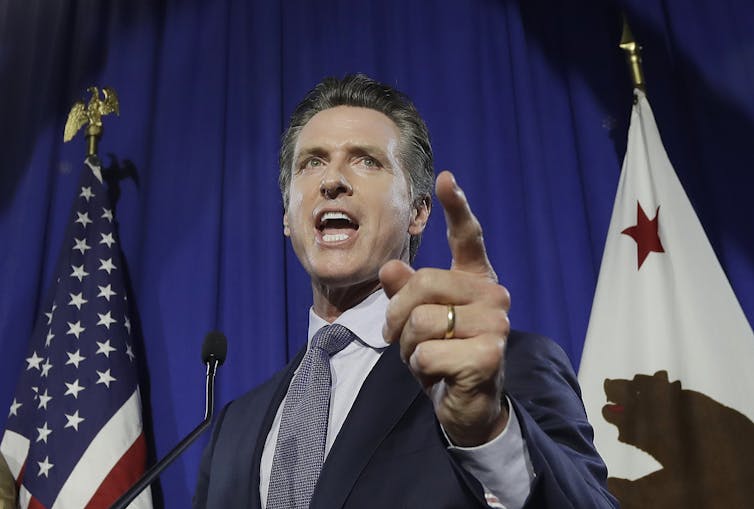
They sent Democratic Lt. Governor Gavin Newsom as the heavy favorite into a November contest against Republican businessman John Cox. With the liberal Newsom positioning himself as a Bay Area Bernie Sanders, and staunchly conservative Cox touting his Twitter endorsement from President Donald Trump, the battle at the top of the ticket will be fought from the ideological poles. Incumbent Dianne Feinstein is safe in the Senate, but key House districts are too close to call as of this writing.
Republican gubernatorial candidate John Cox, center, speaks during a Republican primary watch party. AP Photo/Gregory Bull
This was not how California’s top two system, or “jungle” primary, was supposed to work.
The hope of reformers who backed it as a ballot proposition nearly a decade ago was that the new rules — which let every voter cast a ballot for any candidate in the primary, with the top two advancing to the general election — would act as an antidote to partisan polarization.
Parties hated the idea. It meant no party was guaranteed a spot in the top two. Voters backed it, ready to experiment with anything in a rapidly polarizing state.
After four primaries run under the new system, the hopes of reformers have yet to materialize. And some of the fears of its opponents have roiled congressional races run under the top two rules, as parties struggle to avoid being shut out of the November ballot in competitive districts.
Here’s how the top two primary is supposed to shake up California politics.
Hope for a centrist electorate
First, it gives voters who don’t affiliate with a political party — a bloc that is now slightly larger than the Republican Party in the state that once produced Richard Nixon and Ronald Reagan — a bigger voice in primaries. Voters with “no party preference” now make up 25.5 percent of registered voters, trailing Democrats at 44.6 percent but ahead of Republicans at 25.1 percent.
Before the reform, independents could vote in a party primary only if the party allowed it. Democrats did, Republicans didn’t, and very few independents turned out in primaries.
The idea was that by opening up primaries to all voters, regardless of party, a flood of new centrist voters would arrive. That would give moderate candidates a route to victory without having to bend toward the ideological extremes to appeal to party loyalists, as often happens in primaries.
Yet when the top two went into effect, no flood of independents turned out to the polls. The trickle continued.
As my colleague Seth Hill and I showed in a comparison of participation in the 2008 and 2010 elections, before the top two primary system took effect, turnout by voters with no party preference actually declined from 17.7 percent to 17.2 percent of registered voters. Those who did vote had the option of casting a ballot for any candidate, regardless of party, an important expressive right brought by the new rules. But the reform failed to deliver a new pool of moderate, nonpartisan voters to buttress centrist or independent candidates.
Hope for more centrist candidates
At least so far, candidates running from the center have also not fared particularly well under the new rules. My other research with Justin Phillips and Boris Shor looked at the positions that congressional and state legislative candidates took on a range of issues in the first races held under top two rules in 2012. We compared them with the positions of the average voter in each district.
If the top two approach had fulfilled its goals, we expected to see a closer match between candidates and voters in 2012, compared with contests held under the old rules in 2010.
However, we found no such evidence. Candidates did not represent voters any better after the reforms, taking positions just as polarized as they did before the top two. We detected no shift toward the ideological middle.
In our findings, we did note one unintended flaw in the top two rules that year, a flaw that has turned some congressional races into a jungle this year. In a battleground district, a party with strong voter support can get shut out of the November election. If one party fields two strong candidates and the other has three or four of them splitting the vote, the party with fewer candidates in the primary can monopolize space on the general election ballot.
This is exactly what happened in California’s 31st Congressional District, where Democrats held a five-point lead in party registration. Two Republicans advanced when four Democrats split the vote in 2012, leaving November voters powerless to pick which party would represent them in a swing district.
That situation, which is without question bad for democratic representation, is threatening to occur again this year. Right now, in three toss-up congressional districts, Democrats are struggling to win a place on the November ballot because they have many well-funded candidates dividing up the party base. All three primaries are too close to call as of publication.
Strategy trumped ideas
Regardless of the outcome, the quirks of the top two system have driven the dynamics of all three close congressional races. Instead of debating the merits of candidates, voters have been debating which one has the best chance of making it to November.
Democrats looking to consolidate around a front-runner in one of these races eagerly awaited any polling numbers to guide them, then became bitterly divided over two conflicting polls released just before the election.
Meanwhile, political consultants have taken up the invitation to mischief created by the new rules.
For example, national Democratic groups wanted to splinter the Republican vote, so they spent money attacking a strong Republican candidate in one San Diego district, while also attempting to prop up weaker Republicans in two Orange Countydistricts. Welcome to the jungle primary, where races can become more about strategic fights and less about battles of ideas.
This year’s governor’s race was supposed to be the one that finally fulfilled the promise of the top two system. In early polling, former Speaker of the Assembly and Los Angeles Mayor Antonio Villaraigosa ran far ahead of political newcomer John Cox. Villaraigosa positioned himself as a moderate Democrat, backing charter schools and refusing to embrace a state single-payer health plan. If he made the top two, he hoped to cobble together a coalition of moderate Democrats, independents and perhaps even a few Republicans to defeat the more liberal Newsom.
That campaign might have changed California politics. Yet Villaraigosa’s dream, like many of the dreams of top two reformers, did not come true. He lost, and now voters face a choice between two partisan and more polarizing party candidates.
Great news for Netflix, Inc. (NFLX) as it will replace Monsanto in the S&P 100. Monsanto is being acquired by BAYER (BAY.TI). Netflix’s stock closed up 1.1% to $365.80 on Tuesday, June 5th, 2018.
The way we view entertainment has changed. Kannan Venkateshwar, media analyst of Barclays Capital states, “We believe the economics for companies with global streaming scale like Netflix may be more favorable than theatrical releases, over time.”
Netflix has given control over to the consumer on how they watch movies. And- consumer are loving it. It gives the viewer a wide choice of content that is viewable any time- on demand, and on any device.
What’s not to love about Netflix?
“13 Reasons Why”, one of Netflix’s most popular shows drawing an audience in the second season of an average audience of 2.6 million viewers in the U.S., all within the first three days on air, according to Nielsen ratings. The premiere episode attracted 6 million viewers in three days of its premiere episode. The controversial series about teen suicide and rape closed with a whisper at the end of season two. Good news for fans, production for season three is tap to premiere in 2019.
What’s driving Netflix growth is operating profit per paid subscriber. Netflix has been adept at increasing pricing without losing subscribers. Netflix does have high costs to develop content and must borrow tremendous amounts of capital to pay for content to run ahead of its competitors, Walt Disney Co (DIS), and Amazon.com, Inc. (AMZN)
In foreign countries like Africa and Asia that growth may slow because of less expensive competitors are already on the market in those countries. Netflix international streaming contribution margin is 15.3%, less than half the amount of its U.S. streaming segment.
CWEB Analysts have initiated a BUY Rating for Netflix, Inc. (NFLX) and a price target of $450 within 12 months.
Read Full Article and Videos CWEB.com – Trending News, Blog, Shopping
Europeans, Canadians and Mexicans buy more American goods and services than anyone else in the world. So why would the Trump administration be willing to start a trade war with the United States’ most important trading partners — as well as some of its oldest allies?
The current dispute started back in March, when the White House proposed tariffs on all imports of steel and aluminum on national security grounds. That led to threats of retaliation. The administration granted temporary exemptions to several key allies, including Canada, Mexico and the European Union. As of May 31, they’ve all expired, and the U.S. government decided not to renew them.
Now the EU, Mexico and Canada are beginning to make good on those threats.
Canadian Prime Minister Justin Trudeau called the tariffs “totally unacceptable” and “an affront” to Canadian soldiers who have served alongside Americans in numerous conflicts.
As an economist who studies international trade, I thought it’d be instructive to explore the trade relationships the U.S. has with each partner to show just how important they are — and what would be the consequences of a full-blown trade war.
Why they’re upset
The Trump administration placed a 25 percent tariff on steel and 10 percent tariff on aluminum with the aim of propping up U.S. metals manufacturers.
A tariff is basically a tax on imports that raises the price of foreign company’s products for American consumers, putting imports at a disadvantage to domestic producers.
To see why these three U.S. allies are so upset, one need only look at the biggest suppliers of U.S. metals. Canada dominates, supplying more than a quarter of all U.S. steel, aluminum and iron imports in 2016. More importantly, steel exports to the U.S. make up more than half of total Canadian production.
The EU came second at 14 percent, while Mexico ranked fifth with 5.4 percent of U.S. imports. Steel exports to the U.S. also make up more than half of Mexican production.
America’s biggest customers
The EU is the single biggest market for exported U.S. goods, buying US$270 billion of American products in 2016, followed closely by Canada and Mexico. By comparison, China buys just $116 billion.
On the flip side, Americans purchase more from those countries than they sell, creating bilateral trade deficits that the president hates — even as most economists say they don’t matter. The U.S. imports $417 billion in goods from the EU, $294 billion from Mexico and $278 billion from Canada.
When the steel tariffs were first proposed in March, the EU, Canada and Mexico all reacted by threatening to retaliate with their own sanctions against some of these products.
So far, only Canada and Mexico have done so. Canada announced dollar-for-dollar tariffs on steel and aluminum, as well as sanctions of 15 percent to 25 percent on whiskey, orange juice and other food products. Mexico also slapped tariffs on U.S. steel, as well as various farm products, including pork, cheese, apples, whiskey, cranberries, grapes and canned goods.
While tariffs on these products won’t have much of an impact on the overall U.S. economy, they could be especially painful for particular industries or regions. For example, Mexico is the second-largest consumer of U.S. pig meat, making the industry vulnerable to Mexican tariffs.
Countries that import U.S. pig meat.
And tariffs like those on Kentucky bourbon and motorcycles seem intended to hit key members of Congress where they live — namely, Senate Majority Leader Mitch McConnell of Kentucky and Speaker of the House Paul Ryan of Wisconsin, the home of Harley-Davidson.
Although the EU hasn’t pulled the trigger on its own tariffs — yet — it recently opened a case at the World Trade Organization, arguing Trump’s tariffs can’t be justified on national security grounds and are no more than “pure protectionism.” A negative judgment at the WTO could result in the U.S. having to compensate aggrieved foreign producers or face broader retaliatory measures.
American consumers will also feel pain
While the purpose of Trump’s tariffs is to shift U.S. steel consumption away from foreign producers and towards domestic producers, Americans will share some of the pain as well.
For example, if automakers have to pay more for the steel used in cars, you’ll see that effect when you visit your local dealer. One estimate put it at an additional $175 per vehicle.
And higher prices for things that require steel or aluminum like cars, planes, construction and appliances can slow the rest of the economy. When President Bush tried a similar tariff in 2001, it was estimated that it cost American consumers $400,000 for each domestic steel job saved.
The reaction of the EU, Canada and Mexico raises the possibility the U.S. is facing down a full-blown trade war — even as it does the same with China. Whether tensions can be turned down before serious harm is done remains to be seen.
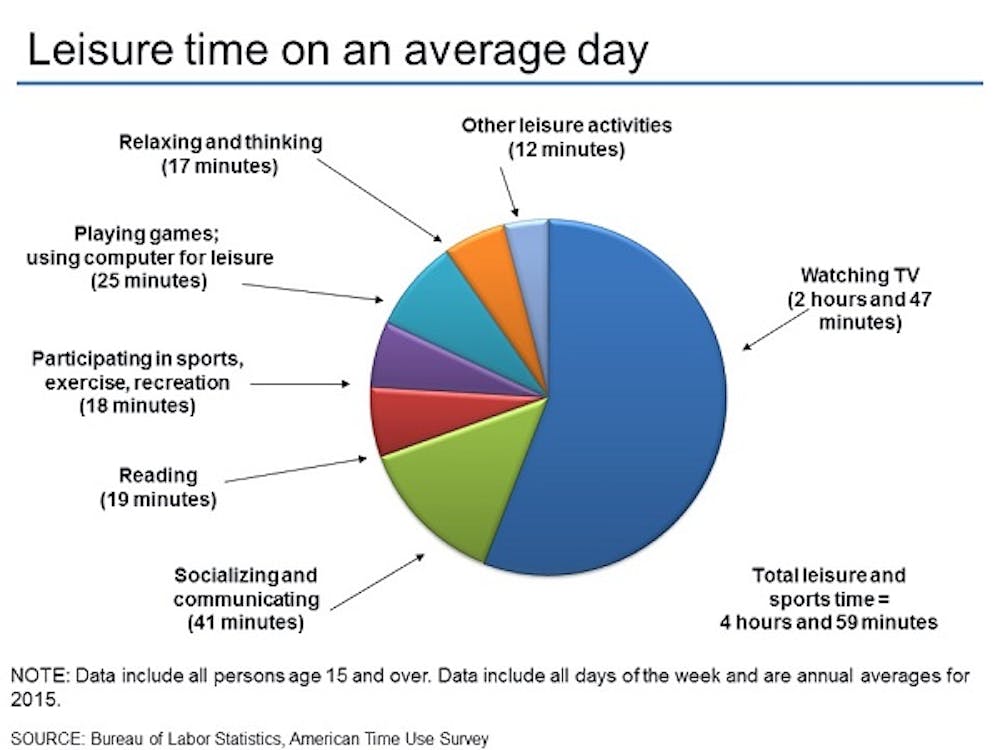
Today Americans live in a world that thrives on being busy, productive and overscheduled. Further, they have developed the technological means to be constantly connected to others and to vast options for information and entertainment through social media. For many, smartphones demand their attention day and night with constant notifications.
As a result, naturally occurring periods of solitude and silence that were once commonplace have been squeezed out of their lives. Music, reality TV shows, YouTube, video games, tweeting and texting are displacing quiet and solitary spaces. Silence and solitude are increasingly viewed as “dead” or “unproductive” time, and being alone makes many Americans uncomfortable and anxious.
We study and teach outdoor education and related fields at several colleges and organizations in North Carolina, through and with other scholars at 2nd Nature TREC, LLC, a training, research, education and consulting firm. We became interested in the broader implications of alone time after studying intentionally designed solitude experiences during wilderness programs, such as those run by Outward Bound. Our findings reveal that time alone in nature is beneficial for many participants in a variety of ways, and is something they wish they had more of in their daily life.
We have conducted research for almost two decades on Outward Bound and undergraduate wilderness programs at Montreat College in North Carolina and Wheaton College in Illinois. For each program, we studied participants’ experiences using multiple methods, including written surveys, focus group interviews, one-on-one interviews and field notes. In some cases, we asked subjects years later to look back and reflect on how the programs had affected them. Among other questions, our research looked at participant perceptions of the value of solo time outdoors.
Our studies showed that people who took part in these programs benefited both from the outdoor settings and from the experience of being alone. These findings build on previous research that has clearly demonstrated the value of spending time in nature.
Scholars in fields including wilderness therapy and environmental psychology have shown that time outdoors benefits our lives in many ways. It has a therapeutic effect, relieves stress and restores attention. Alone time in nature can have a calming effect on the mind because it occurs in beautiful, natural and inspirational settings.
Spending time in city parks like Audubon Park in New Orleans provides some of the same benefits as time in wilderness areas, including reduced stress levels and increased energy levels. InSapphoWeTrust, CC BY-SA
Nature also provides challenges that spur individuals to creative problem-solving and increased self-confidence. For example, some find that being alone in the outdoors, particularly at night, is a challenging situation. Mental, physical and emotional challenges in moderation encourage personal growth that is manifested in an increased comfort with one’s self in the absence of others.
Being alone also can have great value. It can allow issues to surface that people spend energy holding at bay, and offer an opportunity to clarify thoughts, hopes, dreams and desires. It provides time and space for people to step back, evaluate their lives and learn from their experiences. Spending time this way prepares them to re-engage with their community relationships and full work schedules.
Putting it together: The outdoor solo
Participants in programmed wilderness expeditions often experience a component known as “Solo,” a time of intentional solitude lasting approximately 24-72 hours. Extensive research has been conducted on solitude in the outdoors because many wilderness education programs have embraced the educational value of solitude and silence.
Solo often emerges as one of the most significant parts of wilderness programs, for a variety of reasons. Alone time creates a contrasting experience to normal living that enriches people mentally, physically and emotionally. As they examine themselves in relation to nature, others, and in some cases, God, people become more attuned to the important matters in their lives and in the world of which they are part.
Solo, an integral part of Outward Bound wilderness trips, can last from a few hours to 72 hours. The experience is designed to give participants an opportunity to reflect on their own thoughts and critically analyze their actions and decisions.
Solitary reflection enhances recognition and appreciation of key personal relationships, encourages reorganization of life priorities, and increases appreciation for alone time, silence, and reflection. People learn lessons they want to transfer to their daily living, because they have had the opportunity to clarify, evaluate and redirect themselves by setting goals for the future.
For some participants, time alone outdoors provides opportunity to consider the spiritual and/or religious dimension of life. Reflective time, especially in nature, often enhances spiritual awareness and makes people feel closer to God. Further, it encourages their increased faith and trust in God. This often occurs through providing ample opportunities for prayer, meditation, fasting, Scripture-reading, journaling and reflection time.
As Thomas Carlyle has written, “In (solitary) silence, great things fashion themselves together.” Whether these escapes are called alone time, solitude or Solo, it seems clear that humans experience many benefits when they retreat from the “rat race” to a place apart and gather their thoughts in quietness.
In order to live and lead effectively, it is important to be intentional about taking the time for solitary reflection. Otherwise, gaps in schedules will always fill up, and even people with the best intentions may never fully realize the life-giving value of being alone.
On May 30, a grand jury indicted Harvey Weinstein on charges he raped one woman and forced another to perform oral sex on him. And new allegations and lawsuits against the movie producer continue to pile up.
Since the earliest reports of his abuse came out in October, scores of women in Hollywood have taken to social media and shared their own stories of sexual assault and harassment by Weinstein. And thanks to the #MeToo movement, women in a range of professions have also found their voices heard, helping topple dozens of other once-powerful men in entertainment, media, sports, business, politics and the judiciary.
But a question #MeToo has been asking since the beginning is how will this affect the lives of women far from the high-powered worlds of Hollywood and Washington. Is this making it any easier for a low or mid-wage worker in middle America to rid her workplace of a sexual harasser?
One important way of doing this is by making an official complaint to the employer. But while women will often complain to family or even on social media, most don’t tell their companies of the misconduct. In fact, barely 1 in 4 ever do.
How come?
Based on experience litigating sexual harassment cases as well as my research, I have determined there are three legal barriers that stand in the way of workers filing complaints — a critical step to rooting out harassment and protecting employees.
Few formally complain
About 30 percent of U.S. workers who experience sexual harassment informally talk about it with someone at the company, such as a manager or union representative, while far fewer lodge formal complaints, according to a 2016 Equal Employment Opportunity Commission report. In addition, 75 percent of those who do formally complain say they face retaliation.
This is one reason for the success of #MeToo. It’s providing the kind of effective sexual harassment complaint forum that employees do not believe they have in their workplace.
Besides a fear of reprisal, the EEOC report cites several other reasons why employees usually don’t come forward, such as concern that they won’t be believed or the company training manual didn’t explain how to properly identify or address sexual harassment.
This is a big problem because if employees who have been sexually harassed don’t file formal complaints with their companies — without suffering retaliation — it is nearly impossible for employers to take action against the harasser or protect the worker. Furthermore, it becomes hard to hold an employer legally responsible if it fails to do either.
So while it’s positive that more women are sharing their own stories on social media and elsewhere, it can’t replace the formal employee complaint process.
Three barriers
The #MeToo movement has given women a forum for talking about sexual harassment. Rainmaker Photo/MediaPunch/IPX
Courts have erected three legal hurdles that discourage employees from filing complaints about sexual harassment.
One barrier is that courts have too narrowly defined sexual harassment when it involves a hostile work environment under Title VII of the Civil Rights Act of 1964. It’s only deemed illegal when it involves unwelcome sexual conduct sufficiently “severe or pervasive” to alter the employee’s employment conditions.
Employees often don’t complain because they fear they won’t be believed that the harassment was sufficiently “severe or pervasive” enough to be legally actionable.
And who can blame them. One court found that a manager rubbing the shoulders, back and hand of an employee, accusing her of not wanting to be “one of my girls” while physically grabbing her, calling her “baby doll” and telling her she should be in bed with him were not sufficiently “severe or pervasive.”
These actions can be harmful and place women as subordinate in the workplace and, unregulated, lead to even more harmful actions. As such, I believe courts need to stop finding such misconduct as “ordinary” or “de minimus” — a legal term meaning too trivial or minor to merit consideration.
Another hurdle is that employers have been largely shielded from liability when an employee complains of a hostile work environment that fosters sexual harassment. That’s because in 1998 the U.S. Supreme Court gave employers a powerful defense in such cases.
Specifically, if a company “exercised reasonable care to prevent and promptly correct any sexually harassing behavior” and the employee “unreasonably failed to take advantage of any preventive or corrective opportunities,” the employer would not be liable even though the worker was, in fact, sexually harassed.
Under this defense, courts have found that if an employer has an anti-sexual harassment policy, and the employee doesn’t complain, the employer generally won’t be found liable. This sounds reasonable, right?
Unfortunately, some employer policies meet the bare legal requirements while doing little to eradicate sexual harassment or encourage complaints by workers. And without effective training about sexual harassment and how to complain about it, employers’ policies stating “zero tolerance” for sexual harassment are meaningless.
Finally, I believe the laws punishing retaliation are not strong enough.
Taking sexual harassment seriously means employers should not fire, demote or ostracize a worker who complains about sexual harassment as they often do. And while the law on the books purportedly protects complainants, courts have told workers that the protection is only for those who reasonably believe they were illegally sexually harassed.
This puts women back in the gray area of determining what is “severe or pervasive.” As I noted above, a manager rubbed an employee’s body, called her “baby doll” and expressed a desire to have sex with her. If that’s not deemed to be sexual harassment, how can employees complain with confidence that they will be protected?
It’s time to toughen laws
What can be done about this?
The good news is that Congress is already considering changes to sexual harassment law.
For example, Sens. Kirsten Gillibrand and Lindsey Graham have introduced a bill to permit sexually harassed workers to litigate their cases in open court rather than be bound by private arbitration. The laudatory bill would prevent employers from keeping harassment or harassers secret from other workers.
But I believe lawmakers should go further by amending Title VII to expand and clarify what sexual harassment really is beyond “severe or pervasive,” strengthen worker protections against retaliation and require employers to create more effective policies and training.
The EEOC and other researchers have identified innovative methods to address sexual harassment, such as a reward system for increased complaints, promoting more women, bystander intervention and civility training. Congress should pay attention and encourage these methods while also toughening existing law.
Inspired by #MeToo, Congress could help eradicate sexual harassment.
The unemployment rate has plunged to about the lowest level in half a century. Yet at least one group of Americans is being left behind: men who didn’t go to college.
Just 78 percent of men aged 25-54 who never went to college were employed in 2016, the latest year for which data are available in the American Community Survey. That contrasts with about 90 percent for those who have at least one year of college and is a big change from the 1950s, when employment rates for college and non-college men were the same.
What’s driving the employment gap, which has been with us for decades?
Supply side just means that the explanation has to do with the individual — the supplier of labor – as opposed to something related to a company — the demand.
My research attempts to get to the bottom of why non-college men aren’t working in hopes that it can suggest the right solutions to turn this around.
A recent study suggests video games are why some young men aren’t working. AP Photo/Kamil Zihnioglu
Employment vs. unemployment
One of the most important measures of an economy is the number of jobs it’s creating, typically measured by the unemployment rate. The latest jobs report, which came out on June 1, showed that the rate dipped to 3.8 percent in May, the lowest since 2000. If it falls any more, it’ll be the lowest since 1969.
But the unemployment rate doesn’t tell the full story because it only includes people actively looking for work. People who report not having looked for work in the previous four weeks are completely left out of this number. The employment rate, which is the share who are actually employed, captures the full picture.
And the numbers are stark. Back in the 1950s, there was no education-based gap in employment. About 90 percent of men aged 25-54 — regardless of whether they went to college — were employed. That began to change in the 70s and 80s as non-college men left the workforce.
The Great Recession was particularly painful for men without any college. By 2010, only 74 percent had a job, compared with 87 percent of those with a year or more of college.
In other words, employment rates diverged over 10 percentage points in just half a century.
The gap extends to the wages of those who actually had jobs as well. As recently as 1980, real hourly wages for the two groups were nearly identical at about US$13. In 2015, men with at least a little college saw their wages soar 65 percent to over $22 an hour. Meanwhile, pay for those who never attended plunged by almost half to less than $8.
Modeling the economy
In fact, wages reveal the answer to this puzzle.
In my analysis, which I’m planning to publish, I wanted to determine whether the widening employment rate gap was caused by factors related to the supply of workers – video games and welfare – or demand – trade and robots.
So I built and calibrated an economic model aimed at finding the answer. Just as an architect builds a model city to test out ideas, economists build model economies out of math. Models allow architects and economists alike to push aside the gory details of reality and cut to the gist of things.
They also allow us to run experiments on what would otherwise be untestable hypotheses. An architect might ask: If I build a balcony, will that compromise the building’s structural integrity? I asked: If the only things that changed since the 1970s were supply-side factors, what would have happened to employment rates?
To answer this question, I plugged employment, wage and other relevant data into my model so that it replicates the real world. I then ran different analyses on the model to try to learn things, such as the underlying causes of the fall in employment for non-college men.
The intuition is like this: If a significant part of the reason non-college men dropped out of the workforce was because of supply-side factors that allowed them to remain home yet still afford their lifestyles, companies would have had to pay them more to entice them to join the labor market. On the other hand, demand-side factors would have put downward pressure on wages.
That’s exactly what my model helped me identify, suggesting that all the blame goes to demand-side factors like trade and automation, not video games.
An important caveat with my analysis – and economic research in general – is that our models are not reality. Economists have to make tough judgment calls in hopes of approximating reality and teasing out underlying truths that are otherwise difficult to ascertain.
Work wanted
All the same, I think my work reveals some important truths.
While it is true that many non-college men are home playing video games, collecting welfare payments and, unfortunately, addicted to opioids, it’s by and large not because they are choosing these over a job. Rather, sadly, it’s because they couldn’t find a job in the first place.
The takeaway is if the government wants to get more of these men back into the workforce, it should focus on stimulating demand or helping people learn new skills.
Even though we know what the problem is, we still have a lot of work ahead to solve it and get these men back into the workforce.
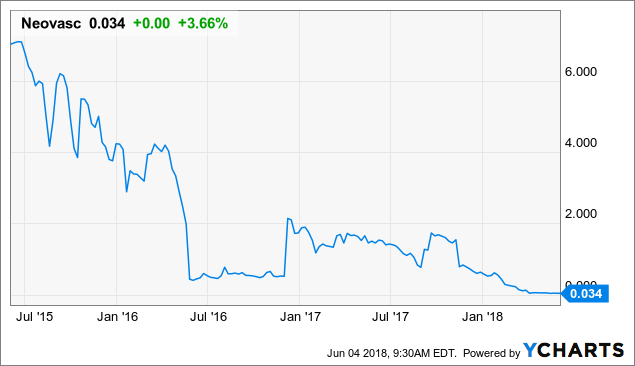
Why Neovasc Inc Is A Very Dangerous Stock — CWEB.Com
Neovasc Inc (NASDAQ, TSX: NVCN) a specialty medical device company, develops, manufactures, and markets cardiovascular devices worldwide. Its products include the Tiara technology for the transcatheter treatment of mitral valve disease; and the Neovasc Reducer for the treatment of refractory angina. The company also provides Peripatch tissue products. The company was formerly known as Medical Ventures Corp. and changed its name to Neovasc Inc. in July 2008.
Legal actions are still not settled and may impede future cash flows.
Projections of net income losses bring into question liquidity problems.
Industry competitiveness and consolidation will bring on a new set of challenges.
“Remaining on the Nasdaq Capital Market (“Nasdaq”) is a critical piece of the Company’s turnaround strategy,” commented Fred Colen , Neovasc’s President and Chief Executive Officer. “Without reaching a minimum bid price above US$1.00 for a minimum of 10 consecutive days before July 2, 2018
Consequences of a failure to effect a reverse stock split and remain on the Nasdaq Management believes a failure to approve a reverse stock split and remain on the Nasdaq could have a material adverse effect on the Company and its stakeholders for several reasons, including the following:
Liquidity in the trading of common shares of the Company (the “Common Shares”) will be significantly reduced, as the Nasdaq is the Company’s primary trading market, thereby putting downward pressure on the share price of the Common Shares.
It will be more difficult for the Company to raise additional capital on reasonable terms from the majority of U.S. based institutional funds that require or want the Company to be listed on a major U.S. exchange in order to make an investment.
The Company’s US$28,575,000 aggregate amount of outstanding senior secured convertible notes (the “Notes”) require the Company to be listed on the Nasdaq or a similar major U.S. exchange. Should the Company default on this requirement, the interest payable on the Notes will jump from 0% to 15% per annum, and holders of the Notes will receive a redemption right with a premium of 118% multiplied by the greatest closing price of the Common Shares during the period commencing on the date of delisting until the date such redemption payment is made.
Revenues decreased 77% to $339,922 for the three months ended March 31, 2018, compared to revenues of $1,481,360 for the same period in 2017. In December 2017, the Company closed its contract manufacturing and consulting services business and is now focused on the commercialization of its own product, the Reducer.
Selling expenses for the three months ended March 31, 2018 were $286,938, compared to $187,168 for the same period in 2017, representing an increase of $99,770, or 53%. The increase in selling expenses for the three months ended March 31, 2018 compared to the same period in 2017 reflects an increase in costs incurred for commercialization activities related to the Reducer.
The other loss for the three months ended March 31, 2018 was $48,324,003 compared to income of $28,299 for the same period in 2017, an increase in other loss of $48,352,302. The increase in the other loss can be substantially explained by the accounting treatment of the November 2017 financings, which resulted in a $49,277,477 increase in net loss between the periods.
Neovasc finances its operations and capital expenditures with cash generated from operations and equity and debt financings. As at March 31, 2018, the Company had cash and cash equivalents of $12,261,559 compared to cash and cash equivalents of $17,507,157 as at December 31, 2017. The Company will require significant additional financing in order to continue to operate its business. Given the current nature of the Company’s capital structure, there can be no assurance that such financing will be available on favorable terms, or at all.
The Company is in a negative working capital position of $1,275,879, with current assets of $14,036,460 and current liabilities of $15,312,339.
Neovasc holds several negative signals and is within a very wide and falling trend, so we believe it will still perform weakly in the next couple of months or a year. We therefore hold a negative evaluation of this stock.
CWEB Analyst’s have initiated a Sell Rating for Neovasc Inc (NASDAQ, TSX: NVCN)



 “I would like to tell you what I often told you when you were much younger. I like you just the way you are. And what’s more, I’m so grateful to you for helping the children in your life to know that you’ll do everything you can to keep them safe. And to help them express their feelings in ways that will bring healing in many different neighborhoods. It’s such a good feeling to know that we’re lifelong friends.”


 That campaign might have changed California politics. Yet Villaraigosa’s dream, like many of the dreams of top two reformers, did not come true. He lost, and now voters face a choice between two partisan and more polarizing party candidates.


 The reaction of the EU, Canada and Mexico raises the possibility the U.S. is facing down a full-blown trade war — even as it does the same with China. Whether tensions can be turned down before serious harm is done remains to be seen.


 In order to live and lead effectively, it is important to be intentional about taking the time for solitary reflection. Otherwise, gaps in schedules will always fill up, and even people with the best intentions may never fully realize the life-giving value of being alone.


 Inspired by #MeToo, Congress could help eradicate sexual harassment.


 Even though we know what the problem is, we still have a lot of work ahead to solve it and get these men back into the workforce.