Post a Free Blog

Submit A Press Release

At CWEB, we are always looking to expand our network of strategic investors and partners. If you're interested in exploring investment opportunities or discussing potential partnerships and serious inquiries. Contact: jacque@cweb.com

Generic selectors
Exact matches only
Search in title
Search in content
Post Type Selectors
Filter by Categories
Action
Animation
Anime
ATP Tour (ATP)
Auto Racing
Baseball
Basketball
Boxing
Breaking News
Business
Business
Business Newsletter
Call of Duty (CALLOFDUTY)
Canadian Football League (CFL)
Car
Celebrity
Champions Tour (CHAMP)
Comedy
CONCACAF
Counter Strike Global Offensive (CSGO)
Crime
Dark Comedy
Defense of the Ancients (DOTA)
Documentary and Foreign
Drama
eSports
European Tour (EPGA)
Fashion
FIFA
FIFA Women’s World Cup (WWC)
FIFA World Cup (FIFA)
Fighting
Football
Formula 1 (F1)
Fortnite
Golf
Health
Hockey
Horror
IndyCar Series (INDY)
International Friendly (FRIENDLY)
Kids & Family
League of Legends (LOL)
LPGA
Madden
Major League Baseball (MLB)
Mixed Martial Arts (MMA)
MLS
Movie and Music
Movie Trailers
Music
Mystery
NASCAR Cup Series (NAS)
National Basketball Association (NBA)
National Football League (NFL)
National Hockey League (NHL)
National Women's Soccer (NWSL)
NBA Development League (NBAGL)
NBA2K
NCAA Baseball (NCAABBL)
NCAA Basketball (NCAAB)
NCAA Football (NCAAF)
NCAA Hockey (NCAAH)
Olympic Mens (OLYHKYM)
Other
Other Sports
Overwatch
PGA
Politics
Premier League (PREM)
Romance
Sci-Fi
Science
Soccer
Sports
Sports
Technology
Tennis
Thriller
Truck Series (TRUCK)
True Crime
Ultimate Fighting Championship (UFC)
US
Valorant
Western
Women’s National Basketball Association (WNBA)
Women’s NCAA Basketball (WNCAAB)
World
World Cup Qualifier (WORLDCUP)
WTA Tour (WTA)
Xfinity (XFT)
XFL
0
Home Blog Page 13300

Increased deaths and illnesses from inhaling airborne dust: An understudied impact of climate change

0

power-station-2781692_960_720

Increased deaths and illnesses from inhaling airborne dust: An understudied impact of climate change – CWEB.com

File 20180608 191971 1tlb4is.jpg?ixlib=rb 1.1
A large dust storm, or haboob, sweeps across downtown Phoenix on July 21, 2012.
AP Photo/Ross D. Franklin, File

Ploy Pattanun Achakulwisut, George Washington University; Loretta Mickley, Harvard University, and Susan Anenberg, George Washington University

The Dust Bowl in the 1930s was one of the worst environmental disasters of the 20th century. Intense dust storms relentlessly pounded the southern Great Plains of the United States, wreaking severe ecological damage, forcing 2.5 million people to leave the region and claiming unnumbered lives, mainly from “dust pneumonia.”

Research has shown that this disaster was fueled by a combination of severe droughts and over-cultivated lands. Today, climate change driven by human actions is enhancing the occurrence of droughts in multiple regions around the world.

As researchers working at the intersection of environmental health, air pollution and climate change, we wanted to know how increasing drought conditions and population growth in the U.S. Southwest could affect airborne dust levels and public health.

In a recently published study, we estimate that if the world stays on its current greenhouse gas emissions path, rising fine dust levels could increase premature deaths by 130 percent and triple hospitalizations due to fine dust exposure in this region.

Harmful effects of inhaling dust

If global greenhouse gas emissions are not sharply reduced, scientists project that the U.S. Southwest — already the nation’s hottest and driest region — will experience unprecedented multi-decade “mega-droughts” in the coming decades.

It is now well understood that short- and long-term exposures to airborne particles, including dust, pose major health risks. Effects range from increased hospital admissions to higher risk of premature death, primarily due to cardiovascular and respiratory disorders.

The ‘Black Sunday’ dust storm on April 14, 1935, was one of the most dramatic of hundreds of “black blizzards” that struck the Great Plains in the 1930s.

In our study, “dust” refers to soil-derived airborne particles generated by wind erosion or human activities, such as farming operations or travel on unpaved roads. Any soil particles smaller than 0.05 millimeters — roughly the width of a human hair — can be uplifted into the air. We focused on particles smaller than 0.0025 millimeters (2.5 microns), which are collectively known as “fine” particulate matter (PM). Particles this small stay in the air longer and cause the greatest harm to human health, since they can penetrate deep into the lungs.

Decades of epidemiological research have firmly established a link between exposure to fine PM and adverse health effects. Although more research is needed to differentiate between the potency and effects of various materials that make up fine PM, which also include emissions from fossil fuel combustion and other industrial sources, evidence suggests that dust is a significant contributor.

For example, silica, which makes up around 60 percent of windblown desert dust, is known to cause chronic lung inflammation, lung cancer and autoimmune diseases. Dust can also transport soil-borne pathogens and toxic contaminants over large areas. In the U.S. Southwest, dust episodes have been linked to outbreaks of valley fever and arsenic poisoning.

Fine particulates are much smaller than a human hair.
USEPA

Dust and droughts in the U.S. Southwest

The southwestern United States, much of which consists of deserts and drylands, has the nation’s highest levels of airborne dust. The first question we investigated was how drought conditions occurring in different hydrologic systems, such as surface soils, river discharge areas and groundwater storage, have been influencing levels of airborne fine dust in recent years.

By analyzing data collected between 2000-2015 at 35 monitoring sites in Arizona, Colorado, New Mexico and Utah, we found that year-to-year changes in fine dust levels observed at each monitoring site tended to occur in sync. This pattern suggests that there is one or more common cause of large-scale changes in fine dust levels.

Indeed, we found that these changes were significantly correlated with soil moisture conditions across southwestern North America. Years with higher-than-normal fine dust levels were also marked by drier-than-normal soil moisture in areas spanning the Chihuahuan, Mojave and Sonoran deserts, the southern Great Plains and the Colorado Plateau.

Studies have shown that dust emissions within these regions primarily come from desert areas, dry lake beds, previously burned areas and lands disturbed by agricultural activities and fossil fuel development. Our findings are consistent with previous field studies showing that soil moisture can control dust emissions by modulating vegetation cover and soil stability.
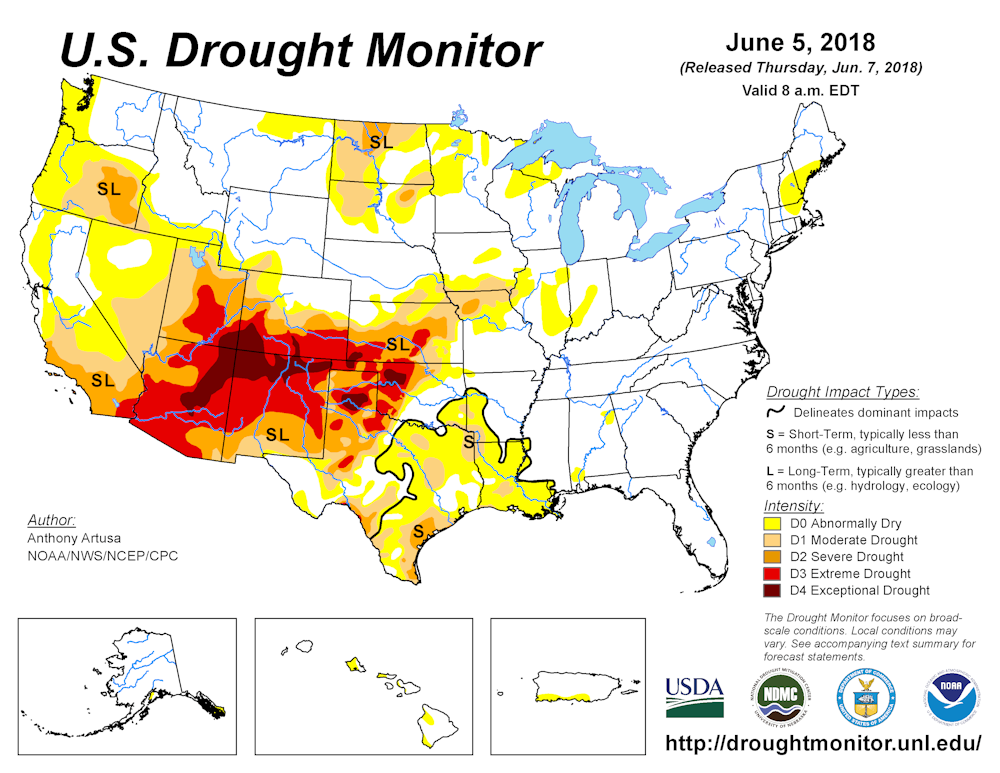
In early June 2018, drought affected 27 percent of the lower 48 states.
NIDIS

Airborne dust and health risks under future climate change

In our next step, we quantified potential future changes in fine dust levels and associated public health impacts under two different climate change scenarios used in the Fifth Assessment Report of the Intergovernmental Panel on Climate Change. The so-called “worst-case” scenario in the report is characterized by unabated, increasing greenhouse gas emissions over time. In the “best-case” scenario, dramatic cuts in emissions are required to hold global warming below two degrees Celsius.

First, we used projections of temperature and precipitation for the years 2076-2095 from an ensemble of 22 climate models in conjunction with our derived dust-soil moisture relationships to quantify future changes in dust due to changing drought conditions under the two climate scenarios. Since there is variation among climate model projections, using a large group of them allows us to gauge the robustness of the results.

We then estimated the resulting public health impacts by applying relationships drawn from studies that have quantified increases in risk of premature deaths and hospitalizations in representative U.S. populations due to exposure to fine PM. In these calculations, we also took into account projections of population growth for the Southwest and changing vulnerability to disease.

On March 31, 2017, thick plumes of dust stretched hundreds of kilometers from northern Mexico into Texas and New Mexico. The source appeared to mainly be farmland near the Mexican town of Janos.
NASA Earth Observatory

Under the worst-case scenario — the path we’re currently on — fine dust levels in the Southwest could increase by 30 percent by the end of this century compared to present-day values. This would result in a 130 percent increase in premature deaths and a 300 percent increase in hospital admissions attributable to fine dust exposure.

Even under the best-case climate mitigation scenario, we project that fine dust levels in the region could increase by 10 percent. This rise would increase premature deaths and hospital admissions due to fine dust exposure by 20 percent and 60 percent respectively, compared to present-day values.

It is worth noting here that we only looked at the isolated effect of future drought conditions. Changes in other factors, such as wind speed and human land use, may enhance or dampen our results.

Dust and droughts are a global threat

Other researchers have found results similar to our study in other parts of the world. For example, researchers have shown that the occurrence of dust storms in China and Saudi Arabia is modulated by rainfall or soil moisture in surrounding regions, which include remote deserts and drylands.

[youtube https://www.youtube.com/watch?v=9TXBP1t2rUc&w=560&h=315]

The ConversationToday, drylands compose 41 percent of the world’s total land area and are home to around 2.1 billion people. On the world’s current greenhouse gas emissions trajectory, droughts will intensify and drylands will expand in parts of South America, Africa, Australia and the Mediterranean. Our findings highlight the potential for climate change to worsen air quality problems in many populated arid regions around the world — one of the many threats posed by climate change to human health and well-being.

Ploy Pattanun Achakulwisut, Postdoctoral Scientist, George Washington University; Loretta Mickley, Senior Research Fellow in Chemistry-Climate Interactions, Harvard University, and Susan Anenberg, Associate Professor of Environmental and Occupational Health and Global Health, George Washington University

This article was originally published on The Conversation.

Why predicting suicide is a difficult and complex challenge

0

anthony

Why predicting suicide is a difficult and complex challenge – CWEB.com

File 20180608 191962 nluw9q.jpg?ixlib=rb 1.1
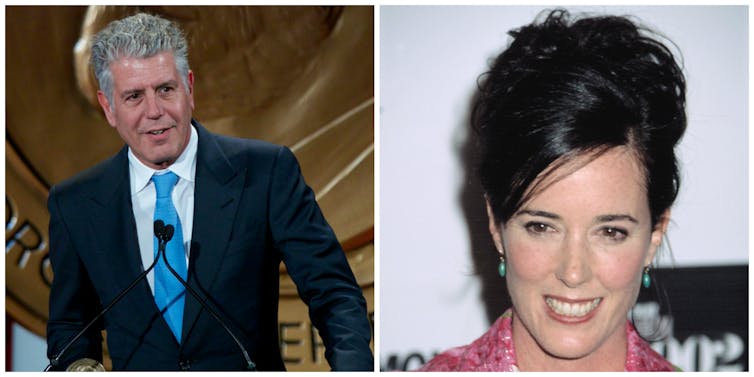
Anthony Bourdain, left, and Kate Spade, right.
The Conversation with images from PeabodyAwards/flickr, CC BY-SA

Joseph Franklin, Florida State University

Who is going to die by suicide? This terrible mystery of human behavior takes on particular poignance in the wake of suicides by high-profile and much-beloved celebrities Kate Spade and Anthony Bourdain. It is only natural that people want to know why such tragedies occur. Those closest to those who take their lives are often tormented, wondering if there is something they could have — or should have — known to prevent their loved one’s suicide.

As a scientist who has focused on this question for the past decade, I should have a pretty good idea of who is and isn’t going to die by suicide. But the sad truth is, I don’t. The sadder truth is, neither do any other suicide experts, psychiatrists or physicians. The sum of the research on suicide shows that it does not matter how long we’ve known someone or how much we know about them. In my research, my colleagues and I have shown that we can only predict who is going to die by suicide slightly more accurately than random guessing.

The need for answers

The fact that suicide is so hard to predict unfortunately took about 50 years for most scientists to appreciate. About the same time that this recognition became widespread a few years ago, a new hope emerged: a form of artificial intelligence called machine learning. As several research groups have demonstrated in recent years, machine learning may be able to predict who is going to attempt or die by suicide with up to 90 percent accuracy.

To understand why this is, and why we humans won’t ever be able to accurately predict suicide on our own, one needs to take a step back and understand a little more about the nature of human cognition, suicide and machine learning.

As humans, we love explanations that have two qualities. First, explanations should be simple, meaning that they involve one or a small number of things. For example, depression is a simple explanation for suicide.

Second, explanations should be determinate, meaning that there is one set explanation that accounts for all or most of something. For example, the idea that depression causes most suicides is a determinate explanation. This simple and determinate explanatory style is highly intuitive and very efficient. It’s great for helping us to survive, procreate, and get through our days.

But this style of thinking is terrible for helping us understand nature. This is because nature is not simple and determinate. In recent decades, scientists have come to recognize that nearly everything — from physics to biology to human behavior — is complex and indeterminate. In other words, a very large number of things combined in a complex way are needed to explain most things, and there’s no set recipe for most physical, biological or behavioral phenomena.

I know that this latter idea of indeterminacy is especially counterintuitive, so let me provide a straightforward example of it. The math equation X plus Y equals 1 is indeterminate. As humans, we instinctively try to find one solution to this equation (e.g., X equals 1, Y equals 0). But there is no set recipe for solving this equation; there are nearly infinite solutions to this equation. Importantly, however, this does not mean that “anything goes.” There are also near infinite values for X and Y that do not solve this equation. This indeterminate middle ground between “one solution” and “anything goes” is difficult for most humans to grasp, but it’s how much of nature works.

The sum of our scientific evidence indicates that, just like most other things in nature, the causes and predictors of suicide are complex and indeterminate. Hundreds, and maybe thousands, of things are relevant to suicide, but nothing predicts suicide much more accurately than random guessing. For example, depression is often considered to be an extremely important predictor of suicide. But about 2 percent of severely depressed people eventually die by suicide, which is only slightly higher than the 1.6 percent of people from the general United States population who eventually die by suicide. Such a pattern is consistent with complexity because it suggests that we must put a lot of factors together to account for suicide.

Empathy will always matter

So how should we put all of these factors together? One intuitive solution is to add many of these factors together. But even when summing hundreds of factors, this doesn’t work — prediction is still only slightly more accurate than random guessing.

A much better solution would be to somehow find an optimized combination of tens or even hundreds of factors. How can we do this? One promising answer is machine learning. In short, machine learning programs can process a large amount of data and learn an optimal combination of factors for a given task. For example, most existing machine learning studies have used data from electronic health records, spanning hundreds of factors related to mental health diagnoses, physical health problems, medications, demographics and hospital visit patterns. Results from several groups in recent years have shown that this approach can consistently predict future suicide attempts and death with 80-90 percent accuracy. Multiple groups are currently working on applying these algorithms to actual clinical practice.

One important thing to keep in mind is that there isn’t, and never will be, a single algorithm or recipe for suicide prediction. This is because suicide is indeterminate, much like the X plus Y equals 1 equation. There are likely near-infinite algorithms that could predict suicide with 80-90 percent accuracy, as a number of studies have shown. Research has already demonstrated that no particular factors are necessary for a good algorithm, and many different types of algorithms can produce accurate prediction. But again, this indeterminacy also means that there are near-infinite bad algorithms, too.

About 2 percent of severely depressed people die by suicide.
Fure/Shutterstock.com

All of this research shows that suicide is unfortunately too complex and indeterminate for humans to predict. Neither I nor anyone else can accurately predict who is going to die by suicide or truly explain why a particular person died by suicide (this includes the suicide decedents themselves). Machine learning can do a much better job of approximating the complexity of suicide, but even it falls far short. Although it can accurately predict who will eventually die by suicide, it cannot yet tell us when someone will die by suicide. This “when” dimension of prediction is critical, and we are likely still many years away from accounting for it.

[youtube https://www.youtube.com/watch?v=9TXBP1t2rUc&w=560&h=315]

In the meantime, what can we humans do? While we don’t have the ability to know whether someone is going to die by suicide or not, we do have the ability to be supportive and caring. If you believe that someone may be struggling, talk with them and let them know about resources such as the US National Suicide Prevention Lifeline (1-800-273-8255).

The ConversationIf this article has raised issues for you or if you’re concerned about someone you know, call Lifeline on 13 11 14.

Joseph Franklin, Assistant professor of Psychology, Florida State University

This article was originally published on The Conversation.
How Korean boy band BTS toppled Asian stereotypes — and took America by storm

0

btsloreakband

How Korean boy band BTS toppled Asian stereotypes — and took America by storm CWEB.com

Susanna Lim, University of Oregon

On May 27, the seven-member South Korean boy band BTS became the first K-pop act to top the Billboard 200 chart with their third album, “Love Yourself: Tear.”

A week earlier, BTS had won “top social artist” for the second year in a row at the 2018 Billboard Music Awards, beating out the likes of Justin Bieber and Ariana Grande. During the show, they performed their single “Fake Love” to the screams of adoring American fans, who seemed to have no trouble singing along to the song’s mostly Korean lyrics.

BTS performs ‘Fake Love’ at the 2018 Billboard Music Awards.

As someone who studies and teaches modern Korean culture, I’ve been following the ebb and flow of K-pop’s popularity in the U.S. with a mix of interest and skepticism. Like Euny Hong, author of “The Birth of Korean Cool” (2014), I, too, am more familiar with a time when Korea was simply “not cool” by Western standards.

For decades, Americans seemed to only think of Korea through the lens of the Korean War and diplomatic tensions with North Korea. Korean pop music barely registered.

But as I listened to “MIC Drop” and “Fake Love” on a local radio station during a recent trip to campus, it struck me that K-pop may have entered a new phase. The genre’s growing popularity says as much about the talent of groups like BTS as it does about the country’s expanding role in global affairs.

A ‘perfect’ aesthetic

K-pop is a particular style of South Korean popular music that’s distinguishable from other popular forms of Korean music, such as trot and sentimental ballads. Many trace its origins to the early 1990s, but the genre came into its own in the 2000s and 2010s, with acts such as BoA, Wonder Girls, Girls’ Generation, TVXQ, Big Bang and 2NE1 becoming hugely popular in Asia and beyond.

The “pop” part of K-pop seems easy enough; you’ll hear American pop musical influences — mostly dance pop, but also rap, hip-hop, R&B, jazz, techno and rock – in K-pop songs.

But what about the “K”? This is where the unique Korean flair plays a role: infectious melodies sung mostly in Korean, a few English words strategically placed in the sing-along refrain, and single-sex groups made up of seven to 15 members.

In my view, the biggest aspect of K-pop’s appeal is the group members’ relentless pursuit of perfection. Their performances involve perfectly synchronized choreography. They also tend to have a very specific look that reflects idealized Caucasian beauty standards: a small, chiseled face, large eyes, a straight nose, long legs and trendy outfits.

K-pop’s global ambition is another quality that distinguishes the genre from other Korean music. Exporting K-pop to the rest of the world is not only a goal of the Korean music industry, but also a government priority. For example, at the Pyongchang Winter Olympics, organizers prominently featured K-pop performers EXO and CL in the closing ceremony.

For decades, South Korea was a war-torn, poverty-stricken country. But beginning in the 1960s and 1970s, under the rule of dictator Park Chung-hee, the country embarked on an ambitious program of economic development, and, in less than a half century, the nation transformed into one of the world’s leading economic powers.

For many young Koreans, K-pop stars represent their ideal image of themselves; for Korean leaders, they symbolize the promising future of their country.

A unique appeal

And yet, until recently, most Americans could probably name only one or two K-pop groups.

Many got their first taste of K-pop following Psy’s 2012 global hit “Gangnam Style.” The song, an ironic paean to the glitzy superficiality of Gangnam, a wealthy area of Seoul, racked up 1 billion YouTube views by the end of 2012.

But some wouldn’t consider Psy and his hit single a true reflection of K-pop.

In “Gangnam Style,” Westerners were exposed to a cartoonish parody of K-pop, a tongue-in-cheek performance that gives off vibes of orientalism and exoticism. Audiences, especially in the West, liked it not because they viewed Psy as an artist, but simply because “Gangnam” was entertainingly weird.

Psy performs during a concert in Seoul, South Korea, in 2014.
AP Photo/Lee Jin-man

BTS’ breakthrough shows that in just six years, K-pop — and Americans’ view of K-pop — have come a long way.

What did BTS do differently? Through social media, BTS members have been able to counter some of the stigmas about Asians that in the past may have hindered K-pop’s popularity in the U.S.

Research has shown that Westerners tend to stereotypically view Asians as a vague, collective mass that robotically imitates the West. They assign them the negative qualities of capitalism — materialism and cutthroat competitiveness — while downplaying Asians’ self-assertion and individuality, which are qualities valued by Western societies.

But unlike other K-pop groups, BTS have done more than perfect their choreography and looks. They also put their personalities on full display.

Via social media, they’ve been able to connect with and cultivate a community of utterly devoted fans. On Twitter — in English and in Korean — group members give fans a window into their lives, express themselves, and talk about issues important to teens, from mental health to body image.

As one of my students told me, “Fans feel like they see the ‘real’ members and their personalities.”

Korea’s new global identity

Make no mistake, BTS is a product of Korea. Its members are driven by the same work ethic that drive millions of Korean youth to hit the books in “hagwon,” the country’s notorious “cram schools.”

But the group does seem to represent a new, more comfortable negotiation of Korean and global identities that has emerged in recent years.

In 1997, Korea experienced a financial crisis. The country was on the brink of economic collapse, and massive shutdowns and layoffs ensued. The crisis, known in Korea as the “IMF crisis” due to the tough bailout package that the International Monetary Fund forced Korea to accept, devastated many families.

But it also led to a program of intense economic and cultural globalization
that opened the doors to foreign investment, made South Korea the most wired country in the world, and exposed Koreans to global culture and media.

In contrast to Korean-Americans or the Gangnam-born Psy, all seven members hail from regional cities like Busan and Gwangju. Born from 1992 to 1997, they’re part of the generation that grew up in South Korea during the post-IMF reforms that exposed them to American culture and the English language from the moment they learned to walk and talk.

Late last year, during BTS’ appearance on “The Ellen DeGeneres Show,” host Ellen compared the pandemonium that greeted them at LAX to Beatlemania.

[youtube https://www.youtube.com/watch?v=9TXBP1t2rUc&w=560&h=315]

But in the U.S., BTS faces two barriers the British band never had to worry about: race and language. American popular culture has a long history of excluding Asians, and there were hints of racism and xenophobia after BTS won their first Billboard award a year ago.

It might be too early to tell if BTS will be at the forefront of a “K-pop Invasion.” But it’s clear that they’ve been able to bridge some of the divides that have prevented K-pop from catching on in the U.S.

The ConversationWe saw it during the Billboard Music Awards when, during their speech, BTS thanked their fans — in English and in Korean.

Susanna Lim, Associate Professor, Korean and Russian studies, University of Oregon

This article was originally published on The Conversation.

Video gamers may soon be paid more than top pro athletes

0

gaming

Video gamers may soon be paid more than top pro athletes – CWEB.com

File 20180604 177088 1kuggti.jpg?ixlib=rb 1.1
The Finnish R6 eSports proleague team, winners of Rainbow Six Pro League Championship in Sao Paulo.
(Ubisoft)

Louis-Etienne Dubois, Ryerson University and Laurel Walzak, Ryerson University

Your interest in sports may have started out as a hobby when you were just a kid. You were better at it than others, and some even said you were gifted. Maybe you had a chance to develop into a professional athlete.

Colleges would soon line up to extend full scholarships. If you pushed hard enough, practised countless hours and kept a cool head, lucrative contracts and international fame awaited.

This fantasy plays out for many North American kids who dream of “making it to the big leagues.”

Whether they play hockey, football or basketball, even the most remote possibility of turning their love of the game into a respected career is worth sacrificing for.

Enter video games.

In less than a decade, the realm of professional sport has been taken by storm by the rise of eSports (short for electronic sports). These video game events now compete with – and in some cases outperform – traditional sports leagues for live viewership and advertising dollars.

For the top eSports players, this means sponsorship contracts, endorsements, prize money and yes, global stardom.

Games on TV still command high ad dollars

This week, dozens of professional video game players will descend on Toronto during NXNE, an annual music and arts festival, to compete in different games for prizes of up to US$1,000. Not a bad payday, perhaps, but still chump change in the eSports scene.

For example, Dota 2, a popular battle arena game published by Valve, recently handed out US$20 million to its top players during its finale.

What does this mean for traditional sports? And sports TV viewership?

The lasting broadcast success of sports leagues games can be explained by the fact that they are meant to be shared happenings and are best experienced live. As such, they have been resilient to disruptions within the media landscape and somewhat spared by the advent of on-demand streaming services such as Netflix and Amazon Prime.

The ability to capture a sizeable number of “eyeballs,” long enough and at a precise time, is the reason why professional sports leagues still command huge TV rights and advertising dollars.

In the past few years, the “Big Four” North American sports leagues have all struck new deals worth hundreds of millions of dollars.

Shifts in sports culture

Some leagues like Major League Baseball, and their once subsidiary Advanced Media division (MLBAM), have long embraced technological innovations to enhance audiences’ experience.

Meanwhile, media and telecommunication giants have been slower to catch on.

In 2016, John Skipper, then president of ESPN, referring to cable TV packages said: “We are still engaged in the most successful business model in the history of media, and see no reason to abandon it.”

This attitude, at the time, was not only symptomatic of a lag or inability to adopt technological innovations, but also raised concerns about the company’s future.

But the decline of the traditional linear broadcast, and the risk of losing relevancy in this digital, broadband and tech savvy media landscape is inevitable, and forces these media giants to question their traditional business models and to focus on online audiences.

Along with this shift, a new, popular and expansive trend for the new generation has emerged – eSports.

Whether eSports are actual sports or not is a whole other debate; however, the emergence of the global video game competition field demands attention and strategic investment.

Why eSports is doing so well

As a spectator sport, video games generate viewership at least on par with professional leagues.

Take, for instance, 2016’s League of Legends tournament that drew 36 million viewers, five million more than the NBA Finals, in front of a sellout crowd at the famous Bird Nest stadium in China.

eSports events regularly draw sellout crowds like major professional sports leagues.
(Ubisoft)

eSports mimic traditional sports leagues principles: Exciting content, likeable stars, catchy team names, slow motion highlights, intense competition and an uncertain outcome.

These video games attract audiences as they are no longer simply designed to be played, but increasingly to be visually pleasing for audiences.

Age-wise, compared to traditional sports that struggle to diversify their audience demographics, eSports have successfully attracted younger viewers.

The fan base is pretty young, with 61 per cent of fans falling in the 18-34 age range. Young men, in particular, are a desirable market for many advertisers.

eSports attracts advertisers

The economic outlook for video gaming sports is staggering. According to NewZoo, eSports “on its current trajectory is estimated to reach US$1.4 billion by 2020.” And a “more optimistic scenario places revenues at US$2.4 billion.”

Companies like Red Bull, Coca-Cola and Samsung, all usual suspects when it comes to advertising and young people, are flocking to eSports.

In recent years, eSports has made efforts to monetize across traditional revenue streams, such as merchandise sales, subscriptions plans, ticket sales and broadcast rights. It is, once again, taking a page straight out traditional sports leagues’ playbook.

So, what can established leagues and media giants do? Given the choice between fighting eSports or joining them, many appear to have chosen the latter. Recall ESPN resisting change in 2016. Then fast forward to their recent strategic investments in the digital platform BAMTech, once MLB Advanced Media, in order to launch ESPN streaming services.

As a result, Disney, the 100 per cent owner of ESPN, now has a say in League of Legends streaming because its publisher Riot Games had signed a seven-year US$350 million dollar broadcast deal with BAMTech.

FIFA just partnered with Electronic Arts on a online tournament that drew 20 million players and 30 million viewers. Also hoping to create platform synergies and to reach new audiences, Amazon acquired Twitch in 2014, the leading game streaming service.

These examples show that eSports are not just popular with gamers, but also among sports leagues and media giants. Both stand to learn from each other. No wonder Activision’s CEO said that he wanted to “become the ESPN of eSports.

This popularity also opens up more opportunities to compete on the professional level and earn huge endorsements, prize money and salaries just like LeBron James, Serena Williams, Danica Patrick or Sidney Crosby.

In fact, higher education eSports programs are already launching across the country and college scholarships are now commonplace, further acknowledging the economic viability and social acceptability of this phenomenon.

[youtube https://www.youtube.com/watch?v=9TXBP1t2rUc&w=560&h=315]

And with talks of introducing eSports in the Paris 2024 Olympic Games, Canada’s “Own the Podium” program may soon have to follow suit.

The ConversationIn any case, it turns out that our parents were wrong all along: You can stay glued to your console in the basement all day and still make it pro.

Louis-Etienne Dubois, Assistant Professor, School of Creative Industries, Ryerson University and Laurel Walzak, Assistant Professor, RTA School of Media, Ryerson University

This article was originally published on The Conversation.


Follow us on Facebook

Should You Invest in Fiat Chrysler?

0

Alfa_Romeo_Brera_Ti_2011_10750450035

Should You Invest in Fiat Chrysler? – CWEB.com

By: Leslie Cohen

The Chrysler Fiat Chrysler (FCAU) name isn’t as popular with consumers in the United States as it once was many years ago. Chrysler offers the 300 model which is a boxy luxury type sedan that will likely erode into the dust and the Pacific minivan which consumers can also purchase as a plug-in hybrid.

One of the most popular brands in the United States is Jeep and the pickup truck Ram that was a spinoff from Dodge in 2009.   Alfa Romeo and Maserati luxury and performance vehicles have been a bit late in joining the global SUV and crossovers vehicle market compared to its competitors.

Dodge is known for cars and SUVs with powerful engines.   These vehicles covet many loyal customers for the Dodge Challenger. The Durango SUV and Charger sedan saw sales decline 15% and 9%, respectively, from a year ago from June 2018.

Model May 2018 sales Change vs. May 2017 Year-to-date sales Change vs. 2017
Jeep Cherokee 23,789 63% 91,286 31%
Jeep Compass 17,327 223% 72,398 315%
Jeep Wrangler 25,102 26% 110,382 38%

FIAT CHRYSLER AUTOMOBILES. YEAR TO DATE SALES ARE THROUGH MAY; COMPARISON IS TO THE SAME PERIOD IN 2017.

Year Jan Feb Mar Apr May Jun Jul Aug Sep Oct Nov Dec Total
2018 132,803 165,903 216,063 184,149 214,294

dodge durango 2018 _cwebMaserati_Levante_CWEBstatistic_id239964_fiat-chrysler-automobiles---us-vehicle-sales-by-segment-2018

Fiat Chrysler shares hit a high of 20.15 euros past Friday, June 8th, 2018 closing down to 18.33 euros.  Fiat Chrysler Shares are still up 95% for the past year. Fiat Chrysler is looking to triple its profits by the year 2022 by investing in electric vehicles and focusing on the Maserati, Alfa Romeo and Jeep Fiat Chrysler shares high of 20.15 euros past Friday closing down to 18.33 Fiat Chrysler Shares are still up 95% for the past year. Fiat Chrysler is looking to triple its profits by the year 2022 by investing in electric vehicles and focusing on Ram trucks Maserati Alfa Romeo and Jeep.

[youtube https://www.youtube.com/watch?v=9TXBP1t2rUc&w=560&h=315]

CEO Sergio Marchionne is stepping down next year, and there is no word on who will replace him. Investors are worried that the departure of Sergio Marchionne could cause trouble for the company, just like when Alan Mulally former President and Chief Executive Officer of the Ford Motor Company stepped down, the company did not fare as well.  Marchionne speaking at Fiat Chrysler’s Capital Markets Day in Italy actually wore a tie to the meeting, something that the media has not seen on him since 2007. Marchionne is known for his outspoken and brazen remarks. While  Marchionne speaking at Fiat Chrysler’s Capital conference laid out some impressive plans, the future is uncertain when a new CEO takes over. Marchionne is credited in saving Fiat SpA from bankruptcy in the mid-2000s and rescued Chrysler five years later.

Let’s not forget  Marchionne legacy of leading Fiat Chrysler’s  14-year turnaround.

Stay tuned……

Follow us on Facebook

Why Mister Rogers’ message of love and kindness is good for your health

0

Fred-Rogers-58fe6ed95f9b581d59f8ca68

Why Mister Rogers’ message of love and kindness is good for your health – CWEB.com

File 20180607 137306 nwj9r6.jpg?ixlib=rb 1.1
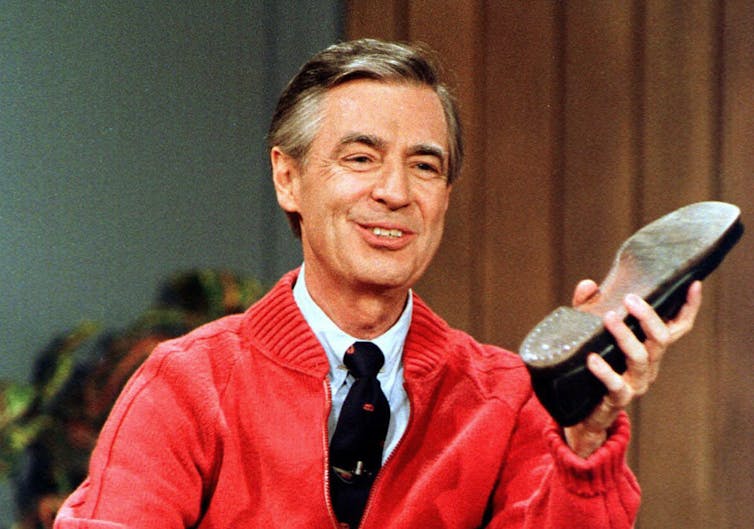
Fred Rogers at a taping of his famous show on June 28, 1989.
Gene J. Puskar/AP File

Richard Gunderman, Indiana University

The release of the Mister Rogers documentary, “Won’t You Be My Neighbor?” calls to mind the essential message of Rogers’ long-running children’s program, “Mister Rogers’ Neighborhood.” Fred McFeely Rogers, who died in 2003, was also an ordained Presbyterian minister. Over the course of three decades on public broadcasting, he brought to millions of children what his faith’s General Assembly referred to as “unconditional love.”

In preaching love, Rogers wasn’t just attending to the moral character of his youthful audience. He believed that he was also promoting their health. As he said in 1979, “My whole approach in broadcasting has always been, ‘You are an important person just the way you are. You can make healthy decisions.’ Maybe I’m going on too long, but I just feel that anything that allows a person to be more active in the control of his or her life, in a healthy way, is important.”

Since Rogers’ death, evidence has mounted that he was on to something — namely, that love and kindness truly are healthful, and that people who express them regularly really do lead healthier lives. Simply put, people who are generous and volunteer their time for the benefit of others seem to be happier than those who don’t, and happy people tend to have fewer health complaints and live longer than those who are unhappy.

Love gave rise to a calling

Born in Pennsylvania in 1928, as a young minister Rogers regretted the messages television was conveying to children in the 1960s. He said, “I went into television because I hated it so, and I thought there’s some way of using this fabulous instrument to nurture those who would watch and listen.” “Mr. Rogers’ Neighborhood” debuted nationally in 1968 and won its creator and host many accolades, including a Presidential Medal of Freedom, two Peabody Awards, and over 40 honorary degrees.

Fred Rogers with Pres. George W. Bush, who is about to place the Presidential Medal of Freedom on Rogers in a July 9, 2002 ceremony.
Kenneth Lambert/AP Photo

Rogers believed that the need to love and be loved was universal, and he sought to cultivate these capacities through every program, saying in a 2004 documentary hosted by actor Michael Keaton, one of his former stagehands, “You know, I think everybody longs to be loved, and longs to know that he or she is lovable. And consequently, the greatest thing we can do is to help somebody know they’re loved and capable of loving.”

Love and health

As it turns out, there are many ways in which love and kindness are good for health. For one thing, they tend to reduce factors that undermine it. Doing something nice for someone causes the release of endorphins, which help to relieve pain. People who make kindness a habit have lower levels of stress hormones such as cortisol. Intentionally helping others can even lower levels of anxiety in individuals who normally avoid social situations.

Carrying out acts of kindness, or even merely witnessing them, also increases levels of oxytocin, a hormone with health benefits as diverse as lowering blood pressure, promoting good sleep and reducing cravings for drugs such as cocaine and alcohol. That oxytocin should have so many health benefits is not so surprising when we recall its central role in stimulating uterine contractions during birth, the letdown of milk during lactation, the pleasure associated with orgasm and pair bonding.

Acts of generosity and compassion also appear to be good for mood. A 2010 study showed that while people with money tend to be somewhat happier than those without it, people who spend money on others report even greater levels of happiness, an effect that can be detected even in toddlers. When people give money to others, areas of the brain associated with pleasure are activated, and this response is greater when the transfer is voluntary rather than mandatory.

Such happiness can have big benefits in longevity. For example, a review of 160 published studies concluded that there is compelling evidence that life satisfaction and optimism are associated with better health and enhanced longevity. Another study of older people showed that, even after correcting for other factors such as age, disease and health habits, those who rated their happiness highest were 35 percent less likely to die in five years than those who were least content.

[youtube https://www.youtube.com/watch?v=9TXBP1t2rUc&w=560&h=315]

What would Mister Rogers say?

Of course, Rogers would remind us that there are reasons to be committed to love and kindness that extend far beyond their health benefits. Rogers was, after all, not a physician but a minister, and ultimately he was ministering to an aspect of human wholeness that cannot be analyzed by blood tests or visualized with CT scans. In a commencement address at Dartmouth College in 2002, he focused less on the body than what he might have called the spirit:

“When I say it’s you I like, I’m talking about that part of you that knows that life is far more than anything you can ever see or hear or touch. That deep part of you that allows you to stand for those things without which humankind cannot survive. Love that conquers hate, peace that rises triumphant over war, and justice that proves more powerful than greed.”

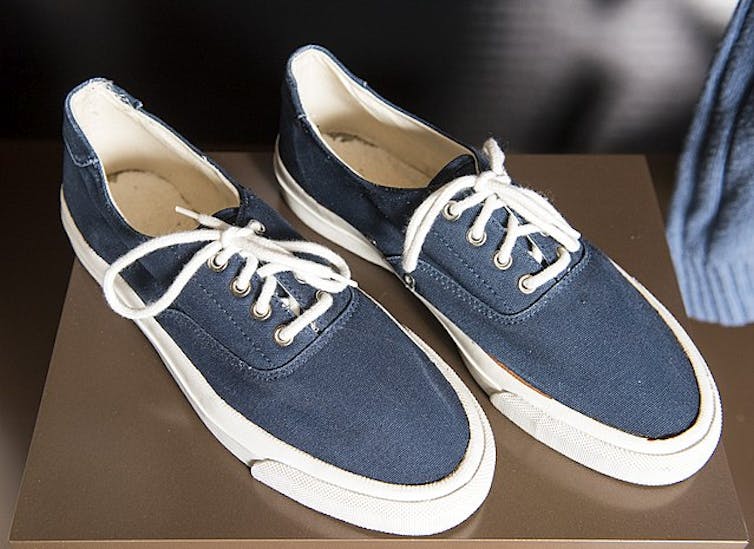
A pair of Mister Rogers’ sneakers at the LBJ Library exhibition to celebrate the 50th anniversary of Pres. Johnson signing the public broadcasting act in 1967.
Jay Godwin/LBJ Foundation

When Rogers encouraged children to be kinder and more loving, he believed that he was not only promoting public health but also nurturing the most important part of a human being — the part that exhibits a divine spark. As Rogers indicated in another commencement speech the year before at Middlebury College, “I believe that appreciation is a holy thing, that when we look for what’s best in the person we happen to be with at the moment, we’re doing what God does; so in appreciating our neighbor, we’re participating in something truly sacred.”

In expressing such deeply religious sentiments, Rogers was not trying to undermine a concern with bodily health. In fact, he regularly encouraged his viewers to adopt healthy life habits, and Rogers himself was a committed vegetarian and lifelong swimmer who maintained a low body weight his entire life. Yet he also believed that health alone does not a full life make, and he regarded the soundness of the body as but part of the wellness of whole persons and communities, which may explain why he was able to face his own mortality with such equanimity.

Just a few months before he died, Rogers recorded a message for the many adult fans who had grown up watching “Mister Rogers’ Neighborhood.” In it, he practiced what he preached, saying:

The Conversation“I would like to tell you what I often told you when you were much younger. I like you just the way you are. And what’s more, I’m so grateful to you for helping the children in your life to know that you’ll do everything you can to keep them safe. And to help them express their feelings in ways that will bring healing in many different neighborhoods. It’s such a good feeling to know that we’re lifelong friends.”

Richard Gunderman, Chancellor’s Professor of Medicine, Liberal Arts, and Philanthropy, Indiana University

This article was originally published on The Conversation.

Competition Is Heating Up Between Costco Walmart And Target -CWEB.com

0

costco _cweb (1)

Competition is heating up between Costco (NASDAQ:COST) Walmart (NYSE:WMT) and Target (TGT) — That’s Good News For Consumers

By Leslie Cohen

CWEB (@cweb) | Twitter

Cutting prices for these companies can also eat into profit margins. Shares of Costco Wholesale (NASDAQ:COST) are up more than 2% on Thursday, June 7th, 2018.

Costco reported tell showing same Source Dale 11% and net sales were up 11.02 Billion from 9.6 billion from the same month of May, 2017.

Costco’s e-commerce sales were up 34%. Rising gasoline prices along with a weaker dollar added more than 3 percentage points of incremental growth. Concurrently, membership fees increased to 14.4% year over year, advanced by a 9% membership fee increase Costco placed into effect in the U.S. and Canada last June.

[youtube https://www.youtube.com/watch?v=9TXBP1t2rUc&w=560&h=315]

Costco competes well with its competitors such as Amazon.com, Inc. NASDAQ: AMZN, and Walmart Inc. NYSE: WMT. Costco has announced it will raise its minimum to a minimum of $14 an hour it employs 130,000 hourly workers. The new wages are set to take place on June 11th which is double the federal minimum wage that is currently at $7.25 per hour. On a pre-tax basis, this will add approximately $110 million to $120 million of incremental costs annually.

Strong earnings for Costco reported have calmed down the fears related to the Amazon Whole Foods takeover. Costco stock should reap healthy gains in the near and long-term since the acquisition of Whole Foods by Amazon. Costco has gone through a string of quarters with comparable sales growth, robust profit growth and healthy margins.

Comparable sales in the U.S. rose by 5.7% at 7.4% elsewhere .5% in Canada Amazon’s acquisition of Whole Foods Costco sales growth Trends have actually improved. “We can see multiple quarters of evidence supporting the trend of growth Costco, but uncertainties related to government fiscal and tax policies including increased tariffs and duties and other restrictions could adversely affect a man products and services,.” as stated in a Securities and Exchange Commission filing.

CWEB Analyst’s have initiated a Buy Rating for Costco (NASDAQ:COST) , and a Price Target of $300

Read Full Article and Videos CWEB.com – Trending News, Blog, Shopping

Chart
COST data by YCharts

California’s jungle primary sets up polarized governor’s race for November

0

gavinnewsome

California’s jungle primary sets up polarized governor’s race for November – CWEB.com

File 20180606 137301 1vuc6qd.jpg?ixlib=rb 1.1
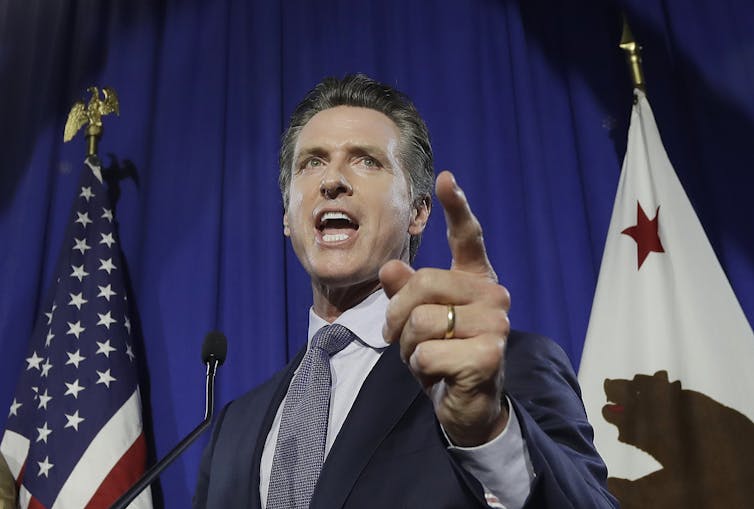
Democratic Lt. Gov. Gavin Newsom speaks at his campaign’s night watch party in San Francisco.
AP Photo/Jeff Chiu

Thad Kousser, University of California San Diego

Voters who took part in California’s innovative and anti-party “jungle” primary delivered a typical and predictably partisan result in the governor’s race.

They sent Democratic Lt. Governor Gavin Newsom as the heavy favorite into a November contest against Republican businessman John Cox. With the liberal Newsom positioning himself as a Bay Area Bernie Sanders, and staunchly conservative Cox touting his Twitter endorsement from President Donald Trump, the battle at the top of the ticket will be fought from the ideological poles. Incumbent Dianne Feinstein is safe in the Senate, but key House districts are too close to call as of this writing.

Republican gubernatorial candidate John Cox, center, speaks during a Republican primary watch party.
AP Photo/Gregory Bull

This was not how California’s top two system, or “jungle” primary, was supposed to work.

The hope of reformers who backed it as a ballot proposition nearly a decade ago was that the new rules — which let every voter cast a ballot for any candidate in the primary, with the top two advancing to the general election — would act as an antidote to partisan polarization.

Parties hated the idea. It meant no party was guaranteed a spot in the top two. Voters backed it, ready to experiment with anything in a rapidly polarizing state.

After four primaries run under the new system, the hopes of reformers have yet to materialize. And some of the fears of its opponents have roiled congressional races run under the top two rules, as parties struggle to avoid being shut out of the November ballot in competitive districts.

Here’s how the top two primary is supposed to shake up California politics.

Hope for a centrist electorate

First, it gives voters who don’t affiliate with a political party — a bloc that is now slightly larger than the Republican Party in the state that once produced Richard Nixon and Ronald Reagan — a bigger voice in primaries. Voters with “no party preference” now make up 25.5 percent of registered voters, trailing Democrats at 44.6 percent but ahead of Republicans at 25.1 percent.

Before the reform, independents could vote in a party primary only if the party allowed it. Democrats did, Republicans didn’t, and very few independents turned out in primaries.

The idea was that by opening up primaries to all voters, regardless of party, a flood of new centrist voters would arrive. That would give moderate candidates a route to victory without having to bend toward the ideological extremes to appeal to party loyalists, as often happens in primaries.

Yet when the top two went into effect, no flood of independents turned out to the polls. The trickle continued.

As my colleague Seth Hill and I showed in a comparison of participation in the 2008 and 2010 elections, before the top two primary system took effect, turnout by voters with no party preference actually declined from 17.7 percent to 17.2 percent of registered voters. Those who did vote had the option of casting a ballot for any candidate, regardless of party, an important expressive right brought by the new rules. But the reform failed to deliver a new pool of moderate, nonpartisan voters to buttress centrist or independent candidates.

Hope for more centrist candidates

At least so far, candidates running from the center have also not fared particularly well under the new rules. My other research with Justin Phillips and Boris Shor looked at the positions that congressional and state legislative candidates took on a range of issues in the first races held under top two rules in 2012. We compared them with the positions of the average voter in each district.

If the top two approach had fulfilled its goals, we expected to see a closer match between candidates and voters in 2012, compared with contests held under the old rules in 2010.

However, we found no such evidence. Candidates did not represent voters any better after the reforms, taking positions just as polarized as they did before the top two. We detected no shift toward the ideological middle.

In our findings, we did note one unintended flaw in the top two rules that year, a flaw that has turned some congressional races into a jungle this year. In a battleground district, a party with strong voter support can get shut out of the November election. If one party fields two strong candidates and the other has three or four of them splitting the vote, the party with fewer candidates in the primary can monopolize space on the general election ballot.

This is exactly what happened in California’s 31st Congressional District, where Democrats held a five-point lead in party registration. Two Republicans advanced when four Democrats split the vote in 2012, leaving November voters powerless to pick which party would represent them in a swing district.

That situation, which is without question bad for democratic representation, is threatening to occur again this year. Right now, in three toss-up congressional districts, Democrats are struggling to win a place on the November ballot because they have many well-funded candidates dividing up the party base. All three primaries are too close to call as of publication.

Strategy trumped ideas

Regardless of the outcome, the quirks of the top two system have driven the dynamics of all three close congressional races. Instead of debating the merits of candidates, voters have been debating which one has the best chance of making it to November.

Democrats looking to consolidate around a front-runner in one of these races eagerly awaited any polling numbers to guide them, then became bitterly divided over two conflicting polls released just before the election.

Meanwhile, political consultants have taken up the invitation to mischief created by the new rules.

[youtube https://www.youtube.com/watch?v=9TXBP1t2rUc&w=560&h=315]

For example, national Democratic groups wanted to splinter the Republican vote, so they spent money attacking a strong Republican candidate in one San Diego district, while also attempting to prop up weaker Republicans in two Orange County districts. Welcome to the jungle primary, where races can become more about strategic fights and less about battles of ideas.

This year’s governor’s race was supposed to be the one that finally fulfilled the promise of the top two system. In early polling, former Speaker of the Assembly and Los Angeles Mayor Antonio Villaraigosa ran far ahead of political newcomer John Cox. Villaraigosa positioned himself as a moderate Democrat, backing charter schools and refusing to embrace a state single-payer health plan. If he made the top two, he hoped to cobble together a coalition of moderate Democrats, independents and perhaps even a few Republicans to defeat the more liberal Newsom.

The ConversationThat campaign might have changed California politics. Yet Villaraigosa’s dream, like many of the dreams of top two reformers, did not come true. He lost, and now voters face a choice between two partisan and more polarizing party candidates.

Thad Kousser, Professor of Political Science, University of California San Diego

This article was originally published on The Conversation.

Netflix: Loyal Subscribers Love Netflix- And So Does Wall Street

0

netflix11


Netflix: Loyal Subscribers Love Netflix- And So Does Wall Street – CWEB.com

By: Leslie Cohen

Great news for Netflix, Inc. (NFLX) as it will replace Monsanto in the S&P 100. Monsanto is being acquired by BAYER (BAY.TI). Netflix’s stock closed up 1.1% to $365.80 on Tuesday, June 5th, 2018.

The way we view entertainment has changed. Kannan Venkateshwar, media analyst of Barclays Capital states, “We believe the economics for companies with global streaming scale like Netflix may be more favorable than theatrical releases, over time.”

Netflix has given control over to the consumer on how they watch movies. And- consumer are loving it. It gives the viewer a wide choice of content that is viewable any time- on demand, and on any device.

What’s not to love about Netflix?

“13 Reasons Why”, one of Netflix’s most popular shows drawing an audience in the second season of an average audience of 2.6 million viewers in the U.S., all within the first three days on air, according to Nielsen ratings. The premiere episode attracted 6 million viewers in three days of its premiere episode. The controversial series about teen suicide and rape closed with a whisper at the end of season two. Good news for fans, production for season three is tap to premiere in 2019.

What’s driving Netflix growth is operating profit per paid subscriber. Netflix has been adept at increasing pricing without losing subscribers. Netflix does have high costs to develop content and must borrow tremendous amounts of capital to pay for content to run ahead of its competitors, Walt Disney Co (DIS), and Amazon.com, Inc. (AMZN)

[youtube https://www.youtube.com/watch?v=9TXBP1t2rUc&w=560&h=315]

In foreign countries like Africa and Asia that growth may slow because of less expensive competitors are already on the market in those countries. Netflix international streaming contribution margin is 15.3%, less than half the amount of its U.S. streaming segment.

CWEB Analysts have initiated a BUY Rating for Netflix, Inc. (NFLX) and a price target of $450 within 12 months.

Read Full Article and Videos CWEB.com – Trending News, Blog, Shopping

Chart
NFLX data by YCharts

4 charts showing why putting tariffs on your friends is a bad idea

0

President_Trump_Meets_with_Russian_Foreign_Minister_Sergey_Lavrov_(34597652845)

4 charts showing why putting tariffs on your friends is a bad idea – CWEB.com

File 20180605 119860 1u2shxj.jpg?ixlib=rb 1.1
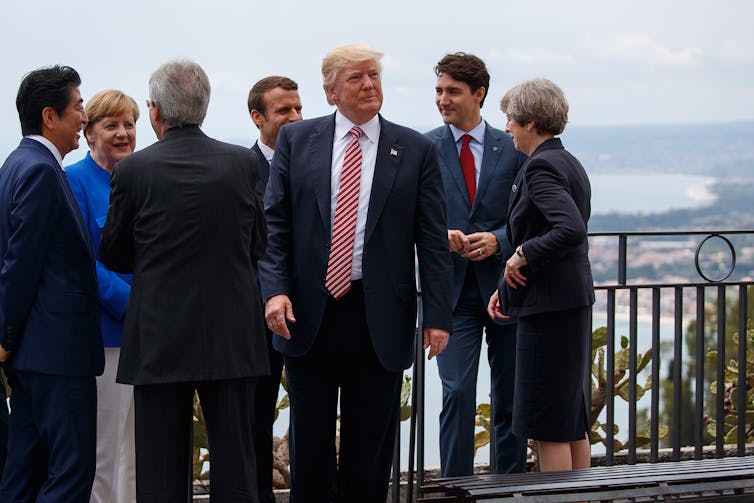
Don’t forget your friends.
AP Photo/Evan Vucci

William Hauk, University of South Carolina

Europeans, Canadians and Mexicans buy more American goods and services than anyone else in the world. So why would the Trump administration be willing to start a trade war with the United States’ most important trading partners — as well as some of its oldest allies?

The current dispute started back in March, when the White House proposed tariffs on all imports of steel and aluminum on national security grounds. That led to threats of retaliation. The administration granted temporary exemptions to several key allies, including Canada, Mexico and the European Union. As of May 31, they’ve all expired, and the U.S. government decided not to renew them.

Now the EU, Mexico and Canada are beginning to make good on those threats.

Canadian Prime Minister Justin Trudeau called the tariffs “totally unacceptable” and “an affront” to Canadian soldiers who have served alongside Americans in numerous conflicts.

As an economist who studies international trade, I thought it’d be instructive to explore the trade relationships the U.S. has with each partner to show just how important they are — and what would be the consequences of a full-blown trade war.

Why they’re upset

The Trump administration placed a 25 percent tariff on steel and 10 percent tariff on aluminum with the aim of propping up U.S. metals manufacturers.

A tariff is basically a tax on imports that raises the price of foreign company’s products for American consumers, putting imports at a disadvantage to domestic producers.

To see why these three U.S. allies are so upset, one need only look at the biggest suppliers of U.S. metals. Canada dominates, supplying more than a quarter of all U.S. steel, aluminum and iron imports in 2016. More importantly, steel exports to the U.S. make up more than half of total Canadian production.

The EU came second at 14 percent, while Mexico ranked fifth with 5.4 percent of U.S. imports. Steel exports to the U.S. also make up more than half of Mexican production.

America’s biggest customers

The EU is the single biggest market for exported U.S. goods, buying US$270 billion of American products in 2016, followed closely by Canada and Mexico. By comparison, China buys just $116 billion.

On the flip side, Americans purchase more from those countries than they sell, creating bilateral trade deficits that the president hates — even as most economists say they don’t matter. The U.S. imports $417 billion in goods from the EU, $294 billion from Mexico and $278 billion from Canada.

When the steel tariffs were first proposed in March, the EU, Canada and Mexico all reacted by threatening to retaliate with their own sanctions against some of these products.

So far, only Canada and Mexico have done so. Canada announced dollar-for-dollar tariffs on steel and aluminum, as well as sanctions of 15 percent to 25 percent on whiskey, orange juice and other food products. Mexico also slapped tariffs on U.S. steel, as well as various farm products, including pork, cheese, apples, whiskey, cranberries, grapes and canned goods.

While tariffs on these products won’t have much of an impact on the overall U.S. economy, they could be especially painful for particular industries or regions. For example, Mexico is the second-largest consumer of U.S. pig meat, making the industry vulnerable to Mexican tariffs.

Countries that import U.S. pig meat.

And tariffs like those on Kentucky bourbon and motorcycles seem intended to hit key members of Congress where they live — namely, Senate Majority Leader Mitch McConnell of Kentucky and Speaker of the House Paul Ryan of Wisconsin, the home of Harley-Davidson.

Disruption to U.S.—Canada trade could also affect cross-border supply chains that have grown during the NAFTA era. The automotive industry is particularly vulnerable in this regard.

Although the EU hasn’t pulled the trigger on its own tariffs — yet — it recently opened a case at the World Trade Organization, arguing Trump’s tariffs can’t be justified on national security grounds and are no more than “pure protectionism.” A negative judgment at the WTO could result in the U.S. having to compensate aggrieved foreign producers or face broader retaliatory measures.

American consumers will also feel pain

While the purpose of Trump’s tariffs is to shift U.S. steel consumption away from foreign producers and towards domestic producers, Americans will share some of the pain as well.

[youtube https://www.youtube.com/watch?v=9TXBP1t2rUc&w=560&h=315]

For example, if automakers have to pay more for the steel used in cars, you’ll see that effect when you visit your local dealer. One estimate put it at an additional $175 per vehicle.

And higher prices for things that require steel or aluminum like cars, planes, construction and appliances can slow the rest of the economy. When President Bush tried a similar tariff in 2001, it was estimated that it cost American consumers $400,000 for each domestic steel job saved.

The ConversationThe reaction of the EU, Canada and Mexico raises the possibility the U.S. is facing down a full-blown trade war — even as it does the same with China. Whether tensions can be turned down before serious harm is done remains to be seen.

William Hauk, Associate Professor of Economics, University of South Carolina

This article was originally published on The Conversation.