At CWEB, we are always looking to expand our network of strategic investors and partners. If you're interested in exploring investment opportunities or discussing potential partnerships and serious inquiries. Contact:jacque@cweb.com
The number of Democrats who have asked Senator Robert Menendez to resign is slowly growing. However, Bob Menendez the senator from New Jersey remains defiant and addressed the charges against him in Jersey. He spoke of his exoneration in future and said that he would remain as a senior senator in the Garden State. Huge amounts of gifts including gold bars, $550,000 in cash and a Mercedes Benz were found at his house during a June 2022 search at his home in Englewood Cliffs, N.J. He was indicted on three counts on Friday.
Senator Robert Menendez stood alone at a lectern in Hudson County and addressed the allegations against him. He remained defiant and said that he would not resign. He said that the prosecutors framed the charged to be “as salacious as possible.”
Federal investigators allege Sen. Bob Menendez, D-N.J., received bribes in the form of gold bars.
He described it as the “biggest fight yet” but expressed confidence that he would be exonerated after the judicial process would be concluded and said that he would remain as the senior senator of New Jersey.
The 69-year-old senator spoke in English followed by Spanish. He did not answer questions thrown at him by TV crews and journalists. He explained the large amount of cash that was stuffed in envelopes and found in his residence as a habit that was a result of the experiences his parents faced in Cuba. He said that it became a habit for him to withdraw cash from his savings accounts and to keep that cash at home.
Federal investigators allege they found money stuffed in Menendez’s jackets when they executed a search warrant in June 2022. Southern District of New York
Senator Bob Menendez remained silent about the amount of gold bars that were also found in his home. He did not mention about the luxury vehicle—a Mercedes Benz but only mentioned about the cash found in his home. His wife Nadine Arslanian Menendez did not appear by his side at the news conference.
Senator Bob Menendez, his wife Nadine Menendez and three businessmen from New Jersey are scheduled to appear at a Manhattan federal court on Wednesday to respond to the criminal charges brought against them.
Jose Uribe and Wael Hana bought a Mercedes-Benz for Sen. Bob Menendez’s wife in return for the Senator interfering in a state criminal prosecution of a Uribe associate. USDC Southern District of New York
New Jersey governor Philip D. Murphy and others had called for his resignation after the announcement of the charges. Close friend and fellow senator Cory Booker asked him to resign late Tuesday. It has been reported that 17 senators have asked him to step down, to date.
Celebrity WEB Update— Premier Jewelry designer and manufacturer fashion house ParisJewelry.com has started manufacturing a new custom line of celebrity jewelry designs with 30% Off and Free Shipping. Replenish Your Body- Refilter Your Health with OrganicGreek.com Vitamin Bottles, Vitamins and Herbs. Become a WebFans Creator and Influencer.
CWEB Summarized Business Newsletter September 27, 2023
The stock market is vulnerable to a government shutdown. Both the White House and Wall Street believed the economy could weather a temporary shutdown, but warned that the dangers would increase the longer the disruption lasted.
The SAFER Banking Act, a rebranded version of the bipartisan proposal that would remove penalties for banks that cooperate with the cannabis industry, appears to be gaining pace in Congress after a long and frustrating wait. The Senate Banking, Housing, and Urban Affairs Committee held a “markup” on the measure today, and it was unanimously approved. SunStream USA’s structure could eventually allow Sundial (SNDL) to comply with all federal and state laws in the United States while also equitizing certain senior credits made by SunStream affiliates undergoing restructurings. Nasdaq, Sundial’s (SNDL) mandatory listing authority, will assess the SunStream USA structure before it is put into action.
The current level of mortgage interest rates is unprecedented since the year 2000. This has led to mortgage applications reaching levels not seen in nearly 27 years. The Mortgage Bankers Association’s seasonally adjusted index showed a 1.3% decrease in the number of mortgage applications from the previous week. The volume was down 25.5% from the same week a year ago.
Despite a better open on Wednesday, U.S. stock markets are still recovering from a poor Tuesday as September waddles into its last trading days. Over 1% was lost across all three major indices. Worst day for the Dow since March. Everything fell off, and that was just how the day went.
Americans are barely scraping by after a lengthy era of rising inflation and increased interest rates. New research from LendingClub shows that, as of August, 60% of individuals reported living paycheck to paycheck.
Target is closing nine stores across four states due to rising thefts and organized retail crime that threaten the safety of employees and customers. Three stores in the Bay Area of California, three stores in Portland, Oregon, two stores in Seattle, and one store in New York City are shutting on October 21. Target has stated that even after the store closures, it will still have a total of 150 locations.
Due to the potential of engine compartment fires, Hyundai and Kia are recalling almost 3.4 million vehicles in the United States and advising owners to park them outside. Several vehicles, notably the Hyundai Santa Fe and Kia Sorrento SUVs, manufactured between the years 2010 and 2019 are being recalled.
Both the top and bottom lines of Costco Wholesale’s (COST) earnings report for the fourth quarter of 2018 were better than expected. Over the coming decade, the firm also intends to increase its presence in the domestic and global markets.
On Wednesday night, the Powerball jackpot will be worth $835 million, making it the fourth largest in the game’s history. On July 19 in California, a lucky winner scooped the third-largest Powerball prize in game history, worth $1.08 billion. Since then, there have been a total of 29 drawings with no jackpot winner.
Spotify‘s new ‘Jam’ feature is a social networking addition. The music streaming service just added a new social listening function that allows for collaborative playlist creation at parties with numerous users. With Spotify Jam, up to 32 users may join in on a live listening session, contribute songs to a common queue, and receive personalized recommendations based on the group’s musical likes.
Despite a successful launch in July, Meta’s real-time messaging software Threads has been struggling to gain new users. According to Insider Intelligence’s first Threads projection, issued on Tuesday, the Twitter clone is now ranked towards the bottom of the most popular social media networks, ahead of only Tumblr as assessed by the number of users in the United States.
Indonesia has said that it will prohibit all e-commerce on social media platforms like TikTok. President Joko Widodo has stated that MSMEs are seeing a sales loss because of the increased availability of imported goods thanks to online platforms like Facebook and Instagram.
Uber Eats and fast-moving-goods specialist Getir have teamed together to provide grocery delivery service in the United Kingdom. The partnership, which will increase the selection of foods available to Uber Eats customers, will soon expand to other European countries where the companies operate, including Germany and the Netherlands.
Paychex (PAYX), Micron Technology (MU), and Jefferies Financial Group (JEF) will all be in the spotlight on earnings day, Wednesday, September 27.
Thursday, September 28th, earnings reports from Accenture (ACN), Nike (NKE), CarMax (KMX), and Jabil (JBL) will be highlighted.
Focus on Carnival (CCL) earnings for Friday September 29.
Stocks to watch with positive momentum and Buy Rating:
One remarkable advancement in this field of AI is the ability of AI models like ChatGPT to not only ‘talk’ but also ‘listen.’ This transformative capability marks a significant milestone in natural language processing (NLP) technology, enabling more dynamic and engaging interactions between humans and machines. In this article, we will delve into the mechanisms behind ChatGPT’s ‘talking’ and ‘listening’ abilities and explore the implications of this technology.
The power of ChatGPT to produce text responses that sound like human speech in natural language is known as its “talking” capability. The Transformer deep neural network architecture, trained on big data sets including a wide range of text from the internet, is used to accomplish this feat. During training, the model picks up on grammar, context, and even linguistic quirks, enabling it to provide responses that are both coherent and contextually appropriate.
ChatGPT can understand and interpret spoken language. It is able to respond in a way that is meaningful to the conversation since it comprehends not just the words but also the context, tone, and subtleties of a dialogue.
ChatGPT uses its in-depth linguistic expertise to create grammatically accurate and appropriately contextualized text responses. ChatGPT’s ‘talking’ ability is its capacity for personalization. It can tailor its responses based on the user’s input, creating a more engaging and relevant conversation.
The ability of ChatGPT to ‘talk’ and ‘listen’ has profound implications across various domains:
Customer Support: Businesses can use ChatGPT to provide automated, efficient, and context-aware customer support, improving user satisfaction and response times.
Education: ChatGPT can act as a personalized tutor, adapting its explanations and responses to the learner’s level of understanding and progress.
Organic Greek Vitamin Bottles and Multivitamin Gummies
Content Creation: Writers, journalists, and content creators can leverage ChatGPT for generating ideas, drafting articles, or even composing creative pieces.
Language Translation: ChatGPT’s language understanding capabilities make it a valuable tool for translation services, offering more contextually accurate translations.
Accessibility: ChatGPT can assist individuals with disabilities by providing natural language interactions, aiding in tasks like reading text aloud or answering questions.
Research: Researchers can use ChatGPT as a conversational partner to explore and discuss complex topics, aiding in the generation of ideas and hypotheses.
An important step forward in AI-driven natural language processing is represented by ChatGPT’s capacity to “talk” and “listen.” Different industries could be completely changed by this technology, which could also change how people interact with machines.
Celebrity WEB Update— Premier Jewelry designer and manufacturer fashion house ParisJewelry.com has started manufacturing a new custom line of celebrity jewelry designs with 30% Off and Free Shipping. Replenish Your Body- Refilter Your Health with OrganicGreek.com Vitamin Bottles, Vitamins and Herbs. Become a WebFans Creator and Influencer.
Golden Boot leader Hany Mukhtar scored a crucial goal in the 66th minute to give Nashville SC a two-goal lead in a 3-0 victory over Sporting Kansas City on Wednesday in Kansas City, Kan.
Thanks to Mukhtar’s 15th goal of the season, Nashville (12-9-7, 43 points) won for the first time in seven matches to solidify its playoff position in the Eastern Conference. Nashville was 0-4-2 in its previous six matches, scoring just two goals total in that span.
Sporting KC (9-13-8, 35 points) already were in a perilous position, and they ended the night three points below the playoff cutoff line in the Western Conference.
Neither team mounted much of an offensive threat in a cleanly and evenly played first half. Each team had five fouls in the first half, and each side had just one shot on goal.
Sporting controlled most of the possession in the first half, and much of that was in the Nashville end. But they couldn’t penetrate the Nashville defense, which came into the match tied for the fewest goals allowed (27) in MLS.
Nashville got on the board in the 29th minute. Fafa Picault, who came from almost outside the box on a corner kick by Daniel Lovitz, rose above the defense and headed it perfectly past SKC goalie Tim Melia.
Nursing a 1-0 halftime lead, Nashville packed it in on defense even more than in the first half. Sporting spent much of the early part of the second half deep in Nashville territory, while Nashville waited on the occasional counter to penetrate the SKC end.
Following a corner kick by Nashville, Sporting cleared the ball into safety. Nashville midfielder Alex Muyl fed the ball back to his keeper, Joe Willis, near the midfield stripe. He sent it deep into SKC territory, where Walker Zimmerman gathered it to the right of the box. He sent it toward the goal. Sporting’s Andreu Fontas deflected it, but Mukhtar fired it past Melia.
After Mukhtar was fouled in the 76th minute, he sent a low-line drive into the box that was redirected by Jack Maher for the final goal of the night.
Hector Herrera and Griffin Dorsey scored first-half goals and Ivan Franco and Ibrahim Aliyu added on in the second half as the Houston Dynamo defeated the visiting Vancouver Whitecaps 4-1 on Wednesday in a key late-season Western Conference match.
The win allowed the Dynamo (12-10-7, 43 points) to leapfrog Vancouver (11-9-8, 41 points) in the West standings, with both teams currently in playoff position. Houston is unbeaten in its past seven league matches (4-0-3) dating back to July 15.
The Whitecaps, playing the fifth match of a club-record, seven-match road trip, fell for the first time after earning three wins and drawing once on their marathon trip.
Herrera got Houston on the board in the 13th minute, converting a free kick from just outside the box after Nelson Quinones drew a foul from Javain Brown. Herrera’s kick bounced off Brian White in the Vancouver wall and wrong-footed Whitecaps goalkeeper Yohei Takaoka before landing in the bottom right corner.
Vancouver had two excellent scoring chances when Ryan Gauld and Ali Ahmed forced saves from Houston keeper Steve Clark in the 16th and 31st minute, respectively. Jose Artur de Lima Junior put a shot on goal for Houston in the 38th minute that was stopped by Takaoka.
That shot on target was countered by one from the Whitecaps’ Pedro Vite a minute later that Clark saved at the top right corner and another by Tristan Blackmon in the 44th minute that was gathered by the Houston keeper.
Dorsey added to the Dynamo lead just before the break when he literally walked into the box and unleashed a shot into the top left corner that Takaoka barely moved on. Corey Baird assisted on the tally that granted Houston a 2-0 advantage.
Franco added to the lead in the 73rd minute, calmly heading home an assist from Brad Smith and all but guaranteeing the Dynamo’s win.
Aliyu was the beneficiary of a sterling pass from Herrera to put away the match in the 84th minute.
Vancouver’s only tally came on an own goal by the Dynamo’s Erik Sviatchenko in the 90th minute that denied Houston and Clark a clean sheet.
Clark was credited with four saves, while Takaoka made one stop.
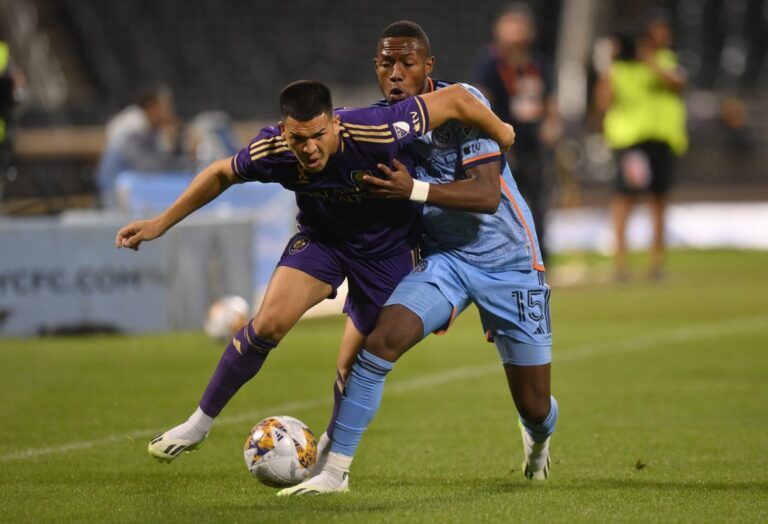
Orlando City clinched a spot in the 2023 MLS Cup playoffs on Wednesday despite falling 2-0 to host New York City FC.
Goals from Mounsef Bakrar and Talles Magno proved the difference for New York (7-10-13, 34 points), as the home side looked the stronger team throughout the night. Orlando City (14-7-8, 50 points) saw their five-game unbeaten run in all competitions end.
Threatening from the early moments, NYCFC nearly found their breakthrough four minutes into the match. Richard Ledezma sent in a cross to Andres Perea at the back post, only for Orlando goalkeeper Pedro Gallese to make a sprawling, one-handed save to force a corner kick.
Bakrar opened the scoring for New York in the 37th minute, heading in a penalty kick rebound after Gallese pushed aside Rodiguez’s spot attempt, following a brief VAR review on a tackle from Orlando’s Ramiro Enrique.
NYCFC extended their lead in the 68th minute as Andres Jasson sent a cross to Magno, who soared over Rodrigo Schlegel to head the ball past Gallese and double the lead.
Ahead of their second goal, NYCFC head coach Nick Cushing was forced to make a change, as Ledezma was taken off on a stretcher due to a tackle on the ankle from Orlando’s Cesar Araujo.
Despite maintaining possession through the later portions of the match, Orlando struggled to string attacks together, finishing the night with just two shots on target and 59.5 possession. In comparison, New York finished with seven shots on target and 40.5 possession.
While Orlando failed to claim any points, DC United’s 1-1 draw against Atlanta United allowed the Lions to clinch a postseason berth with five matches remaining in their regular-season schedule.
Meanwhile, the victory vaulted NYCFC further into playoff contention, bringing them within two points of D.C. United, the ninth-place team in the Eastern Conference and current holder of the final playoff spot.
New York’s Matt Freese made two saves in his clean-sheet victory.
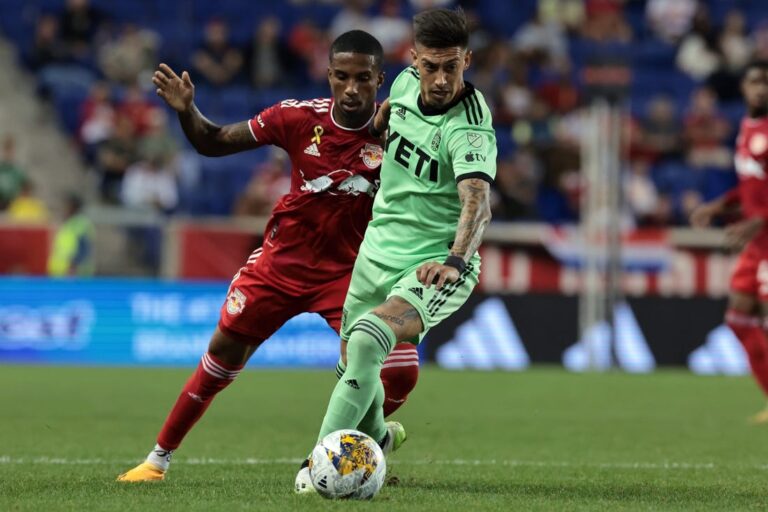
The New York Red Bulls and Austin FC played to a 1-1 draw on Wednesday night in Harrison, N.J. An Austin FC own goal got New York on the board in the seventh minute, and Sebastian Driussi equalized in the 44th minute.
New York (7-12-10, 31 points) is now winless in five straight following back-to-back draws. Austin (9-13-7, 34 points) is without a win in eight consecutive games across all competitions, with their last victory coming against Sporting Kansas City on July 15.
Emiliano Rigoni’s own goal put the Red Bulls on the board. New York’s John Tolkin put a cross into the area on a free kick, and teammate Dante Vanzeir’s strike directed off the Austin FC midfielder and past goalkeeper Brad Stuver.
Rigoni redeemed himself with his corner in the final minute of the opening half. Jhojan Valencia headed the corner across to Driussi, and the Argentine put his header past Carlos Coronel for his team-leading 10th goal of the season.
New York had plenty of opportunity to take control of the game in the first 45.
The Red Bulls controlled the first-half possession and had seven shots in the opening 45 while holding Austin to just a single shot on goal.
Elias Manoel had the Red Bulls’ first quality scoring chance in the 2nd minute but put his strike over the bar. Then, late in the first half, Tolkin had a pair of opportunities, putting a shot over the bar in the 37th minute and then putting his strike wide of the goal in the 41st minute.
Austin FC edged the Red Bulls 4-3 in the only other meeting between the two clubs in July 2022.
Up next, the Red Bulls visit D.C. United on Saturday, while Austin FC host the LA Galaxy on Sunday.
Luciano Acosta scored on a penalty in the seventh minute of second-half stoppage time to help FC Cincinnati secure a 1-1 draw against host CF Montreal on Wednesday.
Cincinnati (17-4-8, 59 points) was awarded the penalty after Montreal goalkeeper Jonathan Sirois took out Dominique Badji on an aerial ball at the top of the 18-yard box. Sirois was shown a yellow card.
Montreal (11-14-4, 37 points) settled for a draw for the second straight match.
It was a quiet first half, with the two sides each recording three shot attempts, none of which were on target.
Junior Moreno had a chance to give the visitors the lead in the 14th minute, curling a shot from distance that went wide of the net.
Cincinnati started to find its game as the half progressed but couldn’t break through. In the 24th minute, Brandon Vazquez brought the ball down low to the right of the goal area, but his pass attempt was blocked by Joel Waterman. Sirois came off his line to snare a pass attempt from Santiago Arias for Aaron Boupendza in the 34th minute.
The visitors came close to breaking the ice in the 41st minute when Arias’ header off a corner by Acosta grazed the right post.
Kwadwo Opoku put Montreal ahead 1-0 in the 53rd minute. Lassi Lappalainen sent a short pass up to Opoku just past midfield, and the 22-year-old hustled up the pitch. Cincinnati midfielder Obinna Nwobodo missed on a tackle and Opoku got above the arc before firing a left-footed strike into the left side of the net.
Cincinnati came within inches of netting the equalizer in the minutes that followed.
In the 59th, Boupendza took a pass from Alvaro Barreal for a header that went over the net. Then, a few minutes after Waterman blocked yet another Vazquez attempt, Yuya Kubo took a feed from Barreal at the top of the 6-yard box, but the ball hit Sirois’ outstretched arm and deflected up and into the crossbar in the 68th minute.
Lionel Messi and Jordi Alba departed with injuries during what might have been a costly 4-0 win for Inter Miami over Toronto FC on Wednesday in Fort Lauderdale, Fla.
Robert Taylor recorded a brace and Facundo Farias and Benjamin Cremaschi also had goals as the Herons (9-15-4, 31 points) moved closer to the Eastern Conference playoff line. However, the bigger-picture focus was on the health of Miami’s star players.
Alba was substituted off in the 35th minute, and Messi left the field two minutes later. Neither player had sustained an obvious injury, but both were in discomfort with apparent lower-body ailments.
Inter Miami coach Gerardo “Tata” Martino said the players came out with muscle fatigue — something that kept both players out of the team’s match against Atlanta United last Saturday. He added that neither player would play Sunday against Orlando City, as the club will evaluate them day by day.
The club was trying to manage the two players’ health and minutes through the Herons’ busy schedule, which includes the U.S. Open Cup final on Sept. 27. Martino said he was unsure if they would play in that contest at Fort Lauderdale.
Miami is 8-0-4 in all competitions with Messi in the lineup, including a 3-0-1 mark in regular-season matches.
Toronto FC (4-15-10, 22 points) lost Victor Vazquez and Brandon Servania to injuries in the first 26 minutes.
All the early stoppages led to nine minutes of extra time in the first half, and Farias struck three minutes into the extended period for his third goal of the season.
Taylor entered the match as Messi’s substitute, then dominated the second half for one of the best performances of his two MLS seasons.
In the 54th minute, Taylor displayed excellent ball control in finding space to shoot from the edge of the box. A chip-pass from Farias set up Taylor’s next goal in the 87th minute, with Taylor converting a shot from a tough angle.
Sandwiched between his two goals, Taylor also earned an assist crossing to Cremaschi in the 73rd minute. It was the second tally of the season for the 18-year-old Cremaschi.
Miami’s Drake Callender made two saves for his fifth shutout of the season. Callender got some help from his goalposts, as Toronto FC’s Lorenzo Insigne and Deandre Kerr each hit the iron.
Toronto is the only MLS team with a winless road record (0-10-4) this season.
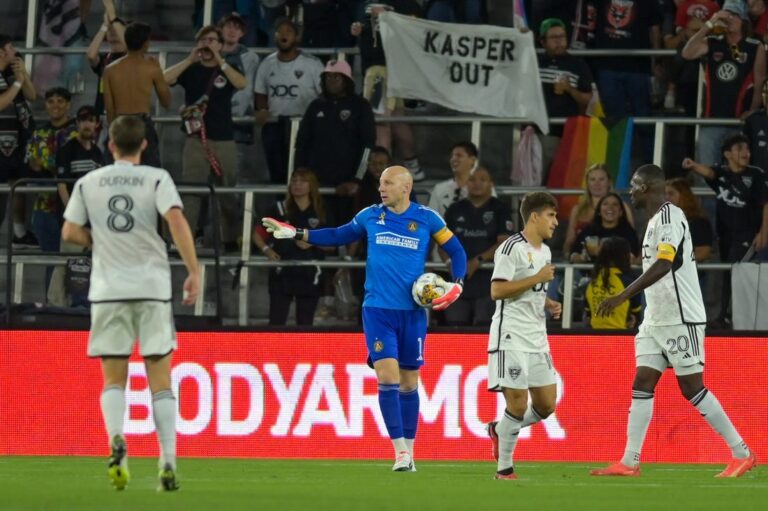
Gabriel Pirani scored in the 80th minute and D.C. United salvaged a 1-1 draw against Atlanta United on Wednesday in Washington to avoid a disastrous result for the hosts’ playoff hopes.
Mateusz Klich contributed his team-leading ninth assist for D.C. (9-12-9, 36 points) on Pirani’s first MLS goal since his arrival on loan from Santos during the secondary transfer window.
The result was D.C.’s third consecutive draw, keeping D.C. narrowly in possession of the ninth and final Eastern Conference playoff berth, two points above New York City FC.
Saba Lobjanidze scored his third goal since his own summer arrival in the game’s early stages early on for Atlanta (12-8-10, 46 points). But the Five Stripes couldn’t build on their early advantage and remained sixth in the East on a night they could have climbed even with New England in fifth.
D.C. thought they would have an opportunity to level the game earlier in the second half when Christian Benteke’s shot struck the triceps of Atlanta defender Luis Abram in the 62nd minute.
But after a lengthy delay, referee Lukasz Szpala overturned the call for an offside violation on D.C. defender Donovan Pines in the buildup.
Instead, Pirani equalized in the 80th minute after Yamil Asad and Klich connected in midfield. Klich’s pass in particular was just a simple square ball, but it played Pirani into space at the top of the 18-yard box where he slotted a low finish past the diving Brad Guzan.
Lobjanidze nearly set up the opener in the 3rd minute when he crossed to Georgios Giakoumakis, whose header struck the near post.
Instead, he was the scorer who put the visitors in front 11 minutes later.
Tyler Wolff did excellent work to press D.C.’s Chris Durkin into a turnover on Atlanta’s left flank, then an early cross into the path of Lobjanidze, The winger hit an excellent first-time shot, opting for precision over power to guide it into the bottom left corner.
Jose Fajardo was involved in most of D.C.’s first-half chances, with his best coming in successive minutes. He skied his 32nd-minute attempt over the bar from a tight angle and then guided an open header wide of the far post in the 33rd.