Post a Free Blog

Submit A Press Release

At CWEB, we are always looking to expand our network of strategic investors and partners. If you're interested in exploring investment opportunities or discussing potential partnerships and serious inquiries. Contact: jacque@cweb.com

Generic selectors
Exact matches only
Search in title
Search in content
Post Type Selectors
Filter by Categories
Action
Animation
Anime
ATP Tour (ATP)
Auto Racing
Baseball
Basketball
Boxing
Breaking News
Business
Business
Business Newsletter
Call of Duty (CALLOFDUTY)
Canadian Football League (CFL)
Car
Celebrity
Champions Tour (CHAMP)
Comedy
CONCACAF
Counter Strike Global Offensive (CSGO)
Crime
Dark Comedy
Defense of the Ancients (DOTA)
Documentary and Foreign
Drama
eSports
European Tour (EPGA)
Fashion
FIFA
FIFA Women’s World Cup (WWC)
FIFA World Cup (FIFA)
Fighting
Football
Formula 1 (F1)
Fortnite
Golf
Health
Hockey
Horror
IndyCar Series (INDY)
International Friendly (FRIENDLY)
Kids & Family
League of Legends (LOL)
LPGA
Madden
Major League Baseball (MLB)
Mixed Martial Arts (MMA)
MLS
Movie and Music
Movie Trailers
Music
Mystery
NASCAR Cup Series (NAS)
National Basketball Association (NBA)
National Football League (NFL)
National Hockey League (NHL)
National Women's Soccer (NWSL)
NBA Development League (NBAGL)
NBA2K
NCAA Baseball (NCAABBL)
NCAA Basketball (NCAAB)
NCAA Football (NCAAF)
NCAA Hockey (NCAAH)
Olympic Mens (OLYHKYM)
Other
Other Sports
Overwatch
PGA
Politics
Premier League (PREM)
Romance
Sci-Fi
Science
Soccer
Sports
Sports
Technology
Tennis
Thriller
Truck Series (TRUCK)
True Crime
Ultimate Fighting Championship (UFC)
US
Valorant
Western
Women’s National Basketball Association (WNBA)
Women’s NCAA Basketball (WNCAAB)
World
World Cup Qualifier (WORLDCUP)
WTA Tour (WTA)
Xfinity (XFT)
XFL
0
Home Blog Page 13554

Freddie Mercury’s family faith: The ancient religion of Zoroastrianism

0

Freddie Mercury’s family faith: The ancient religion of Zoroastrianism – CWEB.com

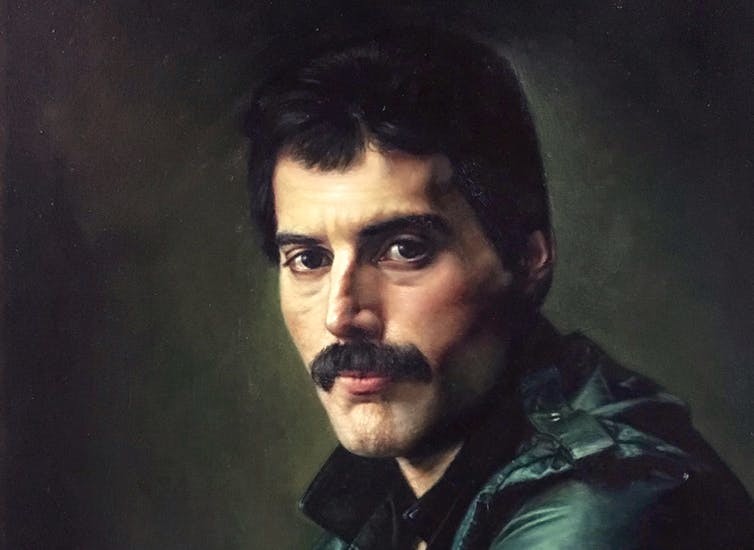
Freddie Mercury, born Farrokh Bulsara, came from a family of Zoroastrians.
atelier nerodimARTE/flickr, CC BY-NC-SA

Vasudha Narayanan, University of Florida

In the Freddie Mercury biopic, “Bohemian Rhapsody,” there’s a scene in which a family member scolds Mercury.

“So now the family name is not good enough for you?”

“I changed it legally,” Mercury responds. “No looking back.”

It might come as a surprise to some that Freddie Mercury was born Farrokh Bulsara. He came from a Parsi family that had roots in India and he was a Zoroastrian by faith.

In the world religion courses I teach at the University of Florida, we discuss Zoroastrianism.

Fleeing religious persecution from Muslims in Persia sometime between the seventh and 10th centuries, the Zoroastrians settled in India, where they came to be called “Parsis.”

Like Freddie Mercury, they worked to integrate into their new surroundings. Yet they also stayed true to the values, beliefs, and practices of their religion, which many scholars say had an influence on Christianity, Islam, and Judaism.

A precursor for Christianity?

The Zoroastrian faith is one of the world’s oldest religions, one that could date back as far as 1200 B.C.

Zoroaster, a prophet who lived in modern-day Iran, is viewed as the founder of Zoroastrianism.

We’re not sure when Zoroaster lived, though some say it was around 1200 B.C. He is thought to have composed the Gathas, the hymns that make up a significant portion of the Yasna, which are the liturgical texts of the Zoroastrians.

According to the Zoroastrian tradition, Ahura Mazda is the supreme lord and creator; he represents all that is good. In this aspect, the religion is one of the oldest examples of monotheism, or the belief in one god.

A glazed tile depiction of the Zoroastrian god Ahura Mazda in the town of Taft, Iran.
A.Davey/flickr, CC BY

The main tenets of the faith center on the opposition between Ahura Mazda and the forces of evil which are embodied by Angra Mainyu, the spirit of destruction, malignancy and chaos. This evil spirit creates a serpent named Azi Dahaka, a symbol of the underworld, not unlike the Biblical serpents of Judeo-Christian traditions.

Within this cosmic battle we see the tension between “asha,” which roughly translates to “truth,” “righteousness,” “justice” or “good things,” and “druj,” or deceit.

Truth is represented by light, and Parsis will always turn to a source of light when they pray, with fire, the sun and the moon all symbolizing this spiritual light.

Indeed, scholars have noted the strong historical influence that Zoroastrianism has had on concepts seen in Judaism, Christianity and Islam, whether it’s monotheism, the duality of good and evil, or Satan

Today Zoroastrianism has a small but devout following, though it’s been shrinking.

In 2004, it was estimated that there were between 128,000 and 190,000 Zoroastrians living around the world, with 18,000 residing in the United States.

Like sugar in milk

The “Qissa e Sanjan,” which translates to “The Story of Sanjan,” was composed around the 17th century. It describes how the Zoroastrians, fleeing religious persecution from Muslim invasions in their Persian homeland many centuries earlier, head to Gujarat, in western India.

Once they arrive, they reach out to the local king, whom they call “Jadi Rana.” He agrees to give them land if they adopt local dress, language and some customs. However there is never any question about religious faith: They still practice their religion, and Jadi Rana is elated that these newcomers worship as they please.

Parsi history has two versions of what took place.

In one, when the Zoroastrian refugees arrived in Gujarat, the king sends them a jar of milk filled to the top — his way of saying that his kingdom is full and there’s no room for any more people. In response, the newcomers stir in a spoonful of sugar and send it back to the king. In other words, not only do they promise to integrate with the local population, but that they’ll also enhance it with their presence.

In the other version, they drop a gold ring into the bowl to show they’ll retain their identity and culture, but they’ll nonetheless add immense value to the region.

These are both compelling narratives, though they make slightly different points. One extols the integration of immigrants, while the other highlights the value of different cultures living together but in harmony.

Parsis in India — and wherever they have gone — have done both. They’ve adopted some of the customs of the land they live in, while maintaining their distinctive culture, religious rituals, and beliefs.

They’ve also made more cultural contributions than the initial wave of refugees to Gujarat could have ever imagined.

Despite their small numbers, Parsis can count a number of famous musicians, scientists, scholars, artists and entrepreneurs among their ranks.

Beyond Freddie Mercury, there’s Zubin Mehta, the director of the Israel Philharmonic Orchestra; Jamshedji Tata, founder of the Tata Group, the largest business conglomerate in India; Dadabhai Naoroji, the first Indian elected to the British Parliament; Harvard professor Homi K. Bhabha; and nuclear physicist Homi J. Bhabha, to name a few.

Freddie Mercury’s family were migrants. Their first home was in India. Then they moved to Zanzibar, before finally settling in England.

Like his ancestors, Freddie Mercury integrated into a new culture. He changed his name, and became a Western pop icon.

Yet through it all, he remained immensely proud of his heritage.

“I think what his Zoroastrian faith gave him,” his sister Kashmira Cooke explained in 2014, “was to work hard, to persevere, and to follow your dreams.”The Conversation

The trailer for ‘Bohemian Rhapsody.’

Vasudha Narayanan, Professor of Religion, University of Florida

This article is republished from The Conversation
A Private War (8/10) Movie Review and Video

0

A Private War (8/10) Movie Review and Video – CWEB.com


by Tony Medley Movie Reviews

Photo Credit Video /Aviron Pictures

Film Distribution /  Aviron Pictures

Runtime 110 minutes.

R

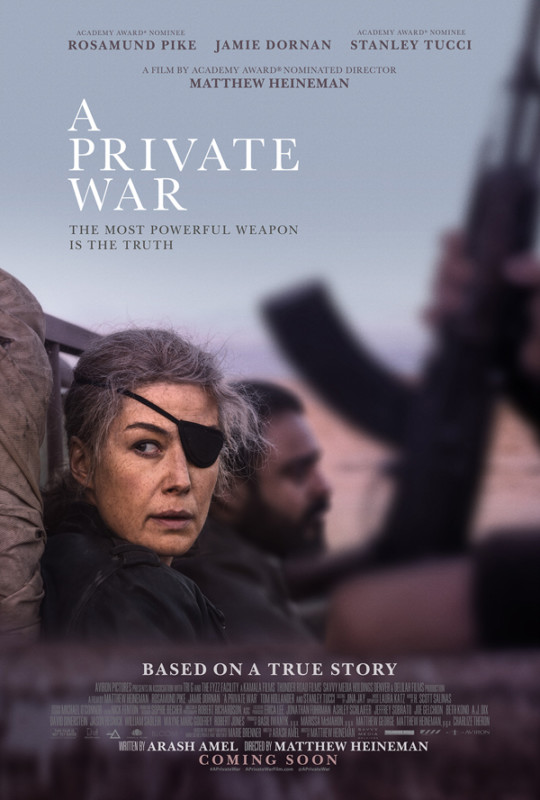
Marie Colvin (Rosamund Pike) was an American expatriate working in London as a war correspondent for The Sunday Times. While working as the first foreign journalist to enter Tamil-held Sri Lanka in six years, she was subject to a bombardment and lost the sight in her left eye.

But she is indomitable and insists that her boss, Sunday Times Editor Sean Ryan (Tom Hollander), send her back into the many frays in the Mideast.

This is no glamour role for the beautiful Pike, as she plays the hard-drinking, hard-smoking, hard-living Colvin to the hilt. In fact, it’s painful to watch what she goes through in this role.

Along the way she hires freelance photographer Paul Conroy (Jamie Dornan) to accompany her on many of her trips. She also falls for businessman Tony Shaw (Stanley Tucci) and begins an affair.

Directed by Matthew Heineman and written by Arash Amel, based on the Vanity Fair article “Marie Colvin’s Private War” written by Marie Brenner, there are a couple of nude scenes that seemed totally unnecessary to me. I’m not sure why they are there because they certainly are not sexy. I’m not even sure that it’s really Pike in the scenes because they are dark and it’s hard to identify who it is. They gain nothing for the movie and nothing would be lost by deleting them.

While the action takes place in Sri Lanka, Iraq, Libya, Afghanistan, and Syria, all the scenes were shot in Jordan.

There is a lot of action and some of the scenes are disturbing. But it seems as if it is a pretty faithful story of a woman who was not normal. In this film she seems drawn to danger like a magnet and used extremely questionable judgment in making decisions. The movie shows her exhibiting the symptoms of suffering from PTSD, which is not unheard of in war correspondents. That’s really the only explanation for why she kept going back.

Maybe the movie wants the viewer to feel admiration for what she did. I thought the risks she took almost foolhardy and, worse, that she disregarded the safety and well-being of those who were supporting her in the danger zones, to their everlasting detriment.

But that’s what makes this a good movie. It tells the story and lets the viewer make its own determination about what it has just seen.

Here’s what Heineman said in a director’s statement about his motivation in making the film, “For me,  A Private War  is a love letter to journalism and an homage to Marie, who risked her life time and time again fighting to tell hard truths. It was deeply important for me to try and also capture Marie’s personal struggle and to examine the demons that plagued her mind. I didn’t want to approach the film as a biopic, but instead, an exploration of the paradoxical swirl of addictions that made Marie brilliant, but also increasingly tortured. She often struggled with the very thing that drove her — Will the world care when her words finally reach them?”

The film ends showing the devastation in Syria, something that the American public hasn’t really seen due to the poor coverage of the truth by the Main Stream Media. This movie is a good counterpoint to director Evgeny Afineevsky’s stunning documentary,  Cries From Syria  (2017), that showed the brutality of the Assad regime and the Russians towards the poor Syrian people; Assad torturing to death innocent Syrian citizens and Russians intentionally bombing hospitals. Both should be seen to realize what’s really going on over there.

Bohemian Rhapsody (9/10) Movie Review and Video

0

Bohemian Rhapsody (9/10) Movie Review and Video – CWEB.com

by Tony Medley Movie Reviews

Photo Credit Video /20th Century Fox

Film Distribution / 20th Century Fox

Runtime 134 minutes

PG-13

We will we will ROCK you!

Who doesn’t know this song by the group Queen?

Freddie Mercury was the lead singer for Queen and was one of the most electric performers ever seen on stage. He had a way and mannerisms all his own. With his buck teeth, skin tight costumes and exuberant energy, he was definitely one of a kind.

Directed by Bryan Singer from a script by Anthony McCarten from a story by McCarten and Peter Morgan, this film perfectly captures Mercury’s flamboyance and Queen’s music that transcended stereotyping and genre identification.

Because of his unique persona and identity, finding someone who could play Freddie without harm to the image was essential to the success of the film. Rami Malek becomes Freddie as much as Freddie could play himself. He looks like him, walks like him, and performs like him.

When biopics are made of iconic singers, I generally prefer that the actor lip-syncs to the real voice, like Larry Parks did with Al Jolson. I always mention how Joaquin Phoenix ruined  Walk the Line  (2006) by insisting the film use his voice instead of Johnny Cash’s. Going into this, that’s the way I felt here, too. But Malek says it was an “amalgamation of voices,” whatever that means. In any event, it is charismatic. No complaints here.

He is aided by a sterling cast, including  Lucy Boynton as Mary Austin,  Gwilym Lee as guitarist Brian May; Ben Hardy   as drummer Roger Taylor; Joe Mazzello as bass guitarist John “Deacy” Deacon; Aidan Gillen as Queen’s first manager John Reid; Tom Hollander as the group’s lawyer-turned-manager Jim “Miami” Beach; Allen Leech as the evil, manipulative Paul Prenter, who started off as Reid’s assistant and became Freddie’s personal manager and lover; Aaron McCusker   as Freddie’s longtime boyfriend Jim Hutton; and Mike Myers as EMI Records’ Ray Foster, apparently a fictional character.

This film captivated me, even though I was not a Queen aficionado. Singer shows Mercury’s mercurial personality, but also his private moments with his girlfriend Mary, along with the disputes that broke up the band as well as the event that brought them back together, ending up with the seminal Live Aid Concert in 1985 with Freddie performing heroically when he was already dying from AIDs.

The climax to the film is the Live Aid concert, and it is marvelous. They recreated the stage used at Wembley Stadium down to the tiniest detail and then expertly wove the actors’ performance into film of the actual concert itself. Here’s how producer Graham King describes what they did:

 “I just lost it. I was in tears. I had never been like that on any movie set before. All the years started flooding back not only to do with this film but being young and watching Live Aid. We knew we had to get it right–the movement, the look, the crowd, it had to be accurate. And it felt right at the very first rehearsal, which was in the first week of filming. We did a lot of takes long into the night, and those four guys, Rami, Gwilym, Ben and Joe, were right inside their characters all the way through. The energy there was so high that no one wanted to stop! We all came together, and we knew we were creating something very special. Live Aid was such an important, precious event that we felt we had to honor it. And from the construction of the set to the music to the atmosphere to the performance, I think we did.”

They did that with the entire movie.


The Guilty (8/10) Movie Review and Video

0

The Guilty (8/10) Movie Review and Video – CWEB.com

by Tony Medley Movie Reviews

Photo Credit Video /Magnolia Pictures

Film Distribution /  Magnolia Pictures

Runtime 84 minutes.

NR

Danish police officer Asger Holm (Jakob Decergren) has been demoted to work as an emergency dispatcher. Then he gets a frantic call from a woman who has been kidnapped. Confined to the police station and anchored to his desk and earphones, Asger tries to help her through calls to and from her and other police bureaus, including his partner.

Brilliantly directed with fine pace and tension by Gustav Moller, this is a spellbinding thriller that never leaves Asger’s desk. Asger has problems of his own, too. It’s hard to believe that watching a man speak on the phone for 84 minutes could be this entrancing.  In Danish.

Why has Halloween become so popular among adults?

0

Why has Halloween become so popular among adults? – CWEB.com

Linus Owens, Middlebury College

Halloween used to be kid stuff. To quit dressing up was an important rite of passage. It meant you were one step closer to becoming an adult.

Not anymore. Today adults have become avid Halloween revelers, especially young adults.

By 2005, just over half of adults celebrated Halloween. Today, that number has grown to over 70 percent. Those between 18 and 34 years old participate at the highest rate, and they’re also the holiday’s biggest spenders, shelling out over twice as much on their costumes as older adults and children.

Halloween celebrations have changed, too: less trick-or-treating and more parties and bar hopping. Today, alcohol is as important as candy to the Halloween economy.

Why has this been happening?

Some blame it on millennials’ refusal to grow up and enter the “real world.”

But that’s too simplistic of an explanation. I’ve been studying how young adults are celebrating Halloween, and what sort of relationship this might have to the changing norms and expectations of adulthood.

Young adults’ embrace of Halloween could have something to do with the fact that adulthood itself has changed.

If Halloween has become more popular among adults, it’s because traditional markers of adulthood have become less clear and less attainable.

Halloween’s shifting meaning

Sociologists tell us if you want to understand a culture, look at its holidays. Christmas gift-giving rituals shed light on how we manage social relationships. Thanksgiving feasts depend on shared understandings of family and national origin stories.

Halloween, with its emphasis on identity, horror and transgression, can tell us about who we want to be and what we fear becoming.

Historian Nicholas Rogers has argued that many of the trends and rituals of the holiday are actually tied to conflicting social values.

For example, urban legends about razor blades in apples in the 1970s reflected cultural anxieties about loss of community and fear of strangers. More recently, debates about skimpy costumes tap into broader concerns about young girls growing up too quickly.

Halloween has also been a holiday embraced by those who were not full members of society. More than a century ago, Irish immigrants, who brought their Halloween traditions with them to America, used the celebration to strengthen community ties.

Initially, their Halloween traditions set them apart. But as they assimilated, they spread the holiday to the rest of the country. By the 1950s, it had become a night for children. Later, gays and lesbians carved out Halloween as a space where their differences could be celebrated not stigmatized.

The ‘emerging adult’ and the space between

Today’s young adults, it could be argued, are living in a sort of purgatory.

Traditional markers of adult responsibility and independence — family, career, home ownership — have either been delayed or abandoned altogether, by choice or necessity. Transitions to adulthood have become uncertain, drawn out and complicated.

In recent years, psychologists and sociologists have coined a term for this transitional life stage, which usually spans someone’s 20s and 30s: “emerging adulthood.”

According to these experts, features of emerging adulthood can include identity exploration, focus on the self and a feeling of being caught between two worlds. There’s also a sense of wonder and possibility.

Others have a less rosy view of emerging adulthood, describing it as a time of fear and anxiety about an unknowable future.

Millennial monsters

So why might an emerging adult be drawn to Halloween?

Most obviously, Halloween costumes let them experiment and explore self and identity. The possibilities are endless. Witch? Robot couple? Sexy Robot? Emoji? Banksy’s shredded art?

Young adults I’ve spoken with often identify this as their favorite part of the holiday — the chance to be, at least for a night, whatever they wish to be.

Costumes are identity work, but they are also just plain work. That matters in a world in which many young adults are stuck in unfulfilling jobs.

Cultural critic Malcolm Harris argues that young adults — despite being highly educated and hardworking compared to older cohorts — rarely find jobs matching their credentials and abilities.

During Halloween, hard work and creative thinking matter. For example, costume contests, in bars or online, provide opportunities for people to construct costumes that meld humorous or timely cultural references with craft skills. You can do more than simply participate in Halloween; you can “win it” with the best costume.

And young adults don’t do it alone. Some have told me that they’ll test out different costumes on social media to see which gets the best response. Others will look to others online for inspiration.

In this way, Halloween meshes with modern networked culture, in which young adults are using social media to navigate the world and make choices. Sociologists have found that many young adults build “collaborative selves” by continuously looking to others online to reinforce and evaluate their identities.

Halloween has always promised the chance to be creative and to become something else.

But in embracing the holiday, emerging adults are doing more than reject traditional adulthood. They’re playing with identity in a way that puts their skills and cultural competence to work. They’re defining new ways to be — and become — an adult. And in the process, they’ve changed the way Halloween is celebrated.The Conversation

Linus Owens, Associate Professor of Sociology, Middlebury College

This article is republished from The Conversation

E-cigarettes and a new threat: How to dispose of them

0

E-cigarettes and a new threat: How to dispose of them – CWEB.com

A discarded Juul on the floor of a San Francisco streetcar March 20, 2018.
Julia McQuoid, CC BY-SA

Yogi H. Hendlin, University of California, San Francisco

The two largest global brands of capsule coffee, Nespresso and Keurig, are regarded by many as environmental nightmares. Billions of the throwaway nonrecyclable plastic products currently clutter waste dumps, waterways and city streets. Both inventor of the “K-cups” John Sylvan and former Nespresso CEO Jean-Paul Gaillard have publicly bemoaned the environmental consequences of the products they once championed. Sylvan has stated that the disposable (but not biodegradable) coffee capsule is “like a cigarette for coffee, a single-serve delivery mechanism for an addictive substance.”

The comparison between cigarette butts and capsule coffee is surprisingly fitting. Both butts and capsules are intentionally designed to be convenient, single-use products. Both are also nonbiodegradable and unrecyclable. As pervasive and polluting as cigarette butts are, however, the e-waste from e-cigarettes presents an even more apt comparison.

As a postdoctoral researcher at the Center for Tobacco Control Research and Education at the University of California, San Francisco with a background in environmental philosophy and public health, I became curious how the waste stream of e-cigarettes has passed completely outside the regulatory radar.

A smoking gun?

San Francisco’s Pax Labs, maker of the market-leading electronic cigarette (e-cigarette) Juul, thinks of its product as a “Nespresso machine, if Nespresso still made great coffee.” It also describes its e-cigarette as a “gun.”

The product has soared in popularity, particularly among teenagers, leading Dr. Scott Gottlieb, commissioner of the Food and Drug Administration, in September 2018 to call Juul smoking among teens an epidemic.

While the health outcomes for e-cigarette vapor versus an inveterate capsule coffee drinker vary greatly, both “disruptive” products present lingering harms to the environment greater than the products they replace.

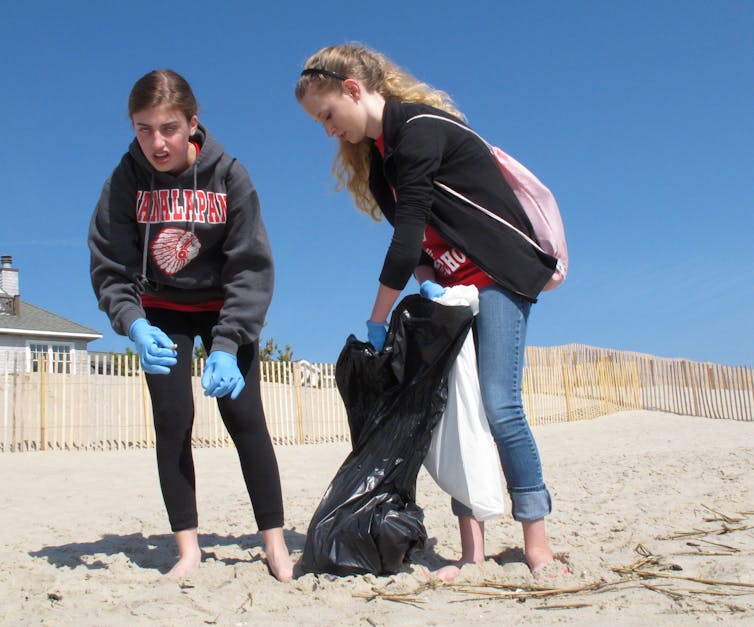
Volunteers pick up cigarette butts at Point Pleasant Beach, New Jersey, on Oct. 12, 2012.
Michael Parry/AP Photo

The legacy of cigarette butts imparts a dark story. An estimated two-thirds of cigarette butts are littered, clogging sewer drains, blighting city parks and contributing to estimated cleanup costs of US$11 billion yearly for U.S. litter alone. Cigarettes are environmentally irresponsible by design, and yet e-cigarettes pose an environmental threat of considerable proportions. Instead of merely being thrown away, these complex devices present simultaneously a biohazard risk with potential high quantities of leftover or residual nicotine and an environmental health threat as littered electronic waste.

Their endocrine-disrupting plastics, lithium ion batteries and electronic circuit boards require disassembly, sorting and proper further recycling and disposal. Their instructions do not say anything about disposal. Electronic waste (e-waste) already presents a daunting environmental quandary and is notoriously difficult to recycle. When littered, broken devices can leach metals, battery acid and nicotine into the local environment and urban landscape.

A preventable environmental health disaster

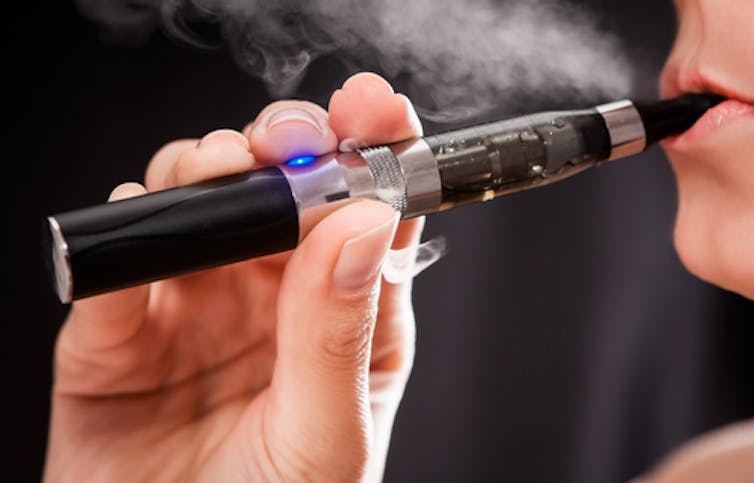
E-cigarettes remain controversial because of the inability to know whether they are a gateway to cigarette smoking. One thing is clear: They are an environmental threat.
RedPixel.pl/Shutterstock.com

A main question public health regulators must face is: How are these new devices being disposed of? Are e-cigarettes being thrown away carelessly, like cigarette butts? Or disposed of in special electronic waste facilities, like smartphones? Preliminary results from litter pickups give mixed results. Juul pods are found routinely littered, especially where young people congregate. But because of the double-bind of e-cigarette waste being both electronic waste due to the components and hazardous waste due to the nicotine liquid residue, currently there is no legal way to recycle them in the U.S. The Office on Smoking and Health and the EPA need to coordinate their regulations to allow for the safe recycling and waste minimization of these products.

More than 58 million e-cigarette products were sold in the U.S. (not including those sold in vape shops or online) in 2015, 19.2 million of which were disposable e-cigarettes. A 2014 study found that none of the surveyed e-cigarette packages contained disposal instructions.

The major transnational tobacco companies so far primarily sell throwaway, one-use “closed” system products. Vuse and MarkTen, owned by Reynolds American and Altria, respectively, are two leading U.S. e-cigarettes, and both are closed systems. While these products may prevent nicotine poisoning in small children, their environmental health harms may be significantly larger due to their expendable design.

Most independent vaporizer manufacturers sell open, or reusable, systems, which are more popular with longer-term users and possibly more effective to quit than traditional cigarettes. In other markets, however, like the U.K. and Japan, transnational tobacco companies British American Tobacco (BAT) and Japan Tobacco International have begun to heavily market open systems.

BAT’s website on the disposal of their Vype e-cigarette warns “electrical waste and electronic equipment can contain hazardous substances which, if not treated properly, could lead to damage to the environment and human health.” So neither open nor closed systems are environmentally sustainable.

The World Health Organization, in its report Tobacco and Its Environmental Impact: An Overview, recently noted the “quieter but shockingly widespread impacts of tobacco from an environmental perspective.” Article 18 of the WHO Framework Convention on Tobacco Control states that all signatory parties “agree to have due regard to the protection of the environment and the health of persons in relation to the environment in respect of tobacco cultivation and manufacture within their respective territories.” It is time to close the loop and pay increased attention to tobacco product disposal as well.

As regulatory agencies continue deciding how to regulate e-cigarettes, not only should the immediate health effects and secondhand effects of the products be taken into account, but I believe the environmental effects of these products should be too.

The mounting environmental impact of the single-use nonrecyclable coffee fad has left coffee capsule Keurig inventor John Sylvan regretting his invention. Will apocryphal e-cigarette inventor Hon Lik ever have a similar reckoning regarding the mountains of e-cigarette e-waste? Let’s hope it never gets to that point.The Conversation

Yogi H. Hendlin, Postdoctoral Research Fellow in Public Health Policy, University of California, San Francisco

This article is republished from The Conversation

Why washing your hands well is so important to protect your family from the flu

0

Why washing your hands well is so important to protect your family from the flu – CWEB.com

One-year-old Kilian Doherty being prepared for a chest X-ray Feb. 9, 2018 to determine if he had flu.
David Goldman/AP Photo

Michelle Sconce Massaquoi, University of Oregon

During my second year of graduate school, I moved in with my sister’s family to save money. “You must get the flu shot if you are going to live here,” my sister declared. Both of my nieces were under the age of 5, putting them at a high risk of flu complications; therefore, it was critical that I do my part in, first, getting vaccinated to minimize my risk of getting the flu, and second, not passing the flu to a vulnerable population. A key part of this was, and still is, washing my hands regularly.

This is serious business. The Centers for Disease Control and Prevention estimates that more than 900,000 people were hospitalized from the flu last season and more than 80,000 people died in the U.S. As the flu season approaches, it’s important to marshal all our defenses against influenza.

As someone who has a history of fainting after shots, including an experience that resulted in multiple stitches just shy of my temple, I understand high anxiety when it comes to needles. But in the evenings when my 4-year-old niece is looking at the intriguing images within my microbiology textbook and asks with each turn of page, “Auntie Chelle, what’s that?” I couldn’t fathom putting her at a higher risk of the flu or any sickness by not getting vaccinated or not washing my hands regularly.

How does the flu virus spread?

The flu virus spreads by droplets made from a cough, sneeze or talk of people who are infected. These droplets can land within the mouths, lungs or noses of people up to 6 feet away. Heavily populated places, such as schools or airports, could increase the transmission of the virus and put people at higher risk of getting the flu. It’s also possible to get the flu by touching a surface, such as chairs, tables or door handles that has flu virus on it and then touching your own mucous membranes in your mouth, nose or eyes. A behavioral study of medical students at the University of New South Wales found that of the 26 participants, students touched their face an average of 23 times per hour and 44 percent of the time it was in contact with a mucous membrane.

With flu season ahead of us and also our holiday travels, do we really stand a chance of preventing the spread of the flu and other germs by keeping our hands clean? Yes, but it takes some work.

Two-fisted approach

There are two main strategies in hand washing.

The first is to decrease the overall biomass of microbes — that is, decrease the amount of bacteria, viruses and other types of microorganisms. We do this by lathering with soap and rinsing with water. Soap’s chemistry helps remove microorganisms from our hands by accentuating the slippery properties of our own skin.

Studies have shown that effectively washing with soap and water significantly reduces the bacterial load of diarrhea-causing bacteria.

Washing hands with warm soap and water is the best way to keep your hands clean.
r.classen/Shutterstock.com

The second strategy is to kill the bacteria. We do this by using products with an antibacterial agent such as alcohols, chlorine, peroxides, chlorhexidine or triclosan.

Some academic work has shown that antibacterial soaps are more effective at reducing certain bacteria on soiled hands than soaps without them.

However, there’s a problem. Some bacterial cells on our hands may have genes that enable them to be resistant to a given antibacterial agent. This means that after the antibacterial agent kills some bacteria, the resistant strains remaining on the hands can flourish.

Further, the genes that allowed the bacteria to be resistant could pass along to other bacteria, causing more resistant strains. Together, the “take-over” of resistant strains would render the use of the antibacterial agent essentially ineffective.

Also, the long-term use of some antibacterial products may harm your health.

For example, animal studies investigating the antibacterial agent triclosan, which used to be in soaps, toothpastes and deodorant, has been shown to alter the way hormones work in the body. The Food and Drug Administration has prohibited the use of over-the-counter antiseptic wash products containing triclosan and many other antibacterial active ingredients.

Nonetheless, the flu is caused by a virus, rendering products with antibiotics useless.

With this in mind, you may want to stick with plain old soap and water.

Best practices

Kids traveling during the holidays often have a hard time keeping their hands clean, just as adults do.
NadyaEugene/Shutterstock.com

To clean our hands, the CDC recommends that we:

  • wet hands with clean water
  • apply soap and lather/scrub every nook and cranny of your hands for 20-30 seconds (about the time to sing “Happy Birthday” twice)
  • rinse well with clean running water
  • dry hands with a clean paper towel or air-dry.

I was shocked to read a study that indicated that 93.2 percent of 2,800 survey respondents did not wash their hands after coughing or sneezing. Also, one study showed that across a college-town environment with observations of 3,749 people, the average hand-washing time was approximately six seconds.

If soap and water are not unavailable, the CDC recommends using an alcohol-based hand sanitizer that contains at least 60 percent ethanol. Alcohols have a broad-spectrum of antimicrobial activity and are less selective for bacterial resistance compared to other antibacterial chemicals.

However, alcohol-based hand sanitizers may not work on all classes of germs.

So what is the take-home message?

There is no doubt that washing our hands with liquid soap and water is effective in reducing the spread of infectious microorganisms, including those that are resistant to antimicrobial agents.

When you don’t have the opportunity to wash your hands after touching questionable surfaces, use an alcohol-based hand sanitizer. Limit the touching of your hands to your mouth, nose and eyes.

Further, build additional protection against pathogens via maintaining a balanced gut-bacteria community by “fertilizing” them with a diversity of plant-based foods.

It’s not only a small world, but a dirty one as well.

Editor’s note: This is an updated version of an article that originally was published Dec. 13, 2017.The Conversation

Michelle Sconce Massaquoi, Doctoral candidate, microbiology, University of Oregon

This article is republished from The Conversation

The Mega Millions jackpot is now more than $1 billion — where does all that lottery profit really go?

0


The Mega Millions jackpot is now more than $1 billion — where does all that lottery profit really go? – CWEB.com

Liberty Vittert, Washington University in St Louis

The Mega Millions jackpot drawing on Oct. 23 has soared to US$1.6 billion.

In the middle of the 20th century, when lotteries first started in the U.S., they were sold to states as a way to benefit the American public. That suggests that bigger and bigger jackpots should mean more tax dollars to spend on public services like education. But that isn’t happening. So what’s really going on?

First, let’s look at how lottery jackpots got so big. This particular jackpot started at $40 million in July, and week after week, no one drew the winning numbers, but the tickets keep getting bought.

You too have the chance to win the biggest Mega Millions jackpot ever with the simple purchase of a $2 ticket. However, your chances are pretty slim. With a 1 in 300 million chance of picking the matching numbers, you are three times more likely to be killed by a vending machine. An easier way to really wrap your head around your chances: It’s like flipping a coin and getting heads 30 times in a row.

About half of Americans play the lottery today, compared to almost 70 percent in the 1980s. That means the lottery needs to extract more money from fewer people — a worrying trend for lottery runners.

Mega Millions decided to decrease each person’s chances of winning, in order to grow the jackpots bigger. Before 2017, players picked five numbers between 1 and 75 and then one number between 1 and 15. Now, each player now picks five numbers between 1 and 70 and then one number between 1 and 25. This increases your chances of matching five numbers and receiving some sort of prize, while decreasing your chances of winning the whole shebang. What’s more, the price of a ticket has doubled.

Apparently, as the jackpot gets bigger, more people are willing to buy a ticket. So the jackpots are getting bigger and people are spending more money — to the tune of $223 per year by the average American, according to a survey by online marketplace LENDedu.

Mega Millions profits are split between 46 lottery jurisdictions — 44 states, D.C. and the U.S. Virgin Islands. Overall, 27 states earmark some or all lottery revenue for education. In D.C., the lotto dollars go to a general fund; in Colorado, the funds go environmental protection; and in Kansas, some of the money pays for juvenile detention facilities.

The lottery was promoted as a way to create more money for education — but most state legislatures haven’t been using the money as additional funding. Instead, they use the lottery money to pay for the education budget, spending the money that would have been used on education if there wasn’t a lottery budget on other things. As a result, public schools rarely get a budget boost.

An April study from the North Carolina Center for Public Policy Research showed that many states — including California, Florida and Michigan — simply substitute lottery revenues for normal appropriations. As of 2016, North Carolina devoted a smaller portion of its total budget to education than it did before starting the lottery.

With states like New York getting $3.3 billion in revenue from the lottery in 2016, that is a pretty darn big bait and switch.

This doesn’t necessarily mean that it’s time to ax the lottery. But it does beg the question: Is lottery money a good thing for a state? It does fund some government services, but it isn’t always clear what. And the harm of gambling addiction must be taken into account somehow.

For now, I’m off to buy a ticket for this Mega Millions jackpot. I mean, someone’s gotta win…The Conversation

Liberty Vittert, Visiting Assistant Professor in Statistics, Washington University in St Louis

This article is republished from The Conversation under a Creative Commons license.

Sears Chief Restructuring Officer Mohsin Meghji Will Change The Company Around

0

Sears Chief Restructuring Officer Mohsin Meghji Will Change The Company Around – CWEB.com

Newly appointed Sears    Sears (NASDAQ:SHLD)

Chief Restructuring Officer Mohsin Meghji Will Change The Company Around

Mr.Mohsin Meghji is a former Arthur Andersen workout consultant and a founder of M-III Partners.

As managing partner at M-III, a New York-based merchant banking and advisory firm, Meghji is a nationally recognized turnaround professional with an exemplary track record in a wide range of industries. He focuses on maximizing value by taking on management and/or advisory roles in partnership with some of the world’s leading financial institutions, private equity and distressed hedge fund investors.

Meghji serves as chairman of the board of directors of Infrastructure & Energy Alternatives, Inc. (NASDAQ:IEA), a leading infrastructure construction company with specialized renewable energy and heavy civil expertise. Listed on the NASDAQ stock exchange, IEA became a public company through a merger with a special-purpose acquisition company sponsored by M-III.

Prior to founding M-III in late 2014, he was executive vice president and head of strategy at Springleaf Holdings, LLC, and CEO of its captive insurance companies. A portfolio company of Fortress Investment Group, Springleaf was listed on the NYSE in 2013.

He is also on the board of Children’s Museum of Manhattan, Inc., bioAffinity Technologies, Inc. and Equity Group International Foundation and Managing Partner at M-III Partners LLC.
In the past Mohsin Y. Meghji was Managing Director & Principal at Loughlin, Meghji & Co., Partner at Global Corporate Finance, Executive Vice President & Head -Strategy at OneMain Holdings, Inc. Chief Executive Officer at Yosemite Insurance Co. Chief Executive Officer for Merit Life Insurance Co. and Executive Vice President & Head-Strategy at Springleaf Finance, Inc. (which are all subsidiaries of OneMain Holdings, Inc.), Partner-Global Corporate Finance Group at Arthur Andersen LLP, Chairman & Chief Executive Officer of M III Acquisition Corp. and Senior Managing Director at C-III Capital Partners LLC.
Mr. Meghji received an undergraduate degree from The Schulich School of Business.

  • Sears Holdings Corporation (“Holdings,” “we,” “our,” or the “Company”) (NASDAQ:  SHLD) today announced that the U.S. Bankruptcy Court for the Southern District of New York (the “Court”) granted interim approval of all the Company’s first day motions related to its voluntary Chapter 11 restructuring.
  • Collectively, the approvals by the Court immediately improve the Company’s liquidity position and allow Holdings to continue its business operations throughout the financial restructuring process.
  • “The Court’s approval of our First Day motions is an important step forward in our financial restructuring process that will allow the Company to continue operating in the normal course and providing our customers and members with trusted service,” said Robert A. Riecker, Chief Financial Officer, and member of the Office of the Chief Executive.

In connection with today’s announcement that Sears Holdings Corporation and certain of its subsidiaries (“Sears”) have filed for bankruptcy protection, Tempur Sealy International, Inc. (NYSE:  TPX) is disclosing its credit exposure and sales volume related to Sears. Sears represented less than 5% of the Company’s global net sales and less than $5 million of its accounts receivable exposure as of September 30, 2018.

Tempur Sealy International, Inc. Chairman and CEO Scott Thompson commented, “Our products are broadly distributed across many channels so consumers can choose where and how they wish to shop. We continue to work closely with Sears during their restructuring process while managing our related financial and operational risks.”

CWEB Analysts have Reiterate a Buy Rating for Sears (NASDAQ:SHLD) Corporation.


First Man Movie Review and Video (5/10)

0

First Man Movie Review and Video (5/10) – CWEB.com

by Tony Medley Movie Reviews

Photo Credit Video /Universal Pictures

Film Distribution /  Universal Pictures

Runtime 138 minutes

PG-13

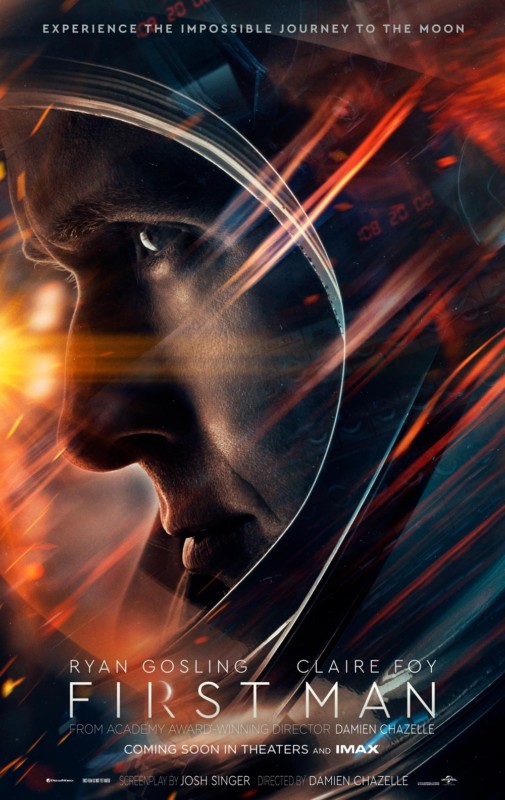
Who knew? According to this depressing film, nobody in the astronaut program was happy. Neil Armstrong (Ryan Gosling; if they ever make a movie about Lee Harvey Oswald, Gosling is a dead ringer for him) was mourning his infant daughter who had died and it’s almost all he could think about. His wife Janet (Claire Foy, in a fine performance) was supportive of his effort, but there’s a scene the night Neil is leaving for his expedition to the moon when she confronts him and asks, “You might not come back, right?” as if this is something that just occurred to her, even though he had been in training for years.

Let’s see, nobody has ever gone to the moon; Neil is about to make the attempt. Three astronauts had just died two years before testing the capsule. He’s going into outer space for an eight day trip to the moon and trying to land where it’s never been done and if there’s any kind of a mishap, he’s dead. And she just realized that there was a chance that he might not return? This really happened the night he is leaving to take the trip? I know that director Damien Chazelle made a movie called “La La Land,” but this scene, if accurate, indicates that Janet had been living in La La Land all the while. That said, I don’t believe the scene for a second.

I found this movie long, depressing, and black, projecting very little feeling for the enormous accomplishment. Immensely disappointing are the promised scenes of the moon in IMAX. There are only a few shots of the moonscape and they were made at a quarry in Atlanta.

The special effects of the blastoff and the few scenes inside the space capsule are well done, as is the fire that killed astronauts Gus Grissom (Shea Whigham), Ed White (Jason Clarke) and Roger Chaffee (Cory Michael Smith) in 1967.

While the film shows a few scenes of the astronaut training (one is very good) it doesn’t show nearly enough of what they had to go through. Mostly it’s a film about Neil and Janet and it is long, slow and fails to adequately capture the tension and danger of putting together a try to get to the moon.

There is one iconic picture that everyone remembers about Armstrong’s landing and that’s the one of the American flag on the moon. The filmmakers (and Gosling) didn’t want anything like that in the film apparently because it gives credit to America. But this was an American triumph, not a triumph of an American man. Christopher Columbus could take credit for the discovery of America because he put the whole thing together; the idea (finding a route to India), the financing, the ships, the crew, the voyage; it was a one man show.

But according to Zack Sharf of Indie Wire, at the Venice Film Festival, “Gosling said the moon landing ‘transcended countries and borders’ and the filmmaking team did not want to ruin their film’s subjectivity by making a political statement.”

This is ignorant Hollywood elitist nonsense. The filmmakers made a political statement by  omitting  the picture.

Armstrong was an employee. The idea of going to the moon before the end of the ‘60s was fostered by President Kennedy in 1961 and 1962, and did not “transcend countries and borders.” The American taxpayers paid the freight and the American government contributed the science and the hardware. Armstrong was merely a cog (albeit an important one) in a huge wheel. Not having the scene of the American flag is a slap in the face of all Americans who take pride in their country for this triumph.

In case you doubt this, both director Chazelle and writer Josh Singer are contributors to the Democratic Party and Obama supporters who do not believe in American Exceptionalism, so clearly want to eliminate any praise for good the country has achieved.

I don’t make any excuses for pointing out the political biases of filmmakers because if they use art as a weapon for their political beliefs, which they have done since they were Communists beginning in the ‘30s, their motives should be revealed so the audience can take what they see for what it’s worth which, as epitomized by Gosling’s puerile statement, isn’t much.

Sure, the movie is about Armstrong, but to eliminate this scene is a huge disrespect that detracts greatly from the film. Armstrong did, in fact, plant the flag and take the picture of Buzz Aldrin saluting it. Obviously this iconic photograph was important to him and should be an essential part of any meaningful biopic about him.

But that’s not the sole reason the movie miscarries. It completely fails to provide an iota of a reason why Armstrong was chosen to be the First Man. Gus Grissom was originally tabbed for that role, but he perished.   Chazelle provides no evidence that Armstrong was a standout leader, or that he had accomplished extraordinary tasks, or that he had a compelling personality like John Glenn. Indeed, the movie shows just the opposite; he comes across as parochial, plodding and depressed. Why was Neil Armstrong chosen to be the first man on the moon? Given his bland credentials, why is he the subject of a major movie? Who knows? Maybe, giving Chazelle credit, that’s the point of the movie. If so, I still found it slow and lackluster.

The true heroes of the moon landing were the engineers who figured out how to do it, how to televise it live to the entire world, and how to bring them back safely. That’s a movie I’d like to see.