Post a Free Blog

Submit A Press Release

At CWEB, we are always looking to expand our network of strategic investors and partners. If you're interested in exploring investment opportunities or discussing potential partnerships and serious inquiries. Contact: jacque@cweb.com

Generic selectors
Exact matches only
Search in title
Search in content
Post Type Selectors
Filter by Categories
Action
Animation
Anime
ATP Tour (ATP)
Auto Racing
Baseball
Basketball
Boxing
Breaking News
Business
Business
Business Newsletter
Call of Duty (CALLOFDUTY)
Canadian Football League (CFL)
Car
Celebrity
Champions Tour (CHAMP)
Comedy
CONCACAF
Counter Strike Global Offensive (CSGO)
Crime
Dark Comedy
Defense of the Ancients (DOTA)
Documentary and Foreign
Drama
eSports
European Tour (EPGA)
Fashion
FIFA
FIFA Women’s World Cup (WWC)
FIFA World Cup (FIFA)
Fighting
Football
Formula 1 (F1)
Fortnite
Golf
Health
Hockey
Horror
IndyCar Series (INDY)
International Friendly (FRIENDLY)
Kids & Family
League of Legends (LOL)
LPGA
Madden
Major League Baseball (MLB)
Mixed Martial Arts (MMA)
MLS
Movie and Music
Movie Trailers
Music
Mystery
NASCAR Cup Series (NAS)
National Basketball Association (NBA)
National Football League (NFL)
National Hockey League (NHL)
National Women's Soccer (NWSL)
NBA Development League (NBAGL)
NBA2K
NCAA Baseball (NCAABBL)
NCAA Basketball (NCAAB)
NCAA Football (NCAAF)
NCAA Hockey (NCAAH)
Olympic Mens (OLYHKYM)
Other
Other Sports
Overwatch
PGA
Politics
Premier League (PREM)
Romance
Sci-Fi
Science
Soccer
Sports
Sports
Technology
Tennis
Thriller
Truck Series (TRUCK)
True Crime
Ultimate Fighting Championship (UFC)
US
Valorant
Western
Women’s National Basketball Association (WNBA)
Women’s NCAA Basketball (WNCAAB)
World
World Cup Qualifier (WORLDCUP)
WTA Tour (WTA)
Xfinity (XFT)
XFL
0
Home Blog Page 13378

When a mom feels depressed, her baby’s cells might feel it too

0

motherbaby

When a mom feels depressed, her baby’s cells might feel it too – CWEB.com

File 20180116 53307 epjvhk.jpg?ixlib=rb 1.1
At just 18 months old, young children can show biological evidence of added stress.
Coy_Creek/shutterstock.com

Benjamin W. Nelson, University of Oregon; Heidemarie Laurent, University of Illinois at Urbana-Champaign, and Nick Allen, University of Oregon

An estimated 1 in 9 women experience symptoms of postpartum depression. These symptoms — including mood swings, fatigue and reduced interest in activities — can make it difficult for mothers to bond with their newborns.

Early relationships between mothers and their infants can influence health across the lifespan, for better or worse. For example, adults who report more household dysfunction and abuse during their childhood are more likely to suffer disease as adults. Those with healthy and supportive relationships during early life are better at handling stress and regulating their emotions.

However, scientists do not completely understand how these environments get “under the skin” to shape health. Our latest paper, published in November, shows a possible link between increasing depression symptoms in mothers and cellular damage in their infants.

Telomeres and health

How does stress affect our cells? One area of burgeoning research focuses on telomeres.

The 46 human chromosomes are shown in blue, with the telomeres appearing as white pinpoints.
NIH Image Gallery, CC BY-NC

Telomeres are caps at the end of our DNA that protect chromosomes. They’re analogous to the plastic tips at the end of shoelaces that keep laces from unraveling. In essence, these plastic caps keep laces functional. The same can be said of your telomeres.

Since the length of telomeres is affected by our genetics and age, they’re sometimes thought of as part of a “biological clock” that reflects the age of our cells. As telomeres shorten over time, people are more likely to experience a host of negative health outcomes, such as cardiovascular disease, dementia, diabetes, cancer, obesity and even death.

Interestingly, telomeres can degrade more quickly when a person suffers from psychological stress. When we experience stress, our bodies release a hormone called cortisol, which influences our emotional responses as well as our energy metabolism, learning and memory. This may be one mechanism that connects psychological stress to telomere length and ultimately physical health. Cells that are exposed to cortisol have shorter telomeres and less telomerase, which is the enzyme responsible for maintaining the ends of telomeres.

This process may explain how psychological stress is converted to biological “wear and tear.” Indeed, adolescents with depressed mothers have heightened cortisol stress responses and shorter telomeres than their peers, even when the adolescents themselves are not depressed.

Our study

We examined whether increasing maternal depressive symptoms affected infant stress and later cell health.

Infancy is a sensitive period, when individuals are strongly influenced by their environment. One way to study how early stress may influence health is to look at how infants respond to their parents’ stress. Studies suggest that infants exposed to maternal depression may be less likely to engage socially and experience more negative emotion.

For our study we recruited 48 mothers with 12-week-old infants and followed these families until the infants were 18 months old. At 6 and 12 months of age, the infants were brought to the lab to engage in mildly stressful tasks. For example, in the “still face experiment,” mothers alternated between playing with their infant and not reacting to their infant’s bids for attention. This can elicit stress in infants, as they rely on their caregivers to not only feed them, but to also soothe their emotions.

An example of the ‘still face experiment.’

During each visit, we measured infants’ stress by collecting saliva samples to look at changes in cortisol. We also collected information on how many depression symptoms mothers were feeling. Finally, when the infants were 18 months of age, we brought the families back into our lab and collected saliva to measure the length of the infant’s telomeres.

Worsening depression symptoms in mothers related to greater infant cortisol stress responses between 6 and 12 months of age. In addition, infants with higher cortisol stress responses were more likely to have shorter telomeres at 18 months of age, indicating greater cellular wear and tear.

Better mental health

While these findings are preliminary and should be replicated with a larger group of infants, our results highlight how patterns of health across the lifespan may be influenced in the first 18 months of life. This early stress may put young children on track for the early onset of poor health outcomes.

The silver lining is that infancy is a sensitive developmental period, when humans are especially responsive to their environments. Fostering positive experiences between infants and their mothers — as well as providing affordable, scientifically supported treatment services for mothers experiencing depression — may allow infants to move toward a healthier life trajectory.

The ConversationIn our view, these results show how important it is to fund effective maternal mental health treatment and early childhood policies.

Benjamin W. Nelson, Doctoral Student in Clinical Psychology, University of Oregon; Heidemarie Laurent, Assistant Professor of Psychology, University of Illinois at Urbana-Champaign, and Nick Allen, Ann Swindells Professor of Clinical Psychology, University of Oregon

This article was originally published on The Conversation.


Your next hearing aid could be a video game

0

hearingaid

Your next hearing aid could be a video game – CWEB.com

File 20180119 110117 rsu0ky.jpg?ixlib=rb 1.1
Video games can help train the brain to hear better.
Monika Wisniewska/Shutterstock.com

Dana Boebinger, Harvard University

Roughly 15 percent of Americans report some sort of hearing difficulty; trouble understanding conversations in noisy environments is one of the most common complaints. Unfortunately, there’s not much doctors or audiologists can do. Hearing aids can amplify things for ears that can’t quite pick up certain sounds, but they don’t distinguish between the voice of a friend at a party and the music in the background. The problem is not only one of technology, but also of brain wiring.

Most hearing aid users say that even with their hearing aids, they still have difficulty communicating in noisy environments. As a neuroscientist who studies speech perception, this issue is prominent in much of my own research, as well as that of many others. The reason isn’t that they can’t hear the sounds; it’s that their brains can’t pick out the conversation from the background chatter.

Harvard neuroscientists Dan Polley and Jonathon Whitton may have found a solution, by harnessing the brain’s incredible ability to learn and change itself. They have discovered that it may be possible for the brain to relearn how to distinguish between speech and noise. And the key to learning that skill could be a video game.

The hearing brain

People with hearing aids often report being frustrated with how their hearing aids handle noisy situations; it’s a key reason many people with hearing loss don’t wear hearing aids, even if they own them. People with untreated hearing loss — including those who don’t wear their hearing aids — are at increased risk of social isolation, depression and even dementia.

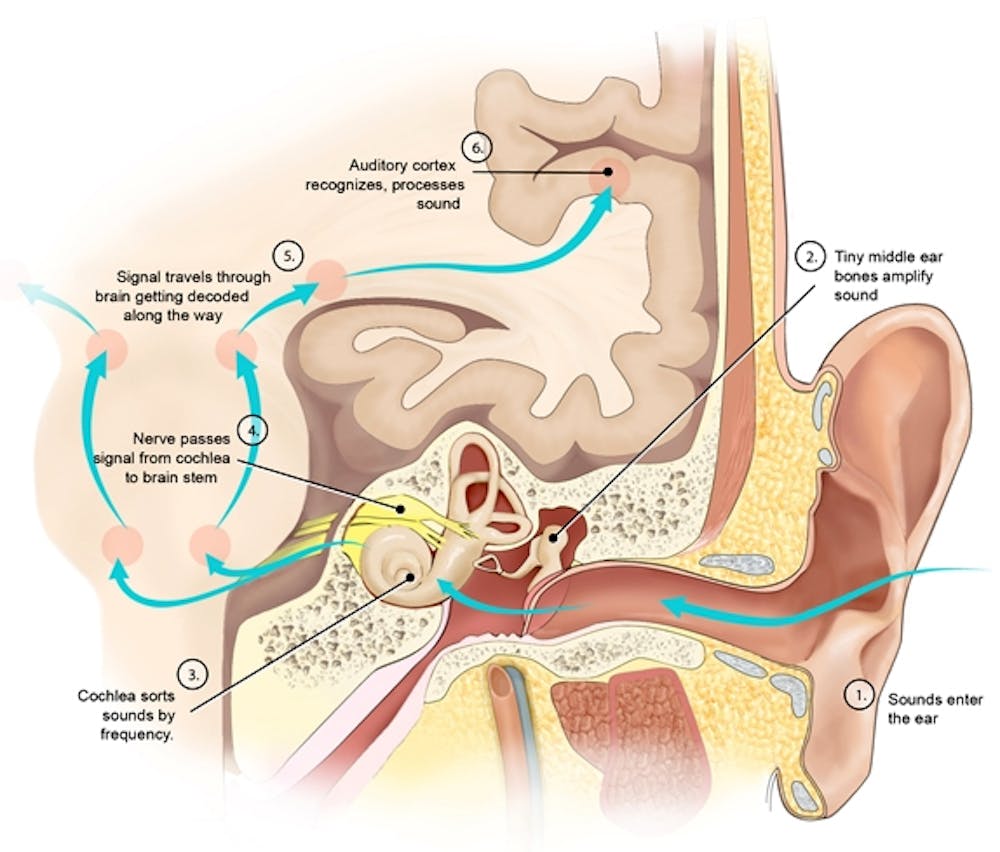
For many people with hearing difficulties, the problem isn’t in their ears — it’s in their brain. In everyday environments, sound waves emitted from every object around you mix together before they enter your ear. Your brain must then sort out which bits of sound belong to each source in the environment and correctly group these bits of sound together, ignoring some — like the hum of the refrigerator — and focusing on others, like a relative calling out from the next room.

This ability to distinguish, process and make sense of sound is one of the first things to break down in hearing loss from normal aging, or from neurological disorders like ADD/ADHD, autism and dyslexia. It’s so complex that for decades, auditory neuroscientists like me have been trying to understand how the brain does this, and how we can help people who have difficulty hearing in noisy surroundings.

The path sound takes into the ear and then into the brain.
Zina Deretsky, National Science Foundation

Video games to the rescue

In their new study, Polley, Whitton and their colleagues created a video game to train players’ brains to distinguish sounds better. Players trace their fingers around a blank tablet screen, seeking to identify the edges of a hidden shape. They get continous auditory feedback on how they’re doing through headphones, which play sounds partially obscured by background noise. It works a bit like the “hotter or colder” children’s game: The only way to find the edges of the shape is to listen carefully to the sounds and notice how they change as they move their finger. As the player gets better at the game, the background noise gets louder, making the game more challenging.

To determine whether this video game could help people in their everyday lives, the researchers recruited 24 older adults with hearing loss. Half of the participants played the auditory training game. The other 12 played an equally challenging game in which they heard nonsense sentences (like “Ready Barron, go to green four now”) amid background noise. Those people had to remember, and later identify, which words they had heard in the sentences. Importantly, this memory task tested hearing, but differed from the video game training in that it did not test people’s ability to distinguish subtle differences in sounds.

After eight weeks of training on their respective games, in several sessions a week at home on a tablet, the memory group was no better at distinguishing speech from background noise. But the people who played the auditory video game were able to understand 25 percent more words and sentences in background noise, which was about three times more beneficial than from their hearing aids alone. This was particularly surprising because the video game group showed improvements in speech understanding, even though their training only involved non-verbal sounds.

Fast feedback

In conversations and interviews, Polley admits that he doesn’t know exactly why the game works, but he suspects that the structure of the game is the key: The brain is able to predict how the video game’s sound will change with each finger movement, and then gets immediate feedback about what actually happened.

This is the same sort of feedback that people receive during activities like sports and playing a musical instrument. For example, a violinist anticipates the next note of a piece, places her finger on the appropriate spot along the neck of the violin, and then listens to the sound of the resulting note and how it fits with the other instruments of the orchestra. If any pitch adjustments are needed, her finger almost immediately shifts to the correct spot. And she must do all of this while ignoring extraneous sounds, like the other melody in the woodwind section or the timpani drumroll.

There is some evidence that periods of intense musical training, especially in childhood, can lead to benefits that generalize to everyday communication. For example, my previous work examined the idea that musicians often outperform non-musicians on tests of speech understanding in background noise, and that musicians’ brains might process speech sounds more precisely than the brains of non-musicians.

But just like musical training, practice seems to be necessary for maintaining the ability to understand speech in noisy backgrounds. Two months after the video game training ended, the researchers tested the participants’ speech understanding abilities again, and found that the benefits of the video game had vanished.

A future with better hearing

Despite the remaining mysteries about how exactly this sound-based video game can improve speech perception, this preliminary result raises exciting possibilities for future clinical therapies. It also gives scientists like me further insight into how the brain learns new perceptual skills, by demonstrating that even short-term training can have a dramatic effect on ability to distinguish speech from background noise.

But what remains to be seen is which brain changes underlie these behavioral improvements. In my own research, I seek to answer that question by examining the brains of people who have undergone various types of training, observing how their brains process sound, and comparing them to people who have not undergone training. The hope is that we can learn more about how the brain changes in response to training, and how that relates to people’s perceptual abilities.

The ConversationSo although people should be cautious about claims about training our brains to improve our general intelligence, this study’s results from targeted perceptual training are encouraging. One day there might be an iPhone app that can help your mother-in-law follow the conversation at a crowded restaurant or a student with a learning disorder focus on the teacher’s voice. Scientists just need to figure out how to best train the brain to listen.

Dana Boebinger, Ph.D. student in Speech and Hearing Bioscience and Technology, Harvard University

This article was originally published on The Conversation.

 

How China’s winemakers succeeded (without stealing)

0

chinese-wine-investment-1

How China’s winemakers succeeded (without stealing) – CWEB.com

File 20180413 566 14t5na1.jpg?ixlib=rb 1.1
More Chinese wines are finding their way into the liquor aisle.
AP Photo/Elizabeth Dalziel

Cynthia Howson, University of Washington and Pierre Ly, University of Puget Sound

Joint ventures between Western and Chinese companies are in the news over accusations — including those of President Donald Trump — that China uses them to steal intellectual property from foreign competitors in industries like cars and technology.

Less well known, however, are the joint ventures between French and Chinese winemakers, which offer a notable counterpoint to this narrative of international rivalry — or foreign exploitation, depending on your perspective.

Unlike for cars and electronics, there are no secret technologies in the making of wine. The millennia-old fermented drink is primarily a product of the land where the grapes are grown. What differentiates the best from the rest is not proprietary technology but experience in combining agriculture, science and art.

During research visits to China’s major wine regions — from beach resorts in Shandong and Ningxia’s rocky and arid landscapes to the lush mountains of Yunnan — we encountered a blend of local and foreign winemakers, farmers, wine scientists and local government officials, all committed to establishing local wines on the world stage.

Winemaking succeeds on the back of such international collaboration. And in our experience, it’s helping Chinese wine producers overcome their biggest obstacles to success.

Entrance of the 2014 International Wine Exposition in Yanqing, where hundreds of foreign and local wineries came to make their pitch.
Cynthia Howson and Pierre Ly, Author provided

No secret technology to steal

China is currently the sixth-largest wine producer, bottling 11.4 million hectoliters in 2016, just behind Australia’s 13 million. China is fifth in terms of consumption.

A few years ago, as we explained in The Conversation, China’s wine industry was focused on overcoming the rising cost of labor, dealing with difficult climates and improving grape quality.

Now, the biggest obstacles Chinese vintners have to overcome are the country’s image problem and growing competition from foreign wine. And that’s where the foreign ventures have proven so valuable.

China has long had a reputation for counterfeiting and food safety scandals. At the same time, the wine industry has become less protected from foreign competition after bilateral trade deals with countries such as Chile and Australia eliminated some tariffs. And although there are still such barriers in place with Europe (as well as the U.S.), Chinese wine lovers still drink a ton of French wine, despite the higher prices.

The authors visit Guanlan Vineyard with owner Yanzhi Zhang, a Beijing wine importer and Bordeaux-trained winemaker who is building two wineries in Ningxia.
Cynthia Howson and Pierre Ly, Author provided

That has meant Chinese makers of premium wines have had to raise their game to compete with skilled foreign competitors. And perhaps ironically, some of those foreign rivals have been only too happy to share knowledge and skills.

Unlike for cars, making good wine doesn’t require proprietary technology. Any serious student can learn the techniques, whether they are traditional or cutting edge, by reading, going to school or finding a mentor. Becoming a good winemaker requires experimenting with a range of tried and true methods, both in the vineyard and the cellar. There is no secret recipe, only hard work and problem solving.

Such collaborative partnerships have been essential to helping China wine producers overcome the image problem and better compete.

Chandon China’s winery sits in the shadow of Helan Mountain in Ningxia.
Cynthia Howson and Pierre Ly, Author provided

Enter the French

It might surprise readers that French Cognac producer Remy Martin was one of the first Western companies to form a joint venture in China, in this case with the city of Tianjin in 1980 to set up a winery.

The French brought winemaking skills and, in exchange, got a foot in the door into a promising market for imported Cognac. The result, Dynasty Winery, is now one of the largest Chinese wine producers.

Remy and other Western companies brought not only skills but also their brand name. Chinese wine enthusiasts — vulnerable to the same stereotypes Westerners have — might question how good a wine from an unknown domestic company might be. But if is made by a famous French wine group, whose wines they enjoy, they might give it a chance.

While Dynasty is a mass market brand, other more recent French-Chinese partnerships have focused on developing premium wines. One involved LVMH and a state-owned enterprise in Ningxia, a poor province often hailed as China’s most promising wine region. In 2013, the French luxury conglomerate launched Chandon China, the latest offspring in the global Chandon family of sparkling wine.

Unlike in other sectors, such as clothing or electronics, Western winemakers are not in China to take advantage of low costs. Chinese wine is expensive to make, due to the rising cost of labor, and, in some regions, the need to bury the vines to protect them from cold winters and dig them out every spring.

Moreover, you can’t outsource the production of wine to another country. Champagne can only be made in the Champagne region of France. Napa Valley wine can only be made in the Napa Valley. If a wine is made in China, it becomes Chinese wine.

Wines from Treaty Port Vineyards, which occupies this Scottish-style castle in Moulangou village, Shandong, are available in the U.K. from The Real Wine Company.
Cynthia Howson and Pierre Ly

Soaring wine quality

The result, for Chinese winemakers, has been soaring quality.

Not long ago, really good Chinese wines were very hard to find. Mass market wine brands, like Changyu, Great Wall or Dynasty, were ubiquitous in supermarkets and convenience stores around the country. But most award-winning boutique wineries you read about in the media were too small or lacked marketing skills and deals with distributors that could put their wines in front of consumers.

Today the best boutique Chinese wines are far more available in major cities because the major distributors have begun to include more Chinese producers in their porfolios of primarily imported wines. This has made the best Chinese wines available in local shops frequented by wine enthusiasts, like Pudao Wines in Beijing and Shanghai, and on a few restaurant wine lists.

At a hotel restaurant in Guangzhou’s main airport in 2016, for example, we were able to order an glass of Pretty Pony, an award winning Ningxia red by Kanaan winery — something we couldn’t have done just a year earlier.

One of the authors orders a glass of Kanaan’s Pretty Pony red during a layover at Guangzhou airport.
Cynthia Howson and Pierre Ly, Author provided

Next stop: exports

So how easy is it to pick up a bottle of Pretty Pony at your local supermarket if you don’t live in China?

Although exports of Chinese wine are still quite low, at just US$1.2 million in 2016 compared with $15 million for Argentina and $3.2 billion for France, a growing number of supermarkets and wine shops in Europe and the U.S. are stocking some of the best Chinese wines, from Seattle and Melbourne to London and Madrid.

The ConversationWhile it’s unlikely Chinese winemakers will be threatening their French peers anytime soon, they are now decidedly on the world’s wine map.

Cynthia Howson, Lecturer, University of Washington and Pierre Ly, Associate Professor, University of Puget Sound

This article was originally published on The Conversation.
 

Housing discrimination thrives 50 years after Fair Housing Act tried to end it

0

Fair_housing_protest,_Seattle,_1964

Housing discrimination thrives 50 years after Fair Housing Act tried to end it – CWEB.com

Fair housing protest in Seattle, Washington, 1964.
Jmabel/Wikimedia Commons, CC BY-NC-ND

Prentiss A. Dantzler, Colorado College

In the midst of riots in 1968 after civil rights leader Martin Luther King Jr. was slain, President Lyndon B. Johnson signed the Fair Housing Act.

The federal legislation addressed one of the bitterest aspects of racism in the U.S.: segregated housing. It prohibited discrimination on the basis of race, color, religion and national origin when selling and renting housing.

The Department of Housing and Urban Development, or HUD, has administered the act with some success. From 1970 to 2010, the share of African-Americans living in highly segregated neighborhoods declined by half. But in areas that remained highly segregated in 2010, there were no signs of improvement. In several cities, such as Baltimore and Philadelphia, average levels of segregation had actually increased.

My scholarship on public housing and residential mobility demonstrates that where African-American people live is often still limited by discrimination.

Meanwhile, HUD — the department charged with ending housing discrimination — has shifted much of its focus away from that core mission to instead promote economic self-sufficiency.

The effect of this change could mean the discrimination that continues to exist will remain, and people of color will continue to have limited options for housing, attend lower-performing schools and experience poorer health outcomes.

Refocusing HUD’s mission

The Fair Housing Act’s dual mission was to eliminate housing discrimination and to promote residential integration. The communities its authors imagined were desegregated and open to all people.

The first HUD secretary, Robert C. Weaver, believed such places would allow for a diverse mix of people and housing options. This founding tenet is reflected in the mission statement HUD has used since 2010: “HUD’s mission is to create strong, sustainable, inclusive communities and quality affordable homes for all.”

However, HUD’s current secretary, Ben Carson, appointed by President Donald Trump, has proposed a new mission statement. It reads: “HUD’s mission is to ensure Americans have access to fair, affordable housing and opportunities to achieve self-sufficiency, thereby strengthening our communities and our nation.”

One of the key differences between these two mission statements is the goal. While the former focused on building inclusive communities, the new mission focuses on individuals being self-sufficient. This shift reflects an age-old debate about the role of the government in helping poor people secure housing. Recent actions by conservatives suggest they are interested in decreasing government assistance for housing to poor people.

For example, the White House’s fiscal year 2019 budget proposal called for slashing HUD’s funding by US$8.8 billion. Shortly thereafter, HUD Secretary Carson tweeted, “The proposed budget is focused on moving more people toward self-sufficiency through reforming rental assistance programs and moving aging public housing to more sustainable platforms.”

On March 23, in lieu of a government shutdown, Congress passed an omnibus bill that actually added money to HUD’s budget. Yet, there is still a possibility that the White House will rescind some of these increases. Conservatives are still split on whether or not they should go against their deal with liberals to save money. This could drastically change the way HUD operates over the next year.

Diminishing role of government

Such efforts to diminish the government’s role in providing housing assistance to the poorest populations is based on historic ideas on the causes of poverty.

Poverty, some people argue, is caused by an individual’s lack of motivation. Blaming other factors out of their control, according to this line of thinking, is a way of not accepting responsibility. This idea is now being translated into housing policy.

The focus on economic self-sufficiency is not new. Starting in the 1980s, HUD linked housing programs and policies with efforts to increase an individual’s ability to support themselves without government assistance.

Promoting self-sufficiency isn’t a bad idea. Raising the income levels of low-income people is a useful endeavor, since housing is often the largest expense among families.

But here’s the problem with focusing on self-sufficiency: It creates the illusion that where people live is solely their choice. It’s not. The market dictates where people can live, and so does discrimination by landlords and mortgage lenders.

Incomes in the U.S. are not increasing at the same rate as housing costs. And as the economy is bouncing back from the Great Recession, housing is becoming increasingly unaffordable for people at nearly all income levels.

So getting people off of housing assistance, while providing training so they can get higher-paying jobs, does not mean they can find affordable housing in the neighborhood of their choice.

To be effective, housing policies must address, not ignore these challenges. A full return to the spirit with which the Fair Housing Act was passed could be a step in the right direction.

The ConversationIf the Fair Housing Act has taught us anything in the last 50 years, it has highlighted that attaining affordable housing is a problem for many people. Focusing on self-sufficiency and turning a blind eye to housing discrimination shifts the focus of housing policy in the United States away from building “inclusive and sustainable communities free from discrimination.”

[youtube https://www.youtube.com/watch?v=9TXBP1t2rUc&w=560&h=315]

Prentiss A. Dantzler, Assistant Professor of Sociology and Urban Studies, Colorado College

This article was originally published on The Conversation.


In Brazil, patients risk everything for the ‘right to beauty’

0

plasticsurgery

In Brazil, patients risk everything for the ‘right to beauty’ – CWEB.com

File 20180430 135817 1pza6i0.jpg?ixlib=rb 1.1
A plastic surgery-themed magazine is displayed in a Brazil storefront.
hollywoodsmile310, CC BY-NC-ND

Alvaro Jarrin, College of the Holy Cross

In the U.S., if you want a face lift or a tummy tuck, it’s generally assumed that you’ll be paying out of pocket. Insurance will tend to cover plastic surgery only when the surgery is deemed “medically necessary” and not merely aesthetic.

In Brazil, however, patients are thought of as having the “right to beauty.” In public hospitals, plastic surgeries are free or low-cost, and the government subsidizes nearly half a million surgeries every year.

As a medical anthropologist, I’ve spent years studying Brazilian plastic surgery. While many patients are incredibly thankful for the opportunity to become beautiful, the “right to beauty” has a darker side to it.

Everyone I interviewed in Brazil admitted that plastic surgeries were risky affairs. In the public hospitals where these plastic surgeries are free or much cheaper than in private clinics, I heard many patients declare that they were “cobaias” (guinea pigs) for the medical residents who would operate on them.

Yet these patients, most of whom were women, also told me that living without beauty in Brazil was to take an even bigger risk. Beauty is perceived as being so central for the job market, so crucial for finding a spouse and so essential for any chances at upward mobility that many can’t say no to these surgeries.

The very long queues for plastic surgery in public hospitals — with wait times of several months or even years — seem to confirm this immense longing for beauty. It’s made Brazil the second-largest consumer of plastic surgery in the world, with 1.2 million surgeries carried out every year.

Brazil’s ‘pope of plastic surgery’

Today, Brazil considers health to be a basic human right and provides free health care to all its citizens — a hard-won victory of social activists after Brazil’s dictatorship fell and a new democratic constitution was written into law in 1988. However, public hospitals remain severely underfunded, and most middle-class and upper-class Brazilians prefer to use private medical services.

In effect, Brazil has a two-tiered system. There is a private health care system that is cutting-edge and luxurious and a public one that is strapped for cash but provides essential services to the working class.

A billboard advertises a private plastic surgery clinic in Barra da Tijuca, a wealthy neighborhood in Rio de Janeiro.
Gregg Newton/Reuters

Plastic surgery is considered an essential service largely due to the efforts of a surgeon named Ivo Pitanguy. In the late 1950s, Pitanguy — now known as the “pope of plastic surgery” — convinced President Juscelino Kubitschek that the “right to beauty” was as basic as any other health need. Pitanguy made the case that ugliness caused so much psychological suffering in Brazil that the medical class could not turn its back on this humanitarian issue.

In 1960, he opened the first institute that offered plastic surgery to the poor, one that doubled as a medical school to train new surgeons. It was so successful that it became the educational model followed by most other plastic surgery residencies around the country. In return for free or low-cost surgeries, working-class patients would help surgeons learn and practice their trade.

Brazil was the perfect testing ground for this idea. In the early 1920s, Brazilian eugenic scientists suggested that beauty was a measure of the nation’s racial progress. Beauty started to assume more cultural clout, and plastic surgeons inherited these ideals, seeing their trade as “fixing” the errors of too much racial mixture in Brazil, particularly among the lower classes.

Beauty’s hidden costs

In my recently published book, “The Biopolitics of Beauty,” I question the idea that humanitarianism is the driving force of plastic surgery in Brazilian public hospitals.

Burn victims and individuals with congenital deformities were once the main beneficiaries of plastic surgery in these hospitals. But at many of the clinics where I carried out my research, nearly 95 percent of all those surgeries have become purely aesthetic. I documented hundreds of instances where surgeons and residents purposely blurred the boundaries between reconstructive and aesthetic procedures to get them approved by the government.

Since most of the surgeries in public hospitals are carried out by medical residents who are still training to be plastic surgeons, they have a vested interest in learning aesthetic procedures — skills that they’ll be able to later market as they open private practices. But they have very little interest in learning the reconstructive procedures that actually improve a bodily function or reduce physical pain.

Additionally, most of Brazil’s surgical innovations are first tested by plastic surgeons in public hospitals, exposing those patients to more risks than wealthier patients. Working-class patients are understood as subjects for inquiry, and I spoke to the small but significant number who were very unhappy with the results of their surgery.

Take one woman I interviewed named Renata. The medical resident who operated on her left her with deformed breasts and uneven nipples. She also developed severe infections that took months to heal and left significant scars. She considered suing the doctor, but discovered she would need a costly expert medical evaluation. She also knew that the Brazilian legal system would likely grant her very little in terms of damages. In the end, she settled for another free surgery, one that she hoped would provide a better result and leave her less unhappy.

This was a typical story among low-income patients that were harmed by plastic surgeons. Their lack of financial resources made it nearly impossible for them to find any justice if anything went wrong, so they assumed all of the risk.

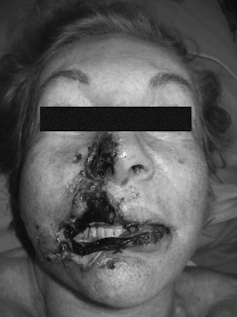
Extensive necrosis in a patient after an application of PMMA.
Anderson Castelo Branco de Castro, Author provided

Plastic surgeons, on the other hand, are eager to try new techniques if they seem promising, no matter how risky they might be. A technique known as “bioplastia,” for example, consists of injecting a liquid compound called PMMA into the body in order to permanently reshape a patient’s features. The compound, which is similar to acrylic glass, doesn’t cause problems in most patients. But in a small minority it causes very severe complications, including necrosis of facial tissue. Yet many doctors I interviewed strongly defended the technique, claiming it was a phenomenal tool that allowed them to transform the human body. Risk, they argued, was inherent in any surgical procedure.

Around the world, Brazilian plastic surgeons are known as the best in their field, and they gain global recognition for their daring new techniques. During an international plastic surgery conference in Brazil, an American surgeon I interviewed told me, “Brazilian surgeons are pioneers… You know why? Because [in Brazil] they don’t have the institutional or legal barriers to generate new techniques. They can be creative as they want to be.”

In other words, there are few regulations in place that could protect low-income patients from malpractice.

The ConversationIn a country where appearance is seen as central to one’s very citizenship, patients agree to becoming experimental subjects in exchange for beauty. But it’s often a choice made under duress, and the consequences can be dire.

Alvaro Jarrin, Assistant Professor of Anthropology, College of the Holy Cross

This article was originally published on The Conversation.


There’s a new generation of water pollutants in your medicine cabinet

0

cabinet

There’s a new generation of water pollutants in your medicine cabinet – CWEB.com

Image 20170418 10221 ajxgkl.jpg?ixlib=rb 1.1
Shutterstock

Lee Blaney, University of Maryland, Baltimore County

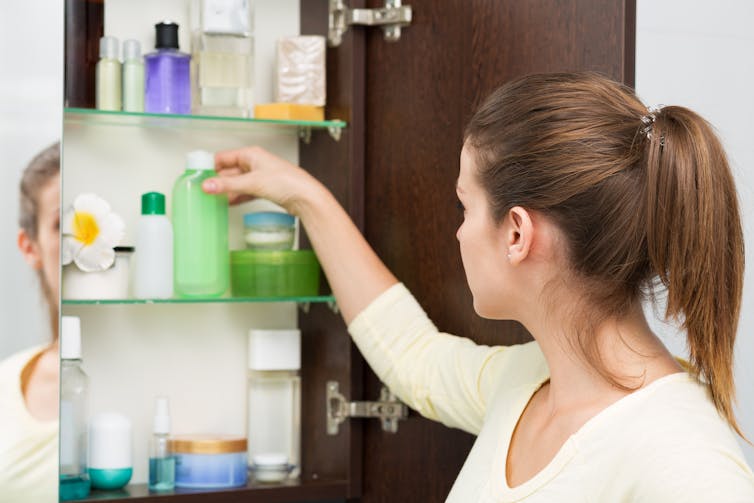
Every day we each use a variety of personal care products. We wash our hands with antibacterial soaps and clean our faces with specialty cleansers. We wash and maintain our hair with shampoo, conditioner and other hair care products. We use deodorant and perfume or cologne to smell nice. Depending on the day, we may apply sunscreen or insect repellent.

All of these products contribute to our quality of life. But where do they go after we use them?

When we bathe, personal care products wash off of our bodies and into sewer systems that carry them to regional wastewater treatment plants. However, these plants are not designed to treat the thousands of specialty chemicals in pharmaceuticals and personal care products. Many of the active and inactive ingredients present in these products pass through our wastewater treatment plants and ultimately end up in rivers, streams or oceans.

Once in the environment, these chemicals may cause hormonal effects and toxicity in aquatic animals. In my laboratory we are studying these emerging water pollutants, which are turning up in surface water, groundwater and even treated drinking water. Although they are typically found at low concentrations, they may still threaten human and ecological health.

New pollutants, present worldwide

Personal care products and their ingredients are widely distributed throughout our environment. In one recent study, our lab aggregated over 5,000 measurements of active ingredients from a variety of personal care products that were found in untreated wastewater, treated wastewater and surface waters such as rivers and streams. They included N,N-diethyl-3-methylbenzamide, or DEET, an insect repellent; galaxolide, a fragrance; oxybenzone, a sunscreen; and triclosan, an antibacterial compound.

UMBC Ph.D. student Ke He collecting raw wastewater for analysis of contaminants of emerging concern, such as antibiotics, hormones and personal care products.
Lee Blaney, Author provided

Other studies conducted near the Mario Zucchelli and McMurdo & Scott research bases confirmed that chemicals in personal care products were even present in Antarctic seawater. Those reports identified the presence of plasticizers, antibacterials, preservatives, sunscreens and fragrances in the Antarctic marine environment. Together, these studies suggest that the active ingredients in personal care products can be found in any water body influenced by human activity.

These substances are typically present in the aquatic environment at concentrations of 10 to 100 nanograms per liter, which is equivalent to 1 to 2 drops in an Olympic-sized swimming pool. But even at these low levels, some still pose a risk.

Moving up the food chain

Depending on their chemical properties, we can classify some of these products as hydrophilic (“water-loving”) or lipophilic (“lipid-loving”). The fat layers in our bodies are comprised of lipids, so lipophilic personal care products can accumulate in the tissue and organs of aquatic animals like fish, birds and even dolphins.

Our group has recently detected a suite of sunscreen agents and 17α-ethinylestradiol, a synthetic form of the hormone estrogen that is the active ingredient in birth control pills, in crayfish from urban streams near Baltimore, Maryland. We have also measured sunscreens in oysters and mussels collected from the Chesapeake Bay. The uptake of these chemicals by aquatic animals raises environmental concerns.

Specifically, as lipophilic chemicals from personal care products accumulate in animals at higher concentrations, there is a greater potential for them to cause toxic effects. For instance, many personal care products disrupt hormone systems in the body. Some chemicals used in personal care products affect reproductive systems and function, causing the feminization of male fish.

These reproductive effects can have important consequences for aquatic animals in the environment, and they may even represent a potential health risk for humans. Last year, the Food and Drug Administration banned the use of triclosan and a number of other antibacterial agents in antiseptic wash products due, in part, to health risks associated with hormonal effects.

U.S. Geological Survey hydrologists sampling shallow groundwater near septic systems on New York’s Fire Island in 2011. The scientists found hormones, detergent degradation products, fragrances, insect repellent, sunscreen additives, a floor cleaner and pharmaceuticals, indicating that contaminants were moving from the septic systems into groundwater.
Chris Schubert, USGS

Recent research has shown that oxybenzone, a sunscreen agent used in many personal care products, is toxic to corals. For many coastal communities, coral reefs are critical to local economies. For example, the net value of Hawaii’s coral reefs is estimated to be US$34 billion.

Earlier this year Hawaii introduced legislation to ban the sale of sunscreens containing oxybenzone and octinoxate in order to protect coral reefs. While research and policymaking are still ongoing in this area, it is important to note that a number of new consumer products have started using labels like “coral safe” and “reef safe.”

Multiple solutions

Typical wastewater treatment plants are designed to treat multiple pollutants, including organic carbon from human and food waste; nutrients like nitrogen and phosphorus; and pathogenic bacteria and viruses that cause disease. However, they are not equipped to handle the many ingredients of concern that are present in personal care products.

The ConversationProtecting the environment and human health from these substances will require progress in several areas. They include improving technologies for wastewater treatment plants; conducting more testing and regulation of personal care products to avoid unintended toxicity to aquatic animals; and designing “green chemicals” that do not pose toxicity concerns. This multi-pronged approach will help us to ensure that personal care products continue to improve our quality of life without harming the environment.


Lee Blaney, Assistant Professor of Environmental Engineering, University of Maryland, Baltimore County

This article was originally published on The Conversation.


The orgasm gap: Picking up where the sexual revolution left off

0

sex

The orgasm gap: Picking up where the sexual revolution left off – CWEB.com

File 20180515 195311 4vmdj3.jpg?ixlib=rb 1.1
Women’s sexual pleasure has not been stressed as much as men’s.
Lucky Business/Shutterstock.com

Laurie Mintz, University of Florida

At the core of the 1960s sexual revolution was “female sexual empowerment.” It fell short of this goal. Specifically, while the revolution made women having intercourse before marriage acceptable, it didn’t lead women to have equally pleasurable sexual experiences.

This assertion comes from my vantage point as a sex researcher and educator. I teach human sexuality to hundreds of college students a year. As a teaching and research tool, I anonymously poll students regarding their sexual experiences and compare the results to published research. Both sources provide striking evidence of an orgasm gap between women and men. This spurred me to write a book to foster pleasure equality. “Becoming Cliterate: Why Orgasm Equality Matters — And How to Get It” aims to expose, explain and close the orgasm gap.

The orgasm gap exposed

One study of college students found 91 percent of men and 39 percent of women always or usually orgasm during sexual encounters. While this study didn’t ask about the sexual context, another revealed that the gap is larger in casual sex than relationship sex. Women were found to orgasm 32 percent as often as men in first time hookups and 72 percent as often in relationships. This study didn’t specify that the sexual encounters include activities that could result in orgasm. When I specify this, 55 percent of male students and 4 percent of female students report always orgasming during hookups.

The orgasm gap isn’t limited to students. Among a nationally representative U.S. sample, 64 percent of women and 91 percent of men said they’d orgasmed at their most recent sexual encounter.

[youtube https://www.youtube.com/watch?v=9TXBP1t2rUc&w=560&h=315]

Clearly, there’s an orgasm gap. But, what are the cultural reasons for this gap?

The orgasm gap explained

Some say the gap isn’t cultural but due to the elusive nature of women’s orgasms. Yet one landmark study found that when masturbating, 95 percent of women reach orgasm easily and within minutes. Four minutes was the average time that sex researcher Alfred Kinsey found it takes women to masturbate to orgasm. Orgasm isn’t elusive when women are alone.

It’s also not elusive when women are together. One study found that orgasm rates don’t vary by sexual orientation for men but do for women. Lesbians are more likely to orgasm than heterosexual women.

What do lesbian sex and female masturbation have in common? They focus on clitoral stimulation. One study found that when women pleasure themselves, almost 99 percent stimulate their clitoris.

Yet, when with male partners, especially casual ones, women forgo the clitoral stimulation needed to orgasm. A survey conducted by a women’s magazine found that 78 percent of women’s orgasm problems in heterosexual sex are due to not enough or not the right kind of clitoral stimulation. An academic study found that receiving oral sex and touching one’s clitoris during intercourse increases orgasm rates and that these behaviors occur more often in relationship sex than casual sex.

Women not getting clitoral stimulation, especially in casual sex, is a major reason for the orgasm gap. This leads to a more nuanced question: Why aren’t women getting the stimulation they need?

A double standard and a lack of knowledge

The first reason is ignorance of the clitoris, fueled by our sex education system. Best-selling author Peggy Orenstein pointed out that sex education ignores the clitoris, teaching only about women’s internal organs. No wonder a study found that over 60 percent of college students falsely believe the clitoris is located inside the vaginal canal. Many of these students also mistakenly believe that women orgasm from intercourse alone. In actuality, only a minority can. Depending on the way the questions are worded, 15 percent to 30 percent of women say they orgasm from intercourse alone. When I ask students, “What is your most reliable route to orgasm?,” 4 percent answer penetration alone.

Yet, by failing to teach this in sex education, we leave people to rely on media images. Orenstein asserts that porn has become the new sex ed. One false image portrayed in porn, and mainstream media, is that it is normal, indeed ideal, for women to orgasm from intercourse. This false belief is a main culprit in women not getting the stimulation they need to orgasm.

But research tells us it’s not the only culprit. Knowledge of the clitoris increases women’s orgasm rate during masturbation but not during partnered sex.

Women’s pleasure may not be a high priority in casual sex especially.
Stas Ponomarencko

So, what in our culture is preventing women from bridging the gap between self and partnered pleasure, especially in casual sex? Researchers in one study found that young adults believe that in casual sex, women’s pleasure is less important than men’s pleasure. They concluded that while it is now acceptable for women to engage in casual sex, it is not acceptable for them to seek sexual pleasure outside of a relationship. They say we have a new sexual double standard.

This takes us full circle, but begs two questions. Why is it important to close the orgasm gap? How can we do so?

The orgasm gap closed

On a surface level, closing the gap is important for equal access to pleasure itself.

Some scholars believe that closing the pleasure gap can empower women to say no.
Sylvie Bouchard/Shutterstock.com

On a deeper level, scholars connect pleasure equality and sexual consent. They say learning about sexual pleasure empowers one to communicate one’s desires to others, making it less likely to be coerced, or to coerce others, into unwanted sex. A number argue for sex education reform. A position paper by the Society for Adolescent Health and Medicine also advocated for reform, saying abstinence-only education “reinforces gender stereotypes about female passivity and male aggressiveness.” While the position paper didn’t suggest teaching about pleasure in sexual education, others do.

Information on pleasure, masturbation, the clitoris and orgasm is taught in commonly used sex education programs in Dutch schools. So is information on abstinence, birth control, consent, communication, sexual decision-making, and the difference between porn and real sex. The Dutch have lower pregnancy and STI rates, and
three times less sexual violence than the U.S.

Connecting sexual violence and the orgasm gap, one writer declared: “Let 2018 be the year we demand more than freedom from sexual harassment and abuse. This year, it’s time we demand pleasure.”

The ConversationTime magazine said the #MeToo movement was simmering for years. It seems that a related sexual revolution for pleasure equality is also emerging.

Laurie Mintz, Professor of Psychology, University of Florida

This article was originally published on The Conversation.


Black employees in the service industry pay an emotional tax at work

0

black-2934630_960_720

Black employees in the service industry pay an emotional tax at work – CWEB.com

File 20180429 135837 f3fq1t.jpg?ixlib=rb 1.1
Starbucks workers in Seattle.
AP Photo/Ted S. Warren, File

Alicia Grandey, Pennsylvania State University

The arrests of two black men who were waiting for a friend at a Starbucks in Philadelphia have raised questions about how race determines how customers are treated.

But does race also affect how the employees are treated within the service industry?

Prior research shows that black workers in people-oriented occupations — health care, service and sales — are rated lower by customers and supervisors than are white workers, even when their performance is objectively the same. Because of this, black workers have a harder time obtaining competitive raises or promotions. But it is unclear why or what workers can do about it.

In the U.S. workforce, blacks are disproportionately represented in low-paying service jobs like cashiers, call center employees and food service workers compared to higher-status jobs. So this issue has serious implications for the financial and professional lives of a large segment of black workers.

Race impacts perception of performance

Friendliness is key to performing well in the service industry. My colleagues Lawrence Houston III, Derek R. Avery and I found that negative stereotypes about blacks — that they are unfriendly, hostile or rude — explain lower performance evaluations of black service providers compared to white service providers.

We found that in order for the performance of black service providers to be rated equivalent to whites, blacks had to amplify and fake positive emotions to override those negative racial stereotypes. In other words, to be seen as good as white employees, black employees need to perform more “emotional labor,” a concept introduced by sociologist Arlie Hochschild.

Perhaps just like the two men at Starbucks, black service employees are assumed to have hostile intentions unless they put in extra effort to put forth a smile and show they are not a threat.

Across three studies

We drew these conclusions from a series of studies we conducted over several years.

In our first study, we asked a representative sample of people for their impressions of an employee described as holding an emotional labor job, a hotel desk clerk. They saw a photo of either a black or white person with a neutral expression, but otherwise the same job qualifications. Regardless of the respondents’ own race, education or income, they saw the black employee as less friendly and more hostile than the white employee.

In the second study, people watched a video of either a black or a white sales clerk ringing up sales in a home goods shop. They saw the clerk acting either warm and friendly or just polite. In all videos the sales clerk was efficient and knowledgeable.

When viewers saw the employee performing less emotional labor — just being polite and efficient — the black employee was rated as less friendly and a worse performer than the white employee. In contrast, after watching the friendly condition, the viewers rated the black and white employees similarly.

In short, just being polite was not enough for the black employee; putting on a big smile was necessary to get the same performance ratings as the white employee.

Both of the above studies were experiments. In a third study, we surveyed actual service employees and their supervisors.

Again, we found that supervisors rated black grocery store clerks as worse performers than white clerks, which could not be explained by job experience or motivation. Yet, black clerks who reported amplifying and faking their positive emotions when interacting with customers — more emotional labor — saw the racial disparity in the performance evaluations disappear.

Notably, white clerks were rated highly regardless of the frequency of their emotional labor. For black clerks to be rated as highly as the white clerks, they had to more consistently exaggerate their smile in customer interactions.

High cost of ‘service with a smile’

All service employees must sometimes put on a fake smile when having an off day, and sometimes they might let the mask slip. Our research shows that white employees who do less emotional labor can still be viewed positively, but black employees are not given the benefit of the doubt. Black employees constantly “fake it to make it” in service jobs.

Being a black service provider requires routinely putting forth more emotional effort — a bigger smile, a more enthusiastic tone of voice, maintained across time and customers — to be evaluated similarly to a white co-worker. If a black employee gets tired of faking that smile, there is a resulting decline in performance evaluation. This also means fewer opportunities for promotions, raises and career advancement.

The ConversationThough putting on a smile might seem like a small price to pay to get ahead at work, research shows that keeping up a friendly façade is a path to job burnout, a state of complete exhaustion linked to a desire to quit and health issues. Recognizing this situation is a first step to improving conditions for black employees and customers alike.

Alicia Grandey, Professor of Psychology, Pennsylvania State University

This article was originally published on The Conversation.


Did artists lead the way in mathematics?

0

ltima_Cena_-_Juan_de_Juanes - Copy

Did artists lead the way in mathematics? – CWEB.com

File 20170424 12645 1us9bvs.jpg?ixlib=rb 1.1
Is there a geometry lesson hidden in ‘The Last Supper’?
Wikimedia Commons

Henry Adams, Case Western Reserve University

Mathematics and art are generally viewed as very different disciplines — one devoted to abstract thought, the other to feeling. But sometimes the parallels between the two are uncanny.

From Islamic tiling to the chaotic patterns of Jackson Pollock, we can see remarkable similarities between art and the mathematical research that follows it. The two modes of thinking are not exactly the same, but, in interesting ways, often one seems to foreshadow the other.

Does art sometimes spur mathematical discovery? There’s no simple answer to this question, but in some instances it seems very likely.

Patterns in the Alhambra

Consider Islamic ornament, such as that found in the Alhambra in Granada, Spain.

In the 14th and 15th centuries, the Alhambra served as the palace and harem of the Berber monarchs. For many visitors, it’s a setting as close to paradise as anything on earth: a series of open courtyards with fountains, surrounded by arcades that provide shelter and shade. The ceilings are molded in elaborate geometric patterns that resemble stalactites. The crowning glory is the ornament in colorful tile on the surrounding walls, which dazzles the eye in a hypnotic way that’s strangely blissful. In a fashion akin to music, the patterns lift the onlooker into an almost out-of-body state, a sort of heavenly rapture.

Tiles at the Alhambra.
Wikimedia Commons, CC BY-SA

It’s a triumph of art — and of mathematical reasoning. The ornament explores a branch of mathematics known as tiling, which seeks to fill a space completely with regular geometric patterns. Math shows that a flat surface can be regularly covered by symmetric shapes with three, four and six sides, but not with shapes of five sides.

It’s also possible to combine different shapes, using triangular, square and hexagonal tiles to fill a space completely. The Alhambra revels in elaborate combinations of this sort, which are hard to see as stable rather than in motion. They seem to spin before our eyes. They trigger our brain into action and, as we look, we arrange and rearrange their patterns in different configurations.

An emotional experience? Very much so. But what’s fascinating about such Islamic tilings is that the work of anonymous artists and craftsmen also displays a near-perfect mastery of mathematical logic. Mathematicians have identified 17 types of symmetry: bilateral symmetry, rotational symmetry and so forth. At least 16 appear in the tilework of the Alhambra, almost as if they were textbook diagrams.

The patterns are not merely beautiful, but mathematically rigorous as well. They explore the fundamental characteristics of symmetry in a surprisingly complete way. Mathematicians, however, did not come up with their analysis of the principles of symmetry until several centuries after the tiles of the Alhambra had been set in place.

Quasicrystalline tiles

Stunning as they are, the decorations of the Alhambra may have been surpassed by a masterpiece in Persia. There, in 1453, anonymous craftsmen at the Darbi-I Imam shrine in Isfahan discovered quasicrystalline patterns. These patterns have complex and mysterious mathematical properties that were not analyzed by mathematicians until the discovery of Penrose tilings in the 1970s.

Such patterns fill a space completely with regular shapes, but in a configuration which never repeats itself — indeed, is infinitely nonrepeated — although the mathematical constant known as the Golden Section occurs over and over again.

Daniel Schectman won the 2001 Nobel Prize for the discovery of quasicrystals, which obey this law of organization. This breakthrough forced scientists to reconsider their conception of the very nature of matter.

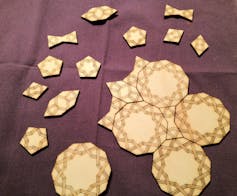
Laser-cut Girih tiles.
Cropped from 38462165@N05/flickr, CC BY

In 2005, Harvard physicist Peter James Lu showed that it’s possible to generate such quasicrystalline patterns relatively easily using girih tiles. Girih tiles combine several pure geometric shapes into five patterns: a regular decagon, an irregular hexagon, a bow tie, a rhombus and a regular pentagon.

Whatever the method, it’s clear that the quasicrystalline patterns at Darbi-I Imam were created by craftsmen without advanced training in mathematics. It took several more centuries for mathematicians to analyze and articulate what they were doing. In other words, intuition preceded full understanding.

Perspective and non-Euclidian mathematics

Geometric perspective made it possible to portray the visible world with a new verisimilitude and accuracy, creating an artistic revolution in the Italian Renaissance. One could argue that perspective also led to a major reexamination of the fundamental laws of mathematics.

In reality, the two rails of the track never meet. But, as they approach the horizon, they seem to converge at a distant ‘vanishing point.’
royluck/flickr, CC BY

According to Euclidian mathematics, two parallel lines will remain parallel into infinity and never meet. In the world of Renaissance perspective, however, parallel lines eventually do meet in the far distance at the so-called “vanishing point.” In other words, Renaissance perspective present a geometry which follows regular mathematical laws, but is non-Euclidian.

When mathematicians first devised non-Euclidian mathematics in the early 19th century, they imagined a world in which parallel lines meet at infinity. The geometry they explored was, in many ways, similar to that of Renaissance perspective.

Non-Euclidian mathematics has since moved on to explore space which has 12 or 13 dimensions, far outside the world of Renaissance perspective. But it’s worth asking whether Renaissance art may have made easier to make that initial leap.

Pollock’s chaotic paintings

An interesting modern case of art that broke traditional boundaries — and that has suggestive parallels with recent developments in mathematics — is that of the paintings of Jackson Pollock.

To those who first encountered them, the paintings of Pollock seemed chaotic and senseless. With time, however, we’ve come to see that they have elements of order, though not a traditional sort. Their shapes are simultaneously predictable and unpredictable, in a fashion similar to the pattern of dripping water from a faucet. There’s no way to predict the exact effect of the next drip. But, if we chart the pattern of drips, we find that they fall within a zone that has a clear shape and boundaries.

‘Greyed Rainbow’ by Jackson Pollock.
ancientartpodcast/flickr, CC BY

Such unpredictability was once out of bounds for mathematicians. But, in recent years, it has become one of the hottest areas of mathematical exploration. For example, chaos theory explores patterns that are not predictable but fall within a definable range of possibilities, while fractal analysis studies shapes that are similar but not identical.

Pollock himself had no particular interest in mathematics, and little known talent in that arena. His fascination with these forms was intuitive and subjective.

Intriguingly, mathematicians have not been able to accurately describe what Pollock was doing in his paintings. For example, there have been attempts to use fractal analysis to create a numerical “signature” of his style, but so far the method has not worked — we can’t mathematically distinguish Pollock’s autograph work from bad imitations. Even the notion that Pollock employed fractal thoughts is probably incorrect.

The ConversationNonetheless, Pollock’s simultaneously chaotic and orderly patterns have suggested a fruitful direction for mathematics. At some point, it may well be possible to describe what Pollock was doing with mathematical tools, and artists will have to move on and mark out a new frontier to explore.

Henry Adams, Ruth Coulter Heede Professor of Art History, Case Western Reserve University

This article was originally published on The Conversation. Read the original article.


Poll finds more favourable attitudes towards Indian immigrants than Pakistanis and Bangladeshis — why?

0

teresamay

Poll finds more favourable attitudes towards Indian immigrants than Pakistanis and Bangladeshis — why? – CWEB.com

Rakib Ehsan, Royal Holloway

A recent survey looking into attitudes towards immigrants of different origins has thrown up some interesting figures.

YouGov asked 1,668 UK adults whether immigrants from various parts of the world had made a positive or negative contribution to British life.

While immigrants from India received a healthy positive figure of +25, their South Asian counterparts are in negative territory. Bangladeshis have a net figure of -3. Pakistanis fare even worse at -4. Net figures are calculated by taking away the figure for “negative contribution” from the figure for “positive contribution”.

There are a range of factors that might account for these differences — some historical, some economic and some social and religious.

Migratory story

The initial flow of steady Indian migration started in the 1950s. As well as a notable number of politically disaffected Punjabi Sikhs, this flow included a stream of highly educated Gujarati migrants. Many ended up working as medical professionals in the NHS.

In the 1970s, a number of migrants of Indian origin sought refuge in the UK following their expulsion from Uganda. The stream of Indian migration from East Africa also included people fleeing state discrimination in Kenya.

The vast proportion of these migrants were well-educated and entrepreneurial. Indeed, following their expulsion, the backbone of the Ugandan economy crumbled under Idi Amin’s dictatorship. Ugandan Indians are collectively a British success story.

Many of the initial Pakistani and Bangladeshi migrants, on the other hand, originated from deprived regions such as Azad Kashmir, where the rate of Pakistani migration increased following the construction of the Mangla Dam in the 1960s, a project that left more than 250 villages submerged. Many others are from Sylhet and migrated following the damage caused by the 1971 Bangladesh liberation war.

Settlers from Pakistan and Bangladesh often filled manual jobs, particularly those in steel mills and the textiles industry. Due to poor English skills, many were unable to progress in terms of employment or to interact with the wider population. This continues to be a problem within Britain’s Pakistani and Bangladeshi communities, particularly among women.

Socioeconomic status

Then there are differences in economic performance. According to 2010 data, Indians in the UK are far more likely to work in higher-skilled professional jobs than Bangladeshis and Pakistanis. A recent population survey found that 59% of UK women in a combined Bangladeshi-Pakistani category were economically inactive. The corresponding figure for Indian-origin women was only 32%.

British Bangladeshi and Pakistani communities have historically ranked highly when measuring average fertility rates by ethnicity in the UK. The fertility rate for British Indians is noticeably lower in comparison.

What this data collectively suggests is that due to superior occupational status, a higher proportion of two-income households and substantially lower fertility rates, British Indian households are far less likely to be dependent on welfare. Therefore perceptions regarding welfare dependency may have fed into the YouGov figures.

Social integration

The YouGov figures could also be influenced by differences in social contact. There is the possibility that a high number of the respondents simply don’t have much experience of communicating with people of Bangladeshi or Pakistani origin.

The 2010 data shows that Bangladeshis and Pakistanis living in the UK have far higher levels of residential and social segregation than Indians. They are more likely to be part of social and economic networks which are predominantly made out of people from their own ethnic group. This is partly down to being occupationally segregated in the transport and hospitality sectors.

Brick Lane, in East London, is famous for its Bangladeshi community.
NordicLondon, CC BY-NC

British Indians have higher levels of “social mixing” through friends, neighbours and work colleagues. This creates greater opportunities for positive contact across ethnic groups. “Outgroupers” may be less likely to experience positive contact with British Bangladeshis and Pakistanis due to the comparatively higher levels of social, economic and residential segregation within these groups.

Religious effect

The religious composition of the ethnic groups cannot be ignored either. A substantial proportion of UK Indians are either Hindu or Sikh. Britain’s Bangladeshis and Pakistanis are nearly all Sunni Muslim. And the 2010 data shows that UK Bangladeshis and Pakistanis are more likely to identify more with their faith (when traded-off against British identification).

Perceptions of homegrown terrorism and Islamic radicalisation could also have played a part in the negative net figures for the Bangladeshi and Pakistani groups. The ethnic background of perpetrators involved in domestic terrorist activities and UK citizens who have joined Daesh “as jihadis” or “jihadi brides” may be implicated in negative group perceptions, even if these people make up a tiny proportion of the population. Major cases of child sexual exploitation in places such as Rochdale and Rotherham are unlikely to have helped.

Looking to the future

The YouGov figures suggest that economic performance, social relations and religio-cultural values can all influence perceptions on immigration.

The negative actions of a minority can certainly lead to unfair generalisations. But considering the group trends in socioeconomic status and sociocultural integration, it’s perhaps unsurprising that Bangladeshi and Pakistani immigrants are viewed more negatively than those of Indian origin. The question remains what to do about it.

The ConversationThe state does have a role to play in improving social and economic outcomes. But frank discussions need to be held within certain groups over socioeconomic progress and sociocultural modernisation. And their place in Britain’s liberal democracy.

Rakib Ehsan, Doctoral Researcher in Political Science, Royal Holloway

This article was originally published on The Conversation.