
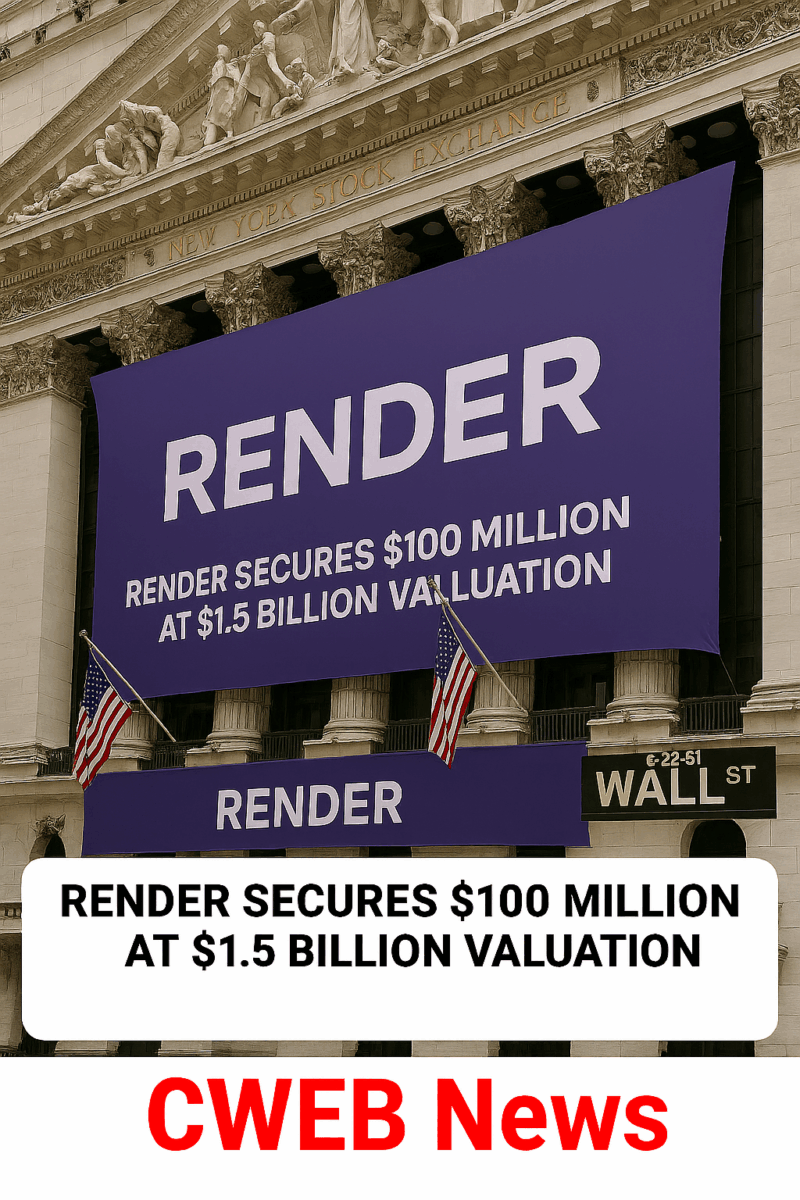
- Render has raised $100 million at a $1.5 billion valuation to expand its cloud platform for AI application developers.
- More than 4.5 million developers now use Render with 250,000 joining monthly as AI-assisted coding accelerates application creation.
- The company will build unified AI runtime capabilities including object storage, workflow orchestration, and an AI gateway to streamline production deployment.
As the artificial intelligence revolution shifts from model training to application deployment, cloud infrastructure provider Render has emerged as a critical player in the developer ecosystem. The company announced today it has raised $100 million in an extension of its Series C funding round, propelling its valuation to $1.5 billion and bringing total capital raised to $258 million.
The platform has become a magnet for developers leveraging AI-assisted coding tools, fundamentally changing how quickly applications move from concept to production. More than 4.5 million developers now build on Render, with a quarter-million new users joining monthly, positioning the company among the fastest-growing cloud platforms globally. The funding round was led by Georgian with substantial participation from existing backers including Addition, Bessemer Venture Partners, General Catalyst, and 01 Advisors.
Render’s architecture is uniquely suited for the demands of AI deployment, where applications require persistent, long-running infrastructure rather than ephemeral computing resources. This technical alignment has made the platform a preferred destination for companies building AI-powered products that need reliability without the complexity traditionally associated with major cloud providers. The fresh capital will accelerate Render’s development of what it calls a “unified AI application runtime,” designed to give developers every cloud primitive necessary to bring AI applications and autonomous agents to market on a single platform.

The company’s explosive growth reflects a tectonic shift in software development methodology. AI-assisted coding tools have collapsed development timelines, yet deploying those applications on hyperscale clouds like AWS remains notoriously complex, often consuming weeks of engineering time even for well-resourced teams. Render addresses this bottleneck with intuitive services that eliminate the operational overhead of traditional infrastructure, letting developers focus on building rather than managing servers.
Render founder and CEO Anurag Goel sees this as a watershed moment for the industry. He notes that hyperscalers have lost their default status among fast-moving development teams who now expect their infrastructure provider to match the velocity of AI-assisted coding. This philosophy underpins Render’s product roadmap, which includes early access to Render Workflows, a durable execution engine for orchestrating complex AI application logic.
Looking ahead, the company plans to introduce object storage, code execution sandboxes, shared filesystems, and a consolidated AI gateway in the coming months. These additions will provide AI-native teams with integrated tooling and observability capabilities designed to reduce time-to-market and control costs. For developers building agentic systems and AI-first applications, these primitives promise to bridge the gap between rapid prototyping and production-grade reliability.
Georgian Lead Investor Emily Walsh emphasized the platform’s strategic importance, describing Render as essential infrastructure for the next generation of AI-native applications. She pointed out that while generative AI accelerates code creation, transforming experimental systems into dependable production software remains a significant hurdle that Render is uniquely positioned to solve.
Render distinguishes itself through comprehensive features including global CDN, DDoS protection, preview environments, private networking, and automated Git deployments. Since winning the 2019 TechCrunch Startup Battlefield, the company has attracted backing from prominent venture firms including avra and South Park Commons Fund alongside its institutional investors.
