

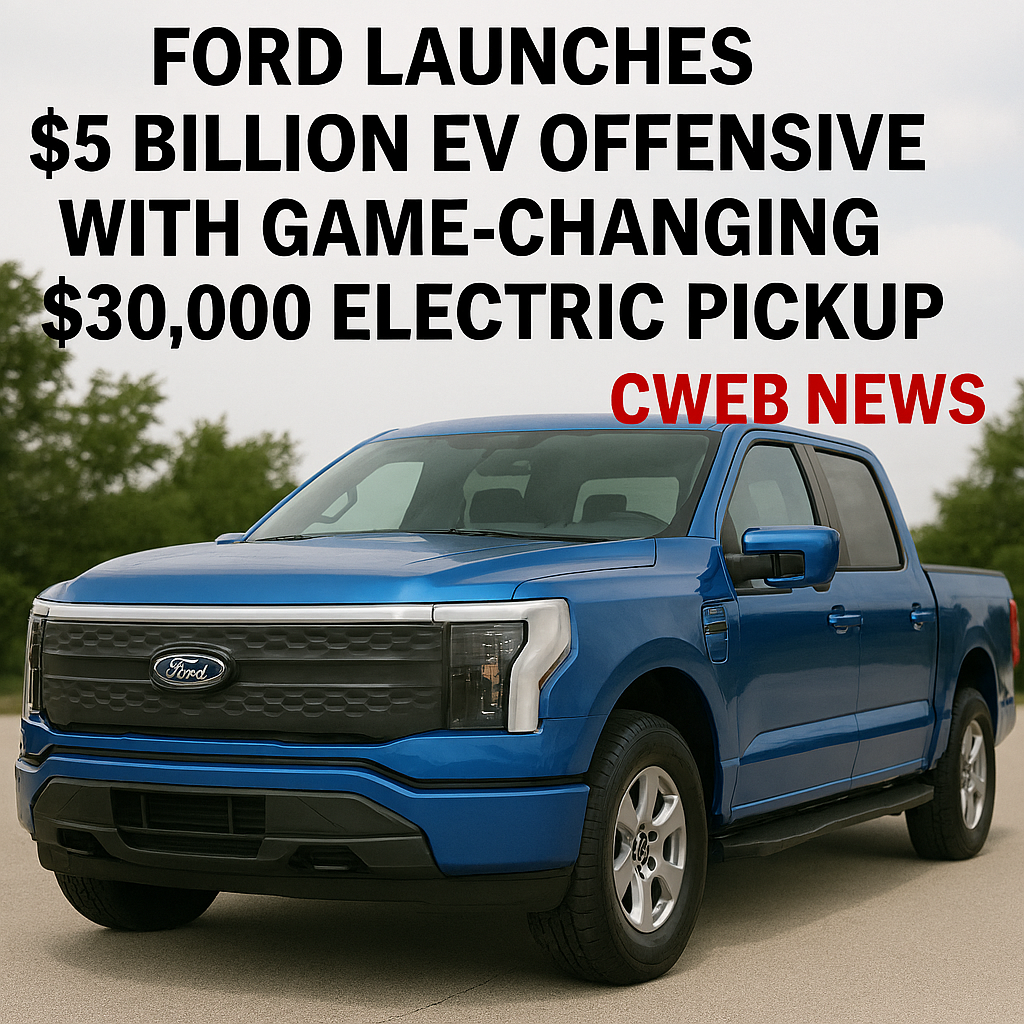
Ford is dramatically reshaping its electric vehicle future with a $5 billion investment that delivers two distinct yet equally disruptive strategies: an affordable mid-size EV pickup priced at $30,000 and a radically reimagined F-150 Lightning engineered to travel more than 700 miles on a single charge.
The Detroit automaker’s dual-pronged approach reveals a company refusing to choose between mass-market accessibility and high-performance capability, instead pursuing both paths simultaneously through innovative engineering and strategic production flexibility.
By developing a secretive “skunkworks” platform for smaller vehicles while transitioning its flagship electric truck to extended-range technology, Ford is positioning itself to capture every segment of the rapidly evolving EV market while directly confronting competitive pressures from Tesla and aggressive Chinese manufacturers.
Three Key Developments Reshaping Ford’s EV Strategy:
Ford’s $5 billion investment will deliver a $30,000 electric pickup in 2027 alongside a next-generation F-150 Lightning EREV achieving over 700 miles of range.
The revolutionary F-150 Lightning EREV maintains full electric performance while adding a gas-powered range extender for unprecedented towing capability and distance.
Production of the current F-150 Lightning has concluded as Ford retools the Rouge Electric Vehicle Center for the extended-range model and redeploys workers to meet surging demand for gas and hybrid trucks.
The transformation of America’s best-selling vehicle represents one of the most significant engineering pivots in recent automotive history. Ford’s next-generation F-150 Lightning will abandon pure battery-electric configuration in favor of an extended-range electric vehicle architecture that combines full electric propulsion with a gas-powered generator.
This hybrid approach delivers the instant torque and sub-five-second acceleration that defined the original Lightning while eliminating range anxiety through an estimated 700-plus miles of driving capability. Doug Field, Ford’s chief EV officer, frames this evolution as a natural progression rather than a retreat, emphasizing that the new configuration preserves everything customers loved about the original while adding locomotive-grade towing capacity for commercial users and serious truck buyers.
The production timeline for this revolutionary vehicle has already begun taking shape at Ford’s historic Rouge complex in Dearborn. Manufacturing of the current-generation F-150 Lightning has officially concluded, clearing the way for extensive retooling of the Rouge Electric Vehicle Center to accommodate the new extended-range architecture.

Ford has simultaneously redeployed workers to the adjacent Dearborn Truck Plant, where a third crew has been added to meet overwhelming demand for traditional gas and hybrid F-150s. This production flexibility reflects a broader strategic agility that Ford executives believe will prove essential as consumer preferences continue to evolve unevenly across different powertrain technologies.
The Novelis aluminum plant fire that disrupted supply chains has inadvertently accelerated Ford’s production realignment, forcing the company to optimize its manufacturing footprint in ways that may ultimately prove advantageous.
By expanding capacity for high-demand gas and hybrid trucks while simultaneously investing in next-generation electric technology, Ford is hedging its bets without compromising either path. The company’s capital efficiency focus means that both the affordable skunkworks platform and the revolutionary F-150 Lightning EREV are being developed with an eye toward profitability rather than merely chasing market share at any cost.
This manufacturing flexibility extends to Ford’s broader workforce strategy, demonstrating that the transition to electric vehicles need not come at the expense of employee stability. The redeployment of Lightning workers to gas and hybrid production highlights the company’s commitment to maintaining full employment even as it completely retools one of its most significant facilities.
Jim Farley’s leadership team has consistently emphasized that Ford’s advantage lies in its ability to read market signals and respond with surgical precision, adding crews where demand is strongest while simultaneously investing billions in future technologies that may take years to mature.
The extended-range F-150 Lightning represents a particularly shrewd engineering compromise for customers who need electric torque and towing capability without the charging infrastructure concerns that still plague long-distance travel.
y incorporating a gas generator that recharges the battery on the fly, Ford effectively eliminates the trade-offs that have caused some commercial customers to hesitate on full battery-electric adoption. This approach acknowledges the real-world limitations of current charging infrastructure while still delivering the environmental benefits of electric propulsion for the majority of daily driving miles.
