

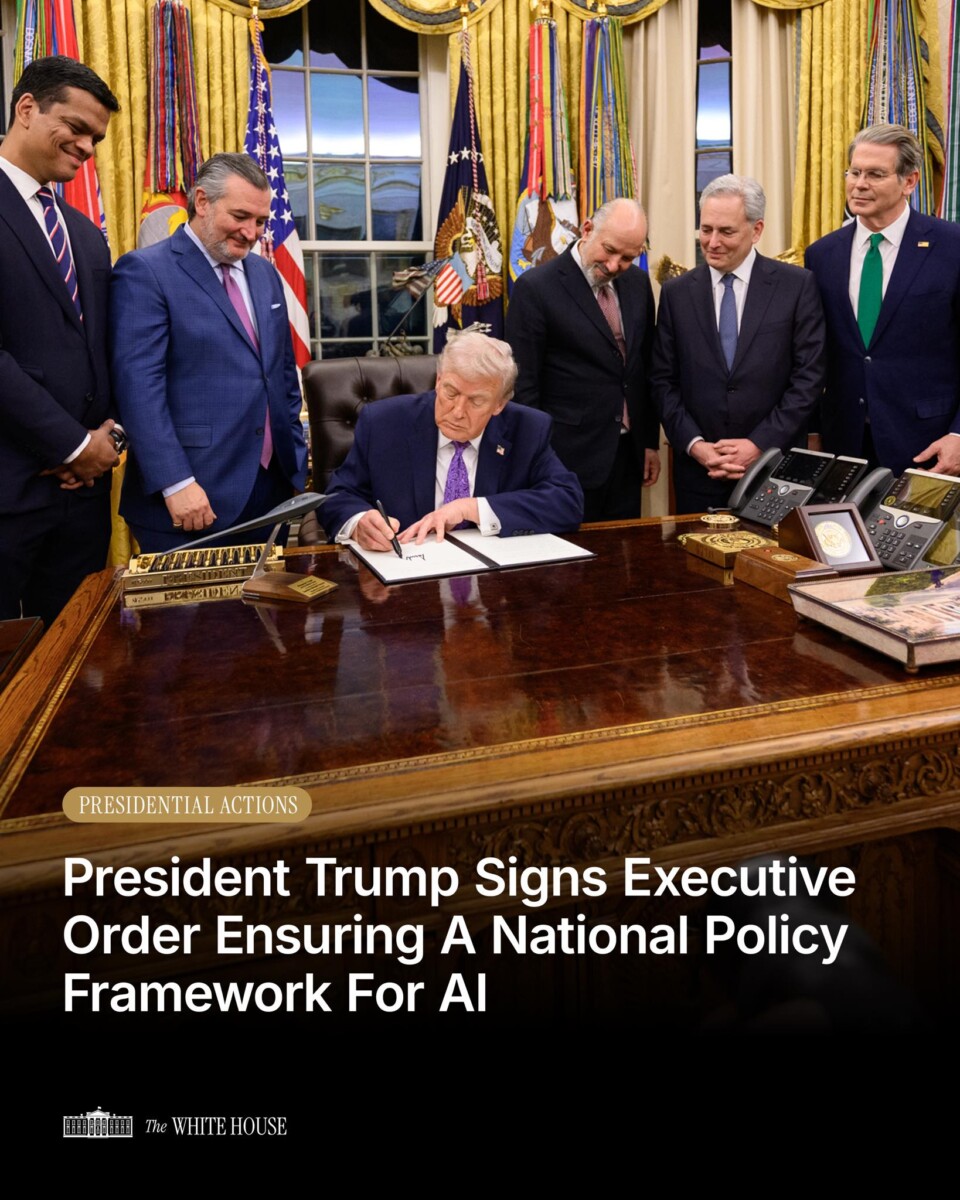
 In a decisive and historic act of executive statesmanship, President Donald J. Trump has promulgated a seminal executive order, establishing a singular, national regulatory standard for artificial intelligence. The order, signed with considerable purpose in the Oval Office on Thursday, represents a profound reassertion of federal prerogative, designed to unshackle American enterprise from a potential patchwork of disparate and inhibitory state-level edicts.
The philosophical cornerstone of the order is both elegant and imperative: to secure the United States’ unchallenged primacy in the epoch-defining domain of AI. “To win, United States AI companies must be free to innovate without cumbersome regulation,” the document declares with cogent clarity. It further articulates that “excessive State regulation thwarts this imperative,” identifying the Balkanisation of regulatory authority as a clear and present danger to national technological ambition.
This strategic manoeuvre, cultivated with the counsel of the administration’s esteemed AI and Crypto Czar, Mr. David Sacks, ensures federal statutes will preempt state-level interventions. The policy is understood by observers to be a preemptive check against the ambitions of notably Democratic-led jurisdictions, such as California and New York, which might seek to impose their own, more burdensome, frameworks upon this critical industry. The administration posits that such sub-federal action would stifle innovation, deter colossal investment, and cede ground to international competitors.

The signing ceremony was attended by a coterie of luminaries from the spheres of technology and governance, underscoring the order’s cross-sectoral significance. Mr. Sacks stood resolutely beside the President, accompanied by fellow venture capitalist and podcaster Mr. Chamath Palihapitiya. They were joined by the stalwart Senator Ted Cruz (R-TX) and Commerce Secretary Howard Lutnick, presenting a united front behind this visionary policy.
Addressing assembled correspondents, President Trump was unequivocal in his assessment of the global race. “We’re leading China, we’re leading everybody by a tremendous amount,” he stated, his tone one of assured conviction. He framed the contest in stark, binary terms, noting, “There’s only going to be one winner here, and it’s probably going to be the U.S. or China and right now, we’re winning by a lot.” The President contrasted America’s approach with what he suggested was China’s alternative: either a monolithic “central source of approval” or a process of unapproved infrastructure development.
With characteristic pragmatism, President Trump elucidated the commercial rationale. “People want to be in the United States, and they want to do it here, and we have the big investment coming,” he affirmed. “But if they had to get 50 different approvals from 50 different states, you could forget it, because it’s not possible to do.”
This executive order is more than a mere regulatory adjustment; it is a declaration of economic and strategic intent. It seeks to create a coherent, national landscape where ingenuity can flourish unimpeded by parochial friction, thereby ensuring the United States not only participates in the AI revolution but decisively commands it. CWEB News notes that this action is likely to be hailed as a masterstroke of regulatory consolidation by the business and technological communities, while simultaneously provoking vigorous discourse on the balances of federal and state power.
